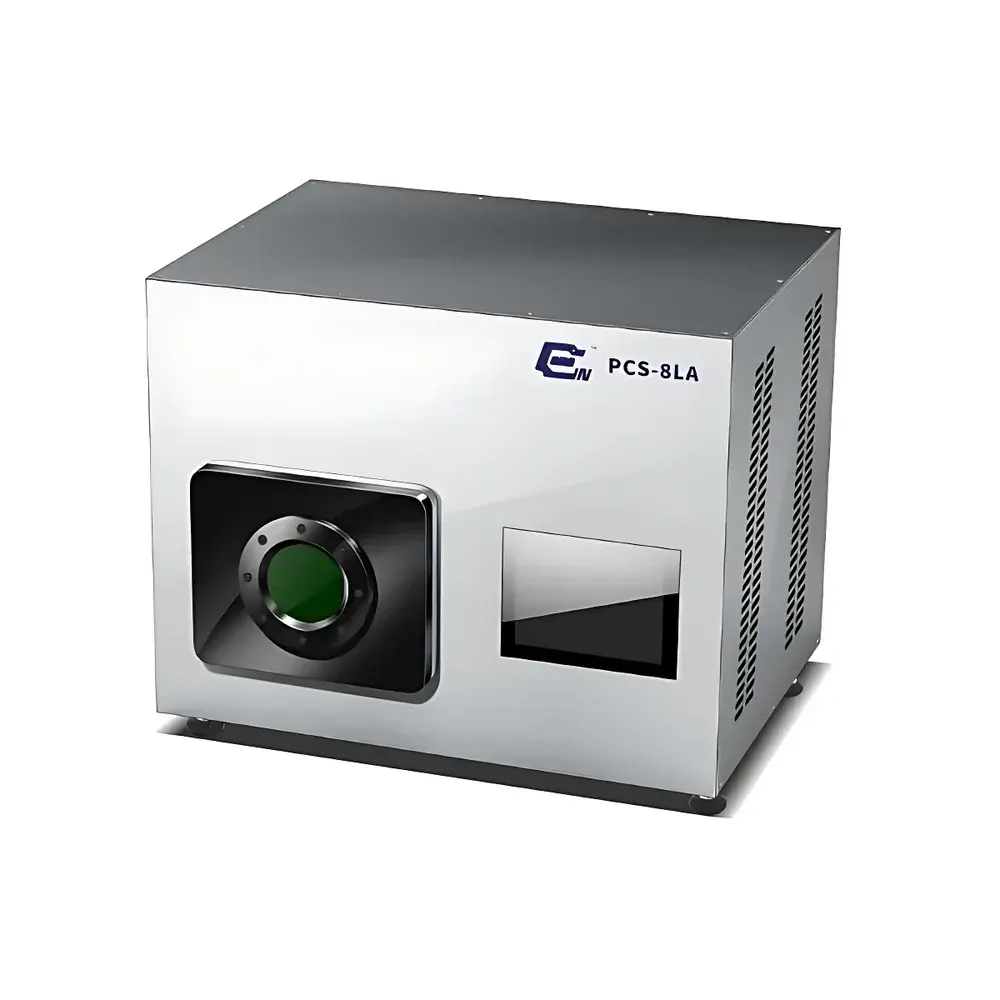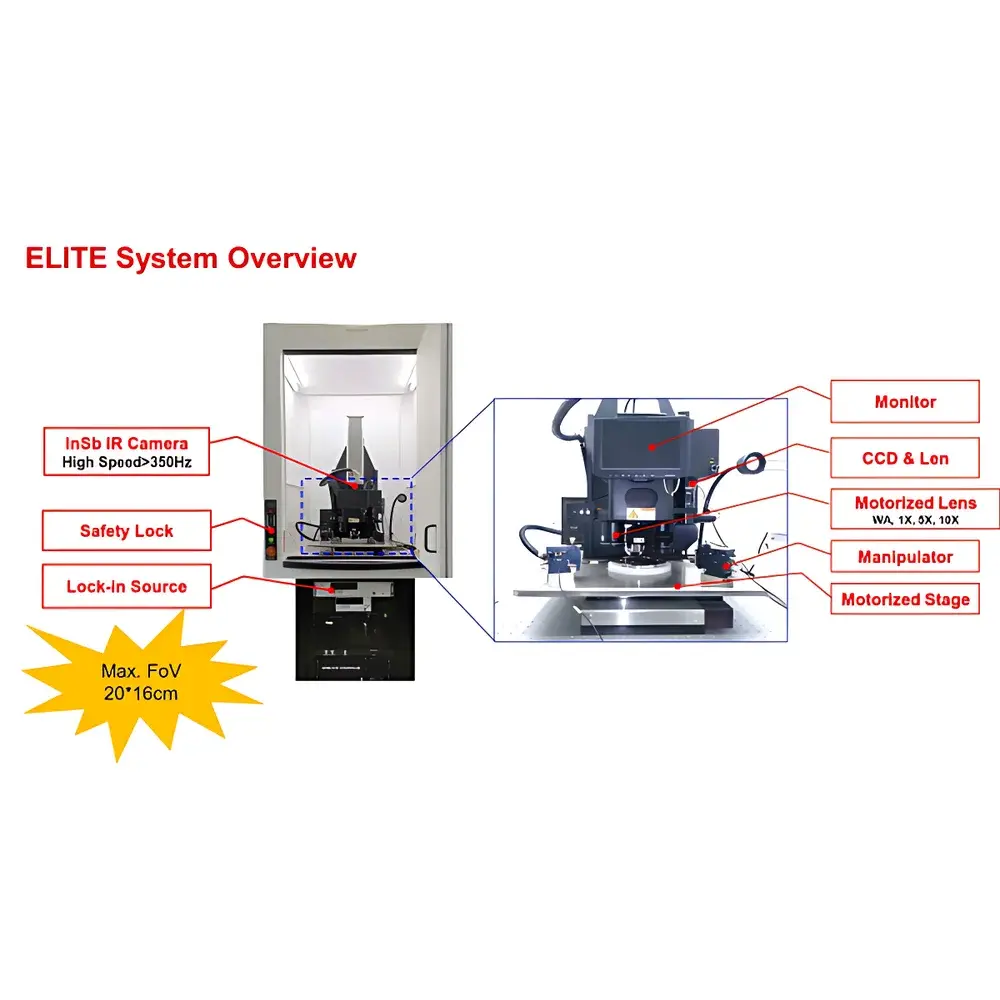
Thermo Fisher Scientific ELITE Lock-in Thermography System
| Brand | Thermo Fisher Scientific |
|---|---|
| Origin | Czech Republic |
| Model | ELITE |
| Type | Lock-in Thermography Inspection System for Semiconductor Failure Analysis |
| Compliance | Designed for ISO/IEC 17025-aligned lab environments, compatible with GLP/GMP documentation workflows |
Overview
The Thermo Fisher Scientific ELITE is a high-sensitivity lock-in thermography (LIT) system engineered specifically for non-destructive failure analysis and defect localization in semiconductor devices and integrated circuits. Unlike conventional thermal imaging, ELITE employs synchronous demodulation of thermally induced surface temperature oscillations—generated by periodic electrical stimulation—to isolate minute power dissipation signatures buried deep within noise floors. Its core principle leverages the phase-resolved detection of thermal transients induced by modulated current injection (e.g., square-wave or sine-wave bias), enabling sub-microwatt spatial resolution of localized Joule heating at sub-100 nm feature scales. This makes ELITE particularly effective for identifying both low-resistance shorts (1 MΩ, where P = V·I governs), across wafers, packaged ICs, and advanced 2.5D/3D heterogeneous assemblies.
Key Features
- Unlimited integration time architecture: No pixel saturation limitation—enables exposure durations up to 80 hours for signal averaging, achieving thermal sensitivity down to 400 nW per pixel under controlled ambient conditions.
- High-frame-rate lock-in acquisition: Synchronized 300 Hz thermal frame capture paired with real-time digital phase demodulation (0.1° phase resolution) for robust separation of resistive heating from ambient drift and thermal diffusion artifacts.
- Sub-microwatt spatial power dissipation mapping: Quantitative local power dissipation resolution of 1 μW (4 min integration), 10 μW (4 s), and 100 μW (single-shot), calibrated traceably to NIST-traceable reference standards.
- Dual-mode excitation interface: Supports voltage-driven (constant-V) and current-driven (constant-I) modulation, with programmable frequency range from 0.1 Hz to 10 kHz—optimized for thermal time-constant matching across dielectric layers, metallization stacks, and junction interfaces.
- Integrated environmental control port: Enables vacuum or inert-gas chamber coupling for suppression of convective heat loss during ultra-low-power measurements on air-sensitive or high-thermal-conductivity substrates (e.g., SiC, GaN).
Sample Compatibility & Compliance
ELITE accommodates full-wafer (up to 300 mm), diced dies, flip-chip packages, and bare-die-on-carrier configurations via motorized XYZ stage with ±5 µm repeatability and tilt compensation. Sample mounting is compatible with standard probe stations (including Cascade Summit and FormFactor MPI platforms) using IEEE 1149.1 JTAG-compatible trigger synchronization. The system meets mechanical and electromagnetic compatibility requirements per IEC 61326-1 for laboratory use. Data acquisition workflows support audit trails compliant with FDA 21 CFR Part 11 when deployed with Thermo Fisher’s optional SecureLog™ software module—ensuring electronic signature capability, user access controls, and immutable measurement metadata logging aligned with ISO/IEC 17025 and JEDEC JESD22-A114F reliability testing guidelines.
Software & Data Management
Control and analysis are performed through Thermo Fisher’s ELITE Suite v4.x—a Windows-based application built on Qt and HDF5 data architecture. It provides real-time lock-in magnitude/phase visualization, automated hotspot clustering (using DBSCAN algorithm), cross-sectional thermal profile extraction along user-defined lines, and export of calibrated thermal maps in TIFF, CSV, and industry-standard CDF5 formats. All raw thermal sequences, stimulus parameters, and environmental logs are stored with SHA-256 checksums. Integration with LabArchives ELN and Siemens Teamcenter PLM is supported via RESTful API. Raw datasets retain full bit-depth fidelity (16-bit per frame) without lossy compression, preserving quantitative integrity for root-cause correlation with SEM-FIB, OBIRCH, or emission microscopy results.
Applications
- Identification of electromigration-induced voids and hillocks in Cu/low-k interconnects.
- Localization of gate oxide pinholes and channel leakage in FinFET and GAA transistor structures.
- Failure isolation in stacked-die packages exhibiting intermittent thermal crosstalk.
- Verification of ESD protection circuit activation thresholds and clamp uniformity.
- Qualification of wafer-level underfill delamination and solder bump fatigue in fan-out WLP.
- Correlative analysis with time-resolved emission (TRE) and photon emission microscopy (PEM) for multi-modal defect signature validation.
FAQ
What is the minimum detectable power dissipation per pixel under standard lab conditions?
Typical system noise floor enables reliable detection of 1 μW with 4-minute integration; extended integration (e.g., 10 h) achieves 100 nW–400 nW sensitivity depending on sample emissivity and ambient stability.
Does ELITE require external vibration isolation?
Yes—optimal performance requires passive or active optical table isolation, especially for sub-μW measurements; system specifications assume 1 Hz.
Can ELITE be used for dynamic thermal profiling during functional testing?
Yes—via TTL-synchronized stimulus triggering and high-speed frame capture, it supports real-time thermal mapping during functional vector patterns (e.g., ATPG, BIST) at up to 10 kHz modulation bandwidth.
Is calibration traceable to national standards?
Yes—factory calibration includes NIST-traceable blackbody source verification at 50°C, 80°C, and 120°C, with annual recalibration recommended per ISO/IEC 17025 Clause 6.5.
How is thermal drift compensated during long integrations?
Through dual-reference background subtraction: one acquired pre-stimulus and one acquired post-stimulus, both phase-locked to the same modulation cycle—eliminating slow ambient drift without compromising SNR.