
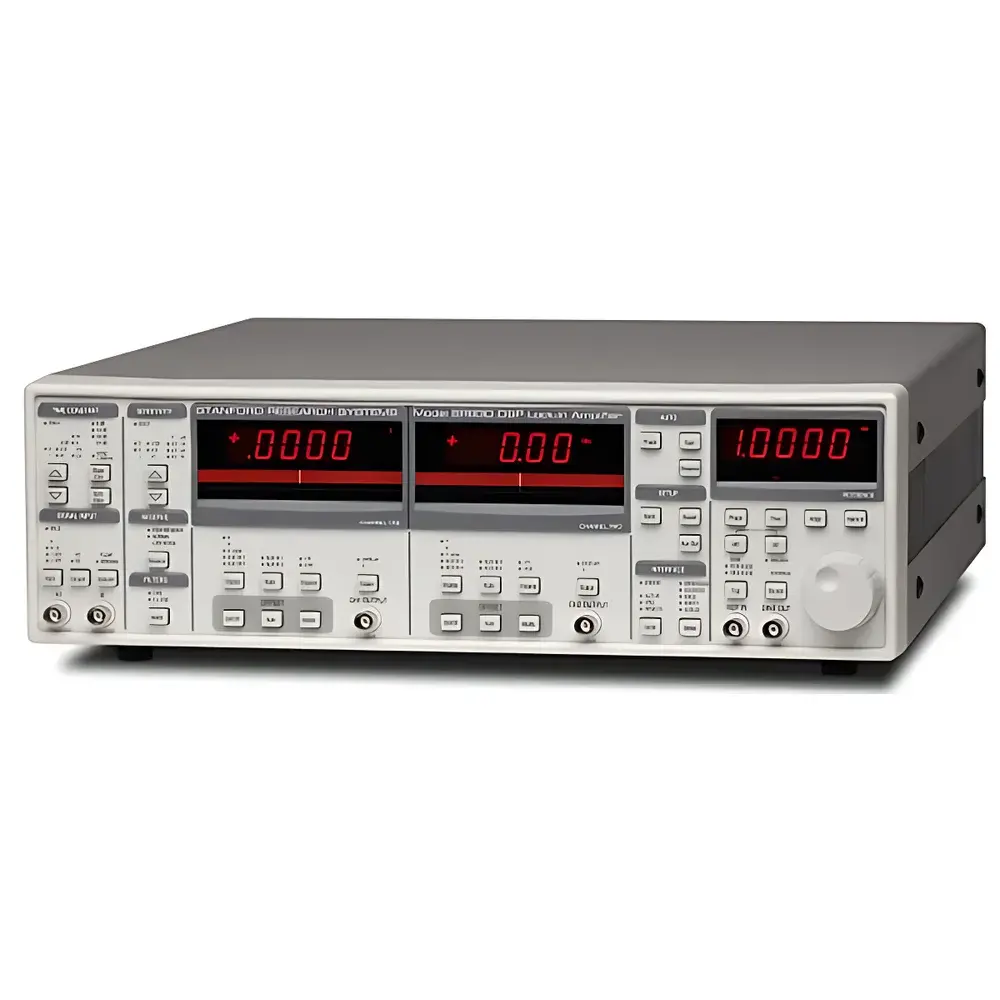
Stanford Research Systems SR810 and SR830 Digital Lock-in Amplifiers
| Brand | Stanford Research Systems (SRS) |
|---|---|
| Origin | USA |
| Model | SR810 / SR830 |
| Frequency Range | 1 mHz – 102.4 kHz |
| Dynamic Reserve | >100 dB |
| Stability | 5 ppm/°C |
| Phase Resolution | 0.01° |
| Time Constants | 10 μs – 30 ks (up to 24 dB/oct rolloff) |
| Reference Source | Synthesized |
| Interfaces | GPIB, RS-232 |
| Signal Display | SR810 — magnitude only |
Overview
The Stanford Research Systems SR810 and SR830 Digital Lock-in Amplifiers are precision instruments engineered for high-sensitivity measurement of small AC signals buried in noise—common in optical spectroscopy, photothermal detection, scanning probe microscopy, and low-temperature physics experiments. Operating on the principle of synchronous demodulation, these lock-ins extract signal amplitude and phase relative to a user-defined reference frequency by multiplying the input signal with a phase-coherent reference and applying low-pass filtering. Unlike analog lock-in architectures, the SR810 and SR830 implement fully digital signal processing (DSP) for demodulation, filtering, and gain control—eliminating drift-prone analog multipliers, passive RC filters, and analog amplifiers. This architecture ensures superior long-term stability, reproducible calibration, and immunity to component aging. The instruments support both internal and external reference modes, with a synthesized reference source offering precise frequency resolution down to 1 mHz and exceptional spectral purity.
Key Features
- Digital signal processing core enabling stable, repeatable measurements without analog drift or component tolerance dependencies
- Frequency range spanning 1 mHz to 102.4 kHz—covering ultra-slow thermal relaxation processes through high-frequency modulation schemes used in laser heterodyne detection
- Dynamic reserve exceeding 100 dB, permitting accurate measurement of microvolt-level signals in the presence of millivolt-level interference
- Phase resolution of 0.01° and temperature coefficient of only 5 ppm/°C—critical for interferometric and ellipsometric applications requiring angular stability
- Configurable time constants from 10 µs to 30 ks, with selectable filter slopes up to 24 dB/octave to balance noise rejection and response speed
- Automated functions including auto-gain, auto-phase, auto-reserve, and auto-offset—reducing operator dependency and accelerating experimental setup
- Integrated synthesized reference oscillator with fine frequency tuning, harmonic rejection, and dual-output capability for differential excitation
- Standard GPIB (IEEE-488.2) and RS-232 interfaces for seamless integration into automated test benches and LabVIEW-based data acquisition systems
Sample Compatibility & Compliance
The SR810 and SR830 are voltage-input instruments optimized for low-noise, high-impedance photodetector outputs (e.g., photodiodes, PMTs, lock-in compatible pyroelectric sensors) and bridge-based transducers (e.g., strain gauges, bolometers). Input impedance is 10 MΩ || 25 pF (single-ended) with optional differential input via external preamplifier. No sample contact or consumables are required—operation is non-invasive and fully electronic. While not certified as medical or industrial safety devices, both models comply with FCC Part 15 Class A and CE EMC directives. Their digital architecture supports traceable calibration protocols aligned with ISO/IEC 17025 laboratory accreditation requirements when operated within documented environmental conditions (23 ± 5°C, <70% RH).
Software & Data Management
Both instruments support SCPI command sets over GPIB and RS-232, enabling full remote control and data streaming in real time. SRS provides free Windows-compatible software (SR810/SR830 Control Panel) for instrument configuration, waveform display, and ASCII data logging. For advanced integration, drivers are available for LabVIEW, MATLAB, Python (PyVISA), and C/C++. All settings—including filter type, time constant, sensitivity, and reference parameters—are stored in non-volatile memory and recalled at power-up. Audit-ready operation is supported via timestamped command logging and programmable data output formats (X/Y/R/θ, CSV, binary). Though not natively 21 CFR Part 11 compliant, the instruments can be deployed within validated systems where electronic records and signatures are managed at the host software or LIMS layer per GxP guidelines.
Applications
- Modulation transfer function (MTF) characterization of optical components using sinusoidal intensity modulation
- Photoluminescence lifetime mapping via time-domain gated detection with phase-sensitive averaging
- Surface plasmon resonance (SPR) and quartz crystal microbalance (QCM) signal recovery under noisy flow-cell conditions
- Cryogenic transport measurements requiring sub-nV sensitivity and millikelvin thermal stability
- Atomic force microscopy (AFM) phase imaging and cantilever resonance tracking
- Calibration of radiometric standards using chopped blackbody sources and cryogenic radiometers
- Gas sensing with tunable diode lasers—extracting wavelength-modulated absorption lineshapes
FAQ
What is the difference between the SR810 and SR830?
The SR830 provides simultaneous readout of both magnitude (R) and phase (θ), while the SR810 outputs magnitude only. Internally, both share identical DSP architecture, dynamic reserve, and noise performance.
Can the SR810/SR830 be used with external reference signals?
Yes—both accept TTL, sine, or CMOS-level external references from function generators, choppers, or laser drivers, with automatic frequency and phase locking.
Is DC coupling supported?
No—input is AC-coupled with a 0.001 Hz high-pass cutoff to reject DC offset and 1/f noise; DC signals require external modulation prior to input.
How is calibration maintained over time?
Internal calibration uses precision voltage references and digitally stored correction coefficients; annual verification against NIST-traceable sources is recommended for metrology-grade use.
Are firmware updates available?
Yes—SRS publishes verified firmware revisions on its official support portal, with installation via serial interface and detailed release notes covering bug fixes and feature enhancements.




