
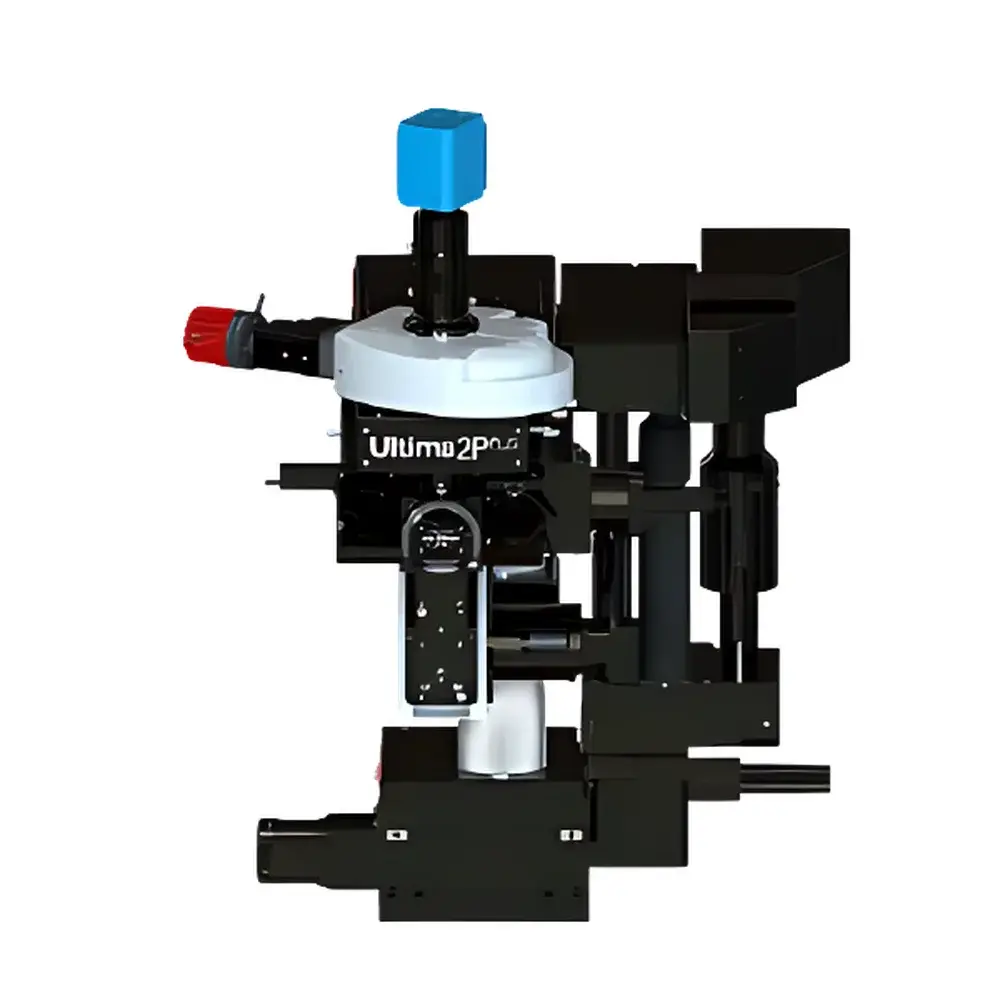
Bruker Ultima Ultra High Resolution Two-Photon Microscope
| Brand | Bruker |
|---|---|
| Origin | USA |
| Manufacturer Type | Authorized Distributor |
| Origin Category | Imported |
| Model | Bruker Ultima Ultra High Resolution Microscope |
| Pricing | Available Upon Request |
Overview
The Bruker Ultima Ultra High Resolution Two-Photon Microscope is a purpose-built, high-performance in vivo imaging platform engineered for deep-tissue, high-speed, and high-fidelity functional microscopy in awake, behaving, or anesthetized animal models. Leveraging pulsed near-infrared (NIR) laser excitation and nonlinear two-photon fluorescence emission, the system achieves intrinsic optical sectioning with reduced phototoxicity and superior penetration depth—up to 1350 µm in highly scattering neural tissue. Its modular architecture integrates seamlessly with electrophysiology rigs, behavioral monitoring systems, and optogenetic stimulation hardware, enabling simultaneous multimodal interrogation of structure, function, and causality in intact biological systems. Designed for rigorous neuroscience, developmental biology, immunology, and oncology applications, the Ultima platform adheres to principles of quantitative reproducibility, spatial fidelity, and temporal precision required for longitudinal in vivo studies under GLP- and IACUC-compliant experimental protocols.
Key Features
- Deep-Tissue Imaging Capability: Optimized optical path and high-numerical-aperture (NA) water-immersion objectives support imaging depths exceeding 1350 µm in cortical and subcortical structures—validated in mouse, rat, ferret, and non-human primate preparations.
- High-Speed Acquisition: Dual-resonant galvanometric scanning enables frame rates up to 45 FPS at 12 kHz line rate, facilitating real-time calcium dynamics tracking and rapid volumetric acquisition.
- Large Field-of-View (FOV) Optics: Ultima 2Pplus delivers a 28 mm diameter FOV with exceptional field flatness and minimal aberration across the entire image plane—enabling whole-structure mapping without tiling artifacts.
- Integrated Dual-Path Scanning: Independent excitation and detection pathways permit concurrent two-photon imaging and patterned photoactivation—critical for closed-loop optogenetics and perturbation-responses experiments.
- Electrically Actuated Precision Positioning: Fully motorized X-Y-Z translation stages with dual rotational axes enable precise targeting and stable long-term registration across sessions.
- Enhanced Photon Collection Efficiency: Custom-designed collection optics positioned proximal to the objective back pupil maximize signal throughput and improve SNR—particularly advantageous in low-signal, high-scatter environments such as thalamus or spinal cord.
Sample Compatibility & Compliance
The Ultima platform supports live, unsectioned specimens ranging from larval zebrafish and C. elegans to adult rodents and non-human primates. Compatible sample holders include stereotaxic frames, head-fixed behavioral arenas, treadmill setups, and custom bridge-stage configurations. All optical components comply with ISO 10110 standards for surface quality and wavefront error control. System firmware and PrairieView software support audit trails, user access controls, and electronic signatures—facilitating compliance with FDA 21 CFR Part 11 requirements where applicable. Experimental workflows align with NIH Guide for the Care and Use of Laboratory Animals and adhere to institutional IACUC review criteria for chronic implantation and longitudinal imaging protocols.
Software & Data Management
PrairieView software serves as the unified acquisition, analysis, and synchronization engine for the Ultima platform. It provides native support for multi-dimensional time-lapse volumetric imaging (x-y-z-t), ROI-based photostimulation (point, spiral, full-field), line-scan acquisition, large-area mosaic stitching, and Z-stack reconstruction. Integration with MATLAB and Python via documented APIs enables custom algorithm development and pipeline automation. Raw data are stored in standardized HDF5 format with embedded metadata—including laser power, dwell time, PMT gain, galvo position, and external TTL timestamps—ensuring FAIR (Findable, Accessible, Interoperable, Reusable) data practices. Optional modules extend functionality to fluorescence lifetime imaging (FLIM), spectral unmixing, and real-time feedback-controlled stimulation using Neuralight 3D spatial light modulators.
Applications
- Longitudinal structural and functional plasticity studies in cortex, hippocampus, and spinal cord
- In vivo calcium, voltage, and neurotransmitter sensor imaging in awake, head-fixed animals
- 3D-targeted optogenetic manipulation combined with simultaneous electrophysiological recording
- Immune cell trafficking and tumor microenvironment dynamics in orthotopic models
- Developmental angiogenesis and neurovascular coupling in embryonic and postnatal tissues
- Behaviorally correlated neural ensemble activity during learning, decision-making, and sensory processing
FAQ
What laser wavelengths are supported by the Ultima system?
The Ultima platform accommodates tunable Ti:Sapphire lasers (680–1300 nm) and optical parametric oscillators (OPOs), enabling excitation of diverse fluorophores including GCaMP, jRGECO, mCherry, tdTomato, and IR-780 derivatives.
Can the Ultima system be integrated with patch-clamp electrophysiology?
Yes—dedicated analog I/O channels, synchronized TTL triggering, and co-aligned optical/electrical coordinate systems allow seamless integration with commercial patch-clamp amplifiers and digitizers.
Is PrairieView software compatible with third-party analysis tools?
Yes—PrairieView exports metadata-rich HDF5 files and provides documented Python and MATLAB interfaces for custom preprocessing, segmentation, and statistical modeling pipelines.
Does the system support chronic imaging over multiple weeks?
With appropriate cranial window fabrication, stabilization hardware (e.g., titanium headplates), and drift-compensation algorithms in PrairieView, chronic imaging sessions spanning >4 weeks have been routinely demonstrated in peer-reviewed publications.
What service and support options are available post-installation?
Bruker offers comprehensive on-site installation, operator training, annual preventive maintenance contracts, and application-specific protocol optimization support through its global network of field application scientists.



