
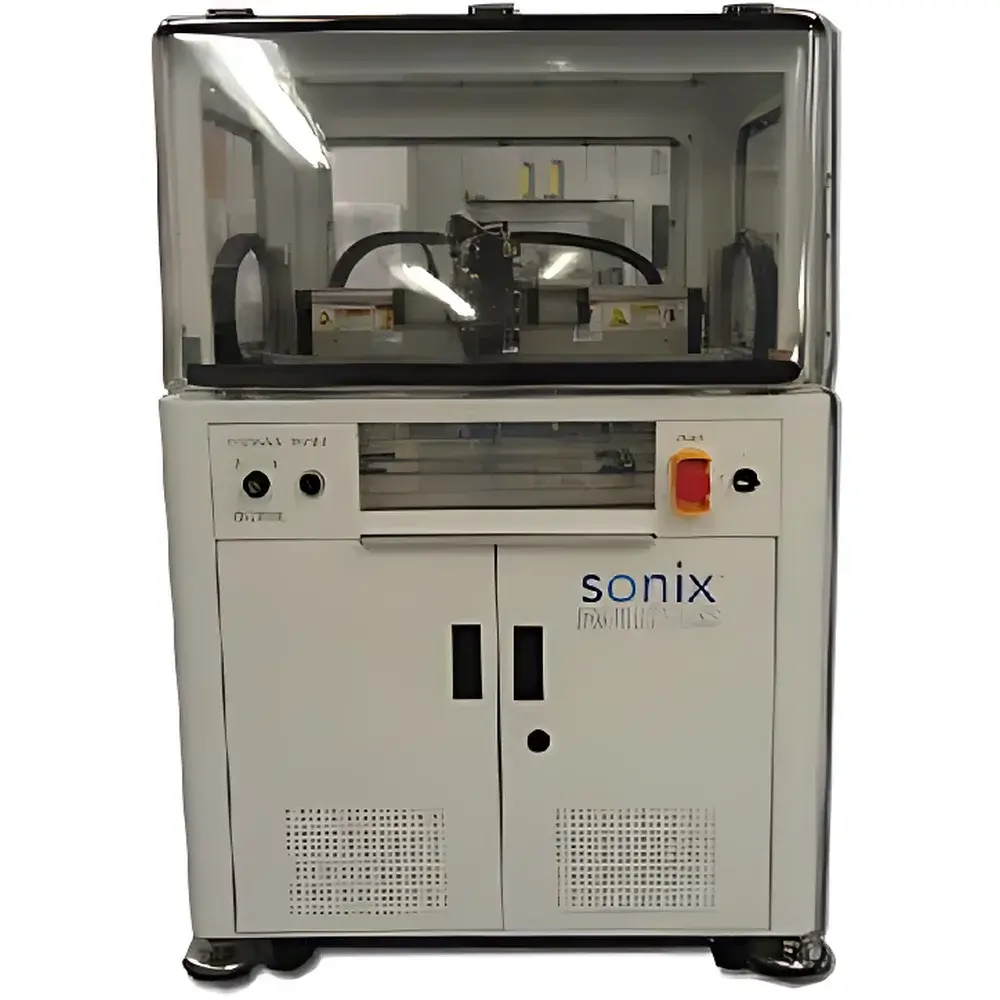
SONIX Echo-LS Ultrasonic Scanning Acoustic Microscope (SAM)
| Brand | SONIX |
|---|---|
| Origin | USA |
| Manufacturer Type | Authorized Distributor |
| Origin Category | Imported |
| Model | Echo-LS |
| Instrument Type | Scanning Acoustic Microscope |
| Resolution | 10,000 × 10,000 pixels |
| Max. Scan Area | 350 mm × 350 mm |
| Scan Speed | 1000 mm/s |
| Acceleration | 10,000 mm/s² |
| Transducer Frequency Range | 10–300 MHz |
| Dimensions | 787 mm (W) × 787 mm (D) × 1219 mm (H) |
Overview
The SONIX Echo-LS Ultrasonic Scanning Acoustic Microscope (SAM) is a high-precision, non-destructive evaluation (NDE) platform engineered for subsurface defect characterization in advanced electronic packaging, semiconductor devices, and multi-material assemblies. Operating on the principle of pulse-echo ultrasonic time-of-flight imaging, the Echo-LS transmits high-frequency acoustic energy (10–300 MHz) into the sample and reconstructs cross-sectional or planar images based on amplitude and phase shifts of reflected signals at material interfaces. Unlike optical or electron microscopy, SAM provides depth-resolved visualization of delaminations, voids, cracks, and disbonds—especially critical in hermetically sealed or opaque structures where conventional inspection methods fail. Designed and manufactured in the USA by SONIX—a pioneer in digital acoustic imaging since 1986—the Echo-LS integrates proprietary transducer lens technology, real-time signal processing, and deterministic motion control to deliver micron-level detection sensitivity (e.g., <0.05 µm interfacial separation) with quantitative repeatability across production and R&D environments.
Key Features
- Patented high-frequency focused transducers (10–300 MHz) with optimized coupling and axial resolution for sub-micron interfacial defect detection
- Modular mechanical architecture featuring linear servo motors on all scan axes—enabling 1000 mm/s velocity and 10,000 mm/s² acceleration while maintaining positional accuracy ≤±0.5 µm
- TAMI (Tomographic Acoustic Microscopy Imaging) mode: Enables automated volumetric acquisition with user-defined depth segmentation—up to 200 C-scan slices per single acquisition without waveform gating
- FSF (Floating Surface Following) algorithm: Compensates for non-planar sample topography in real time, ensuring consistent focal plane alignment during C-scan acquisition
- ICEBERG offline analysis suite: Decouples data acquisition from post-processing—raw RF data stored in vendor-neutral formats (e.g., HDF5) for reprocessing, spectral analysis, and custom algorithm integration on standard Windows workstations
- Multi-mode scanning capability: Supports A-scan (point interrogation), B-scan (cross-sectional), C-scan (planar), T-scan (through-transmission), Multi-Scan (layered stack), Tray-Scan (multi-die wafer trays), Jump-Scan (discontinuous ROI mapping), HTS (high-throughput scanning), and TAMI-Scan (tomographic reconstruction)
Sample Compatibility & Compliance
The Echo-LS accommodates diverse specimen geometries—from individual die and flip-chip packages to full 300-mm wafers and stacked modules—within its 350 mm × 350 mm maximum scan envelope. It supports immersion, water-path, and delay-line coupling configurations for optimal signal-to-noise ratio across materials including silicon, copper, molding compounds (EMC), underfill (MUF), solder alloys, and ceramic substrates. The system meets key regulatory and industry standards relevant to qualification testing: ASTM E1781 (Standard Practice for Acoustic Microscopy of Electronic Components), ISO/IEC 17025 (for accredited lab use), and supports audit-ready documentation required under GLP and GMP frameworks. Data integrity features—including timestamped acquisition logs, user access controls, and electronic signature support—align with FDA 21 CFR Part 11 expectations when deployed in regulated manufacturing settings.
Software & Data Management
SONIX’s native software platform provides a unified interface for instrument control, real-time imaging, and quantitative analysis. All scanning sequences are programmable via intuitive graphical workflow editors—enabling fully automated batch runs with conditional logic (e.g., pass/fail thresholds triggering secondary scans). Image data is stored with embedded metadata (transducer ID, gain, gate settings, temperature, operator ID) and supports export to TIFF, PNG, CSV, and MATLAB-compatible binary formats. The ICEBERG engine allows retrospective application of alternative gating strategies, envelope detection algorithms, or deconvolution filters—without reacquisition. For enterprise integration, API hooks enable direct linkage to MES systems, LIMS databases, and statistical process control (SPC) dashboards using RESTful web services and OPC UA protocols.
Applications
The Echo-LS is routinely deployed for failure analysis and process validation in semiconductor back-end operations, including: detection of mold compound delamination beneath die attach; voiding assessment in copper pillar bumps and microbumps; interfacial integrity verification in 2.5D/3D IC stacks (e.g., SDI™); underfill coverage uniformity in flip-chip assemblies; void and crack identification in plastic-encapsulated ICs (e.g., QFP, BGA, CSP); and bondline quality screening in hybrid MCMs and power modules. Its ability to resolve sub-100 nm thickness variations makes it indispensable for evaluating thermal interface materials (TIMs), MEMS cavity seals, and aerospace composite laminates—where mechanical reliability depends critically on internal adhesion fidelity.
FAQ
What is the minimum detectable delamination thickness?
The Echo-LS achieves reliable detection of interfacial separations as thin as 0.05 µm under optimal coupling and transducer selection (e.g., 200 MHz lens on silicon-based stacks).
Can the system perform both reflection and transmission scanning simultaneously?
Yes—via SONIX’s proprietary PETT (Phase-Encoded Through-Transmission) mode, which acquires co-registered A-scan waveforms from both front-wall echo and back-wall transmission in a single pass.
Is the software compliant with FDA 21 CFR Part 11 requirements?
The software includes configurable audit trails, electronic signatures, and role-based access control—fully supporting Part 11 compliance when implemented with validated IT infrastructure and documented SOPs.
Does the system support automated reporting for production line deployment?
Yes—customizable report templates (PDF/HTML) can be generated automatically upon scan completion, including pass/fail flags, annotated images, measurement statistics, and traceable metadata.
What maintenance intervals are recommended for long-term operational stability?
SONIX recommends quarterly calibration verification using NIST-traceable reference standards and annual preventive maintenance—including transducer alignment check, motor belt tension verification, and water degassing system inspection.



