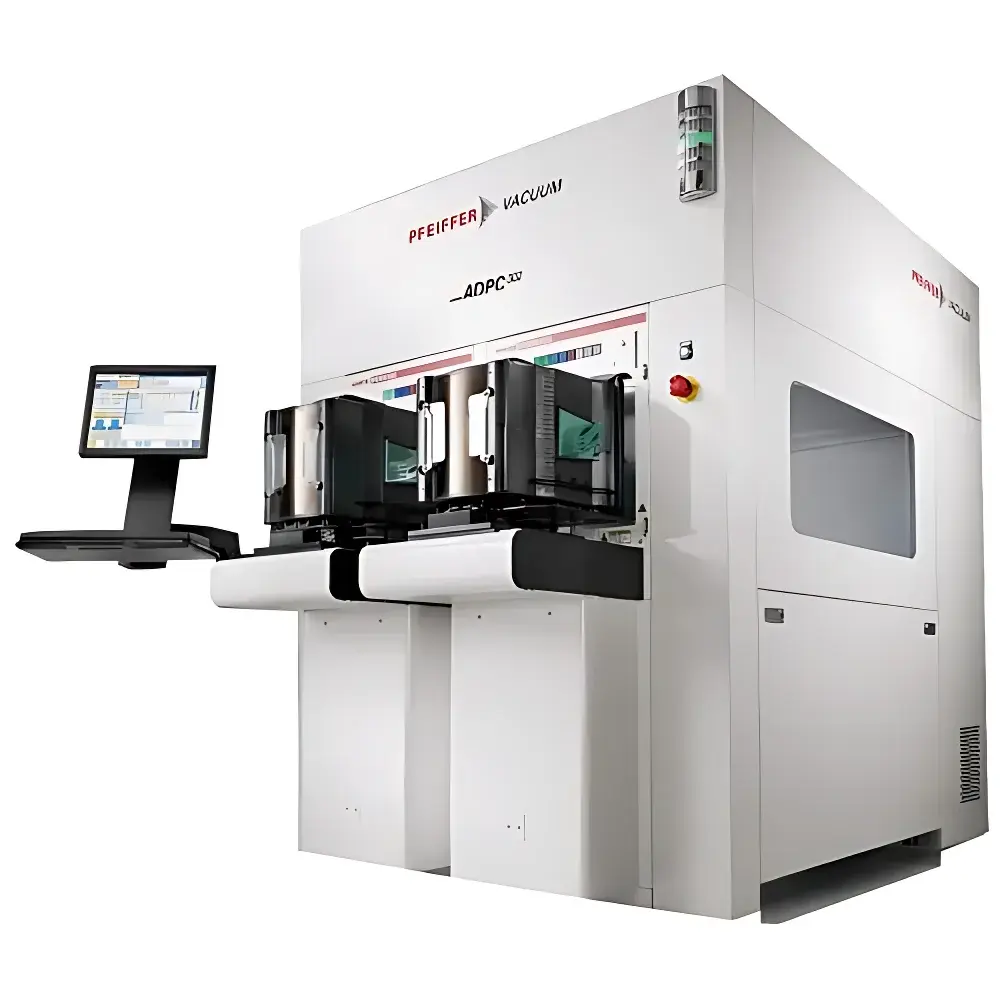
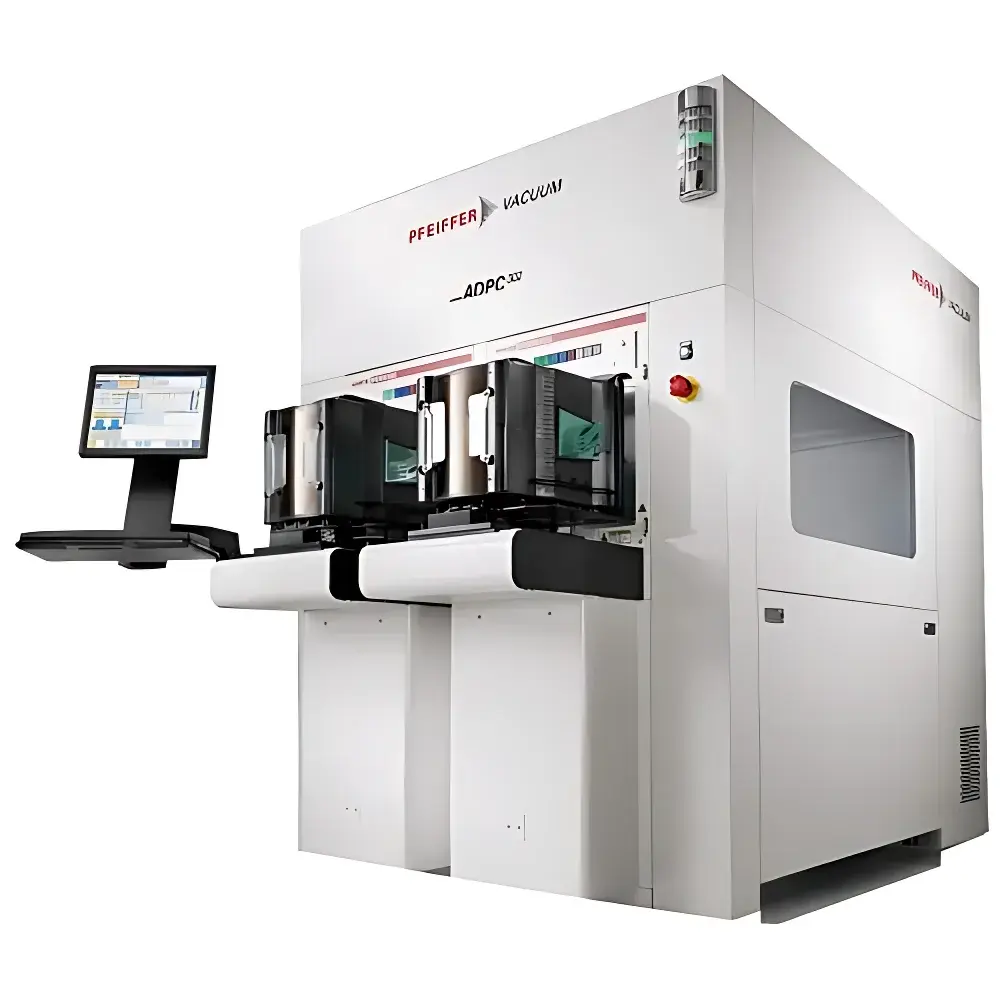
Pfeiffer Vacuum ADPC 302 In-line Submicron Particle Monitoring System for FOUP/FOSB
| Brand | Pfeiffer Vacuum |
|---|---|
| Model | ADPC 302 |
| Origin | France |
| Type | In-line Dry Particle Counter for Semiconductor Front-Opening Unified Pod (FOUP) and Front-Opening Shipping Box (FOSB) |
| Measurement Range | 0.1 µm – 5.0 µm |
| Counting Principle | Laser Light Scattering (LLS) with Automated Surface Scanning |
| Cycle Time | ≤7 min per FOUP/FOSB |
| Throughput | Up to 8 carriers/hour |
| Compliance | SEMI S2/S8, ISO 14644-1 Class 1–ISO Class 3 environments |
| Interface | Ethernet/IP, SECS/GEM compatible |
| Operating Mode | Fully Automated, Unattended, Integrated into 300 mm Fab Automation |
Overview
The Pfeiffer Vacuum ADPC 302 is an in-line, dry-particle monitoring system engineered specifically for semiconductor front-opening unified pods (FOUPs) and front-opening shipping boxes (FOSBs). It addresses a critical yield-limiting factor in advanced node fabrication: submicron particle contamination originating from carrier surfaces—including doors, latches, and internal walls—during wafer transport and idle storage. Unlike conventional liquid-based particle counters requiring manual sampling and offline analysis, the ADPC 302 employs a patented, fully automated laser light scattering (LLS) methodology to scan and quantify particles ≥0.1 µm directly on FOUP/FOSB interior surfaces in situ. Its measurement principle is based on calibrated optical detection of scattered intensity from airborne and loosely adhered particles dislodged via controlled laminar airflow and electrostatic neutralization during scanning. Designed for integration at load ports or material handling stations, it operates without interrupting production flow—enabling real-time carrier qualification prior to wafer loading.
Key Features
- Fully automated, hands-off operation: No operator intervention required for positioning, scanning, or data reporting.
- Submicron sensitivity: Detects and sizes particles from 0.1 µm to 5.0 µm with traceable calibration against NIST-traceable reference standards.
- Integrated surface mapping: Patented scanning protocol covers all critical interior surfaces—including door seals, latch mechanisms, and floor zones—with spatial resolution sufficient to identify localized contamination hotspots.
- High-throughput performance: Completes full FOUP characterization in ≤7 minutes; supports up to 8 carriers per hour under continuous operation.
- SEMI-compliant architecture: Meets SEMI S2 (safety) and S8 (ergonomics) requirements; designed for seamless integration with 300 mm factory automation (OHT, AMHS, GEM/SECS interfaces).
- Dry measurement principle: Eliminates solvent use, residue risk, and drying time associated with wet-counting methods—reducing cross-contamination and enabling same-cycle requalification.
Sample Compatibility & Compliance
The ADPC 302 is validated for standard 300 mm FOUPs (SEMI E47.1 compliant) and FOSBs used across logic, memory, and foundry fabs. It accommodates both manual and OHT-delivered carriers via dual-load-port configuration. All measurements are performed under controlled ISO Class 1–3 cleanroom conditions (per ISO 14644-1), with environmental monitoring (temperature, RH, pressure) logged alongside particle counts for auditability. The system complies with industry data integrity standards: raw count data, timestamps, carrier ID, and operator-free audit trail are stored in accordance with FDA 21 CFR Part 11 requirements when deployed in regulated manufacturing environments. Calibration verification follows a scheduled auto-calibration routine traceable to internal reference aerosols.
Software & Data Management
The ADPC 302 runs on Pfeiffer Vacuum’s proprietary CleanTrace™ software platform, supporting real-time dashboard visualization, historical trend analysis, and SPC-based control charting (X̄-R, CUSUM). Data export is available in CSV, XML, and SEMI EDA-compliant formats. Integration with MES and APC systems is enabled via standard OPC UA and SECS/GEM protocols. All measurement sessions generate immutable records containing carrier barcode, timestamp, measurement parameters, pass/fail status per size bin, and digital image snapshots of high-density particle clusters. Audit logs capture user access, calibration events, and firmware updates—fully aligned with GLP and GMP documentation practices.
Applications
- FOUP/FOSB qualification and release prior to wafer loading into lithography, etch, or deposition tools.
- Root-cause analysis of particle-related yield excursions through comparative carrier profiling across cleaning batches.
- Optimization of dry-clean processes (e.g., plasma, UV-ozone, megasonic) by quantifying residual particle reduction efficiency per cycle.
- Baseline establishment and periodic revalidation of carrier fleet cleanliness in high-mix, low-volume R&D and pilot-line environments.
- Supporting ITRS-defined defect control strategies for nodes ≤5 nm, where 0.1–0.3 µm particles pose direct pattern collapse and bridging risks.
FAQ
Does the ADPC 302 require consumables or reagents?
No. As a dry, optical particle counter, it uses no solvents, filters, or calibration fluids—only compressed dry nitrogen or clean dry air for purge and particle mobilization.
Can it distinguish between airborne and surface-bound particles?
Yes. The system differentiates loosely adhered particles (dislodged by controlled airflow) from airborne background via synchronized temporal gating and multi-angle scattering signature analysis.
Is remote diagnostics and software update supported?
Yes. Secure remote access via TLS-encrypted connection enables firmware updates, parameter tuning, and predictive maintenance alerts through Pfeiffer Vacuum’s CloudConnect™ service portal.
How is measurement repeatability verified across multiple units?
Each unit undergoes factory calibration using monodisperse polystyrene latex (PSL) standards; inter-unit correlation is maintained through quarterly inter-laboratory round-robin testing coordinated with major semiconductor equipment manufacturers.
What happens if a FOUP fails the particle threshold?
The system triggers configurable alerts (email, MES flag, local HMI warning) and optionally initiates automatic quarantine tagging via AMHS interface—preventing non-conforming carriers from entering process tools.