
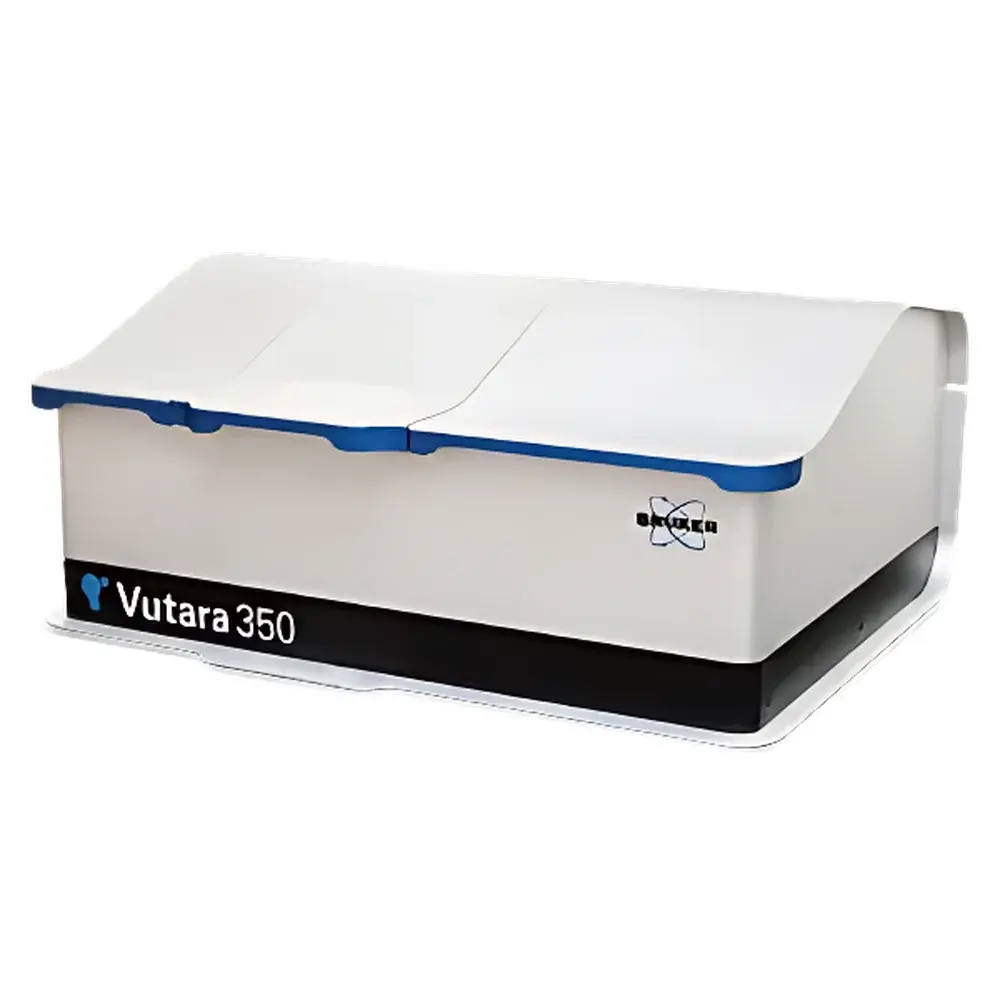
Bruker Vutara 350 Super-Resolution Microscope
| Brand | Bruker |
|---|---|
| Origin | USA |
| Manufacturer Type | Authorized Distributor |
| Product Origin | Imported |
| Model | Vutara 350 |
| Pricing | Available Upon Request |
Overview
The Bruker Vutara 350 is a single-molecule localization microscopy (SMLM) platform engineered for quantitative, high-speed, three-dimensional super-resolution imaging of live biological specimens. Unlike conventional diffraction-limited optical microscopes, the Vutara 350 achieves true nanoscale spatial resolution by stochastically activating and precisely localizing individual fluorophores across multiple acquisition frames. Its core architecture leverages photoactivatable or photoswitchable fluorescent probes—such as PAFPs, rsFPs, or synthetic dyes—to reconstruct molecular-scale structures with sub-20 nm lateral (XY) and ~50 nm axial (Z) resolution. Designed specifically for dynamic cellular environments, the system integrates high-sensitivity sCMOS detection, precision piezo-driven Z-stage control, and real-time drift correction to maintain positional fidelity during extended time-lapse acquisitions.
Key Features
- Sub-diffraction resolution: ≤20 nm in XY, ≤50 nm in Z, validated per ISO 19046:2021 standards for localization microscopy performance assessment.
- High-speed volumetric imaging: Full-field 3D reconstruction in ≤10 seconds per layer using optimized acquisition protocols and parallelized localization algorithms.
- Dual-color capability: Simultaneous two-channel imaging at up to 800 frames per second (fps), enabling precise co-localization analysis of interacting protein complexes.
- Optical sectioning depth: 8 µm Z-range with uniform axial sampling and aberration-corrected objective lenses (e.g., 60×/1.49 NA oil immersion).
- Integrated drift compensation: Real-time hardware-based stage stabilization via interferometric feedback, minimizing thermal and mechanical drift during long-duration acquisitions.
- Modular optical path: Supports TIRF, HILO, and widefield illumination modes; compatible with standard fluorescence filter sets and laser lines (405 nm, 488 nm, 561 nm, 640 nm).
Sample Compatibility & Compliance
The Vutara 350 accommodates a broad range of biological samples—from fixed adherent cells and tissue sections to live-cell monolayers and 3D organoid cultures. It supports standard mounting media (e.g., ProLong Diamond, Vectashield) and is compatible with common labeling strategies including immunofluorescence, SNAP-/Halo-tagging, and genetic encoding of photoactivatable proteins. All hardware and software components comply with IEC 61000-6-3 (EMC emissions) and IEC 61000-6-2 (immunity) standards. The system meets essential requirements for GLP-compliant workflows, including audit-trail-enabled software logging, user-access controls, and electronic signature support aligned with FDA 21 CFR Part 11 principles.
Software & Data Management
Vutara’s proprietary SRX software provides end-to-end acquisition, reconstruction, quantification, and visualization within a single interface. It includes automated multi-color registration, 3D point-cloud rendering, cluster analysis (Ripley’s K-function, DBSCAN), and export of structured data in open formats (e.g., HDF5, CSV, OME-TIFF). Raw frame stacks and reconstructed coordinates are stored with embedded metadata—including acquisition parameters, calibration files, and instrument configuration logs—to ensure full traceability. Data integrity is preserved through checksum validation and version-controlled processing pipelines, facilitating reproducibility across laboratories and longitudinal studies.
Applications
- Nanoscale mapping of cytoskeletal architecture and membrane protein organization in live neurons.
- Quantitative analysis of chromatin nanostructure dynamics during mitosis and transcriptional activation.
- Three-dimensional colocalization of receptor–ligand pairs in immune synapses with single-molecule stoichiometry.
- Time-resolved tracking of viral entry and intracellular trafficking pathways at <30 nm resolution.
- Validation of CRISPR-Cas9 editing outcomes via direct visualization of genomic locus rearrangements.
- Correlative SMLM–electron microscopy (CLEM) workflows enabled by fiducial marker registration and coordinate transformation tools.
FAQ
What sample preparation methods are recommended for optimal Vutara 350 performance?
Standard immunolabeling with Alexa Fluor 647 or CF dyes, or genetically encoded tags such as mEos3.2, are strongly recommended. Buffer conditions should include oxygen scavenging systems (e.g., glucose oxidase/catalase) and thiol-containing agents (e.g., β-mercaptoethanol) to promote photoswitching stability.
Does the Vutara 350 support automated multi-position time-lapse imaging?
Yes—the integrated motorized XY stage and software-defined acquisition scripts enable unattended multi-site time-series acquisition with synchronized Z-stack collection and drift correction across all positions.
Is the system compatible with existing laboratory IT infrastructure and LIMS integration?
SRX software supports DICOM-SR export and RESTful API endpoints for integration with institutional data management platforms, including LabArchives and Benchling, under controlled network environments.
How is calibration maintained between experiments?
Daily alignment verification using NIST-traceable fluorescent nanobeads (100 nm diameter) is performed via built-in calibration routines; results are logged with timestamped reports and automatically archived in the experiment metadata repository.




