
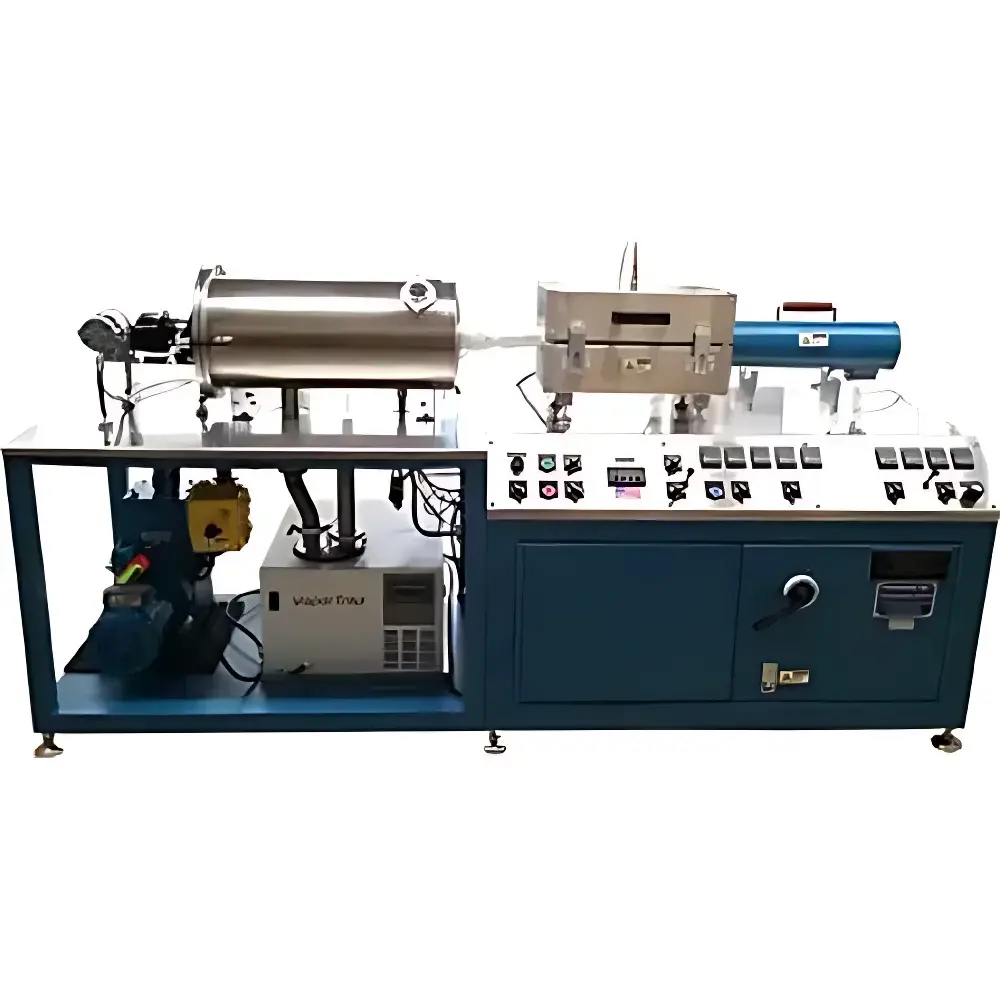
Paratronix V494 & H1092 Vertical and Horizontal Parylene Coating Systems
| Brand | Paratronix |
|---|---|
| Origin | USA |
| Model | V494 (Vertical) / H1092 (Horizontal) |
| Voltage Options | Internal Transformer Supported |
| Cooling | Integrated Mechanical Chiller (LN₂-Free) |
| Control System | PLC with Touchscreen HMI (Rotating & Tilting Pod), USB & Ethernet Connectivity |
| Operation Modes | Manual, Semi-Automatic Batch, Recipe-Driven Deposition |
| Safety Features | Over-Temperature Cut-off, Vacuum-Level Interlock, Alarm History Logging |
| Compliance | UL 508A (US/CAN), CE Marked |
| Warranty | 1 Year |
Overview
The Paratronix V494 and H1092 Parylene Coating Systems are precision-engineered vacuum deposition platforms designed for reproducible, conformal polymer coating of sensitive microelectronic, biomedical, and MEMS components. Both systems implement the standard parylene C (and compatible variants such as N or HT) vapor deposition polymerization (VDP) process: solid parylene dimer is sublimed at ~150 °C, pyrolyzed at ~680 °C into reactive monomer vapor, and condensed uniformly onto substrates held at ambient or controlled temperature in a high-vacuum chamber (<10 mTorr). The V494 employs a vertical chamber architecture optimized for static, rack-mounted substrates—ideal for PCBs, sensors, and flat assemblies requiring minimal handling-induced contamination. In contrast, the H1092 utilizes a horizontal rotating drum configuration enabling uniform 360° coverage of small, high-volume parts—including O-rings, ferrite cores, elastomeric seals, and ceramic rods—without manual repositioning. Each system integrates real-time process parameter monitoring, closed-loop thermal control, and automated endpoint detection to ensure batch-to-batch consistency aligned with ISO 9001–certified manufacturing protocols.
Key Features
- Integrated mechanical chiller eliminates dependency on liquid nitrogen (LN₂), reducing operational complexity, consumable costs, and facility infrastructure requirements.
- Robust structural frame and vacuum chamber construction engineered for long-term stability under repeated thermal cycling and high-vacuum stress (≤1 × 10⁻³ Torr base pressure).
- Programmable Logic Controller (PLC) with industrial-grade touchscreen HMI featuring rotating/tilting pod for ergonomic access; supports multi-user authentication and role-based permissions.
- Comprehensive data logging: all critical parameters—including sublimation temperature, pyrolysis zone setpoints, chamber pressure profiles, deposition time, and cooling rates—are timestamped and stored internally with export capability via USB or Ethernet.
- Dual-mode operation: manual mode for R&D process development; semi-automatic batch mode with recipe recall for production repeatability—up to 99 user-defined process protocols stored onboard.
- Embedded safety interlocks: redundant over-temperature shutdown (dual thermocouple verification), vacuum-level threshold lockout, and real-time alarm history with event tagging and retention.
Sample Compatibility & Compliance
The V494 accommodates substrates up to 12″ × 12″ × 6″ (W × D × H) in static fixtures, supporting rigid and semi-flexible assemblies such as printed circuit boards, optical sensors, and hermetic packages. The H1092 drum accepts parts ≤1.5″ diameter × 3″ length per batch (standard drum volume: 1.2 L), with validated uniformity across complex geometries including internal bores, undercuts, and porous surfaces. Both systems comply with UL 508A (listed for use in the U.S. and Canada), CE marking per EU Machinery Directive 2006/42/EC and Electromagnetic Compatibility Directive 2014/30/EU, and meet essential requirements of ISO 14001 environmental management standards. Process documentation supports GLP/GMP traceability when integrated with validated LIMS or electronic lab notebook (ELN) platforms.
Software & Data Management
The embedded control firmware provides audit-trail-capable data recording compliant with FDA 21 CFR Part 11 principles—including electronic signatures, user session logging, and immutable parameter history. Raw deposition logs (CSV format) include cycle start/stop timestamps, real-time pressure curves, heater power modulation, and chiller coolant temperature feedback. Optional OPC UA server integration enables bidirectional communication with MES or SCADA systems for centralized fleet monitoring. Remote diagnostics and firmware updates are supported via secure TLS-encrypted Ethernet connection—no external cloud dependency required.
Applications
- Conformal dielectric encapsulation of implantable medical devices (e.g., neurostimulator leads, cochlear implants) meeting ISO 10993 biocompatibility requirements.
- Moisture and chemical barrier protection for aerospace-grade avionics and downhole sensor modules exposed to H₂S, salt fog, or extreme thermal gradients.
- Surface passivation of MEMS accelerometers, RF filters, and piezoresistive pressure transducers to suppress stiction and environmental drift.
- Functional hydrophobic coatings on diagnostic microfluidic chips and lab-on-a-chip substrates without altering channel geometry or surface energy.
- Corrosion mitigation for legacy military electronics undergoing depot-level refurbishment under MIL-STD-810G environmental test protocols.
FAQ
What parylene variants are supported by these systems?
Both the V494 and H1092 are configured for parylene C deposition by default; optional hardware upgrades (e.g., enhanced pyrolysis zone insulation, quartz-lined sublimation crucibles) enable stable operation with parylene N and HT formulations.
Is cleanroom compatibility certified?
While not ISO Class 5–rated as a standalone unit, both systems meet particle generation limits per ISO 14644-1 Class 8 when installed with appropriate exhaust ducting and HEPA-filtered make-up air—verified via in-situ airborne particle counting during qualification.
Can deposition thickness be monitored in real time?
Quartz crystal microbalance (QCM) thickness monitoring is available as a factory-installed option on both models, providing nanometer-resolution in situ measurement referenced to ASTM F1559-22.
What maintenance intervals are recommended?
Mechanical pump oil replacement every 2,000 operating hours; chamber O-ring inspection and replacement every 12 months or 500 cycles (whichever occurs first); chiller refrigerant charge validation annually per ASHRAE 15 guidelines.
Are IQ/OQ protocols included with purchase?
Yes—each system ships with a complete, customizable Installation Qualification (IQ) and Operational Qualification (OQ) document package, pre-populated with equipment-specific acceptance criteria aligned with ASTM E2500-22 and ICH Q5D guidance.



