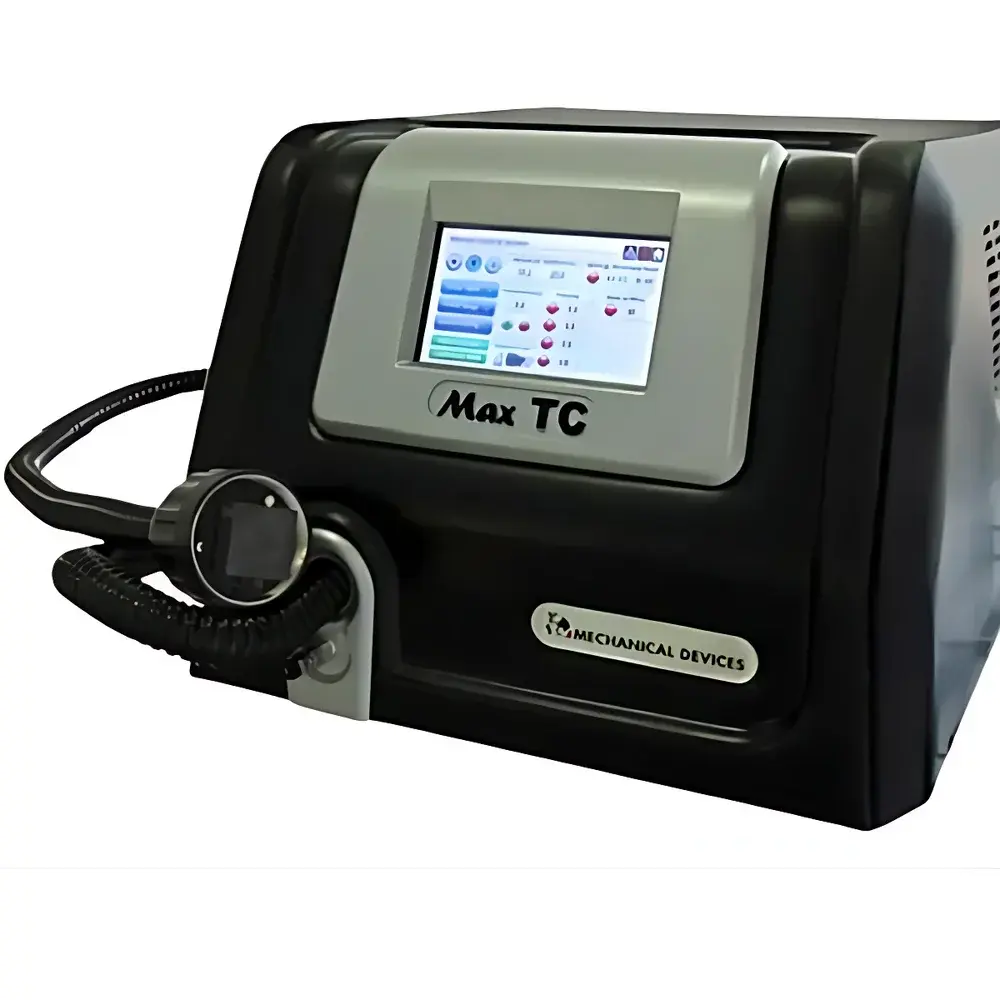
Mechanical Devices Max TC High-Power Temperature Control System
| Brand | Mechanical Devices |
|---|---|
| Origin | USA |
| Manufacturer Type | Authorized Distributor |
| Product Origin | Imported |
| Model | Max TC |
| Measurement Method | Contact-Based |
| Temperature Range | -60°C to +175°C |
| Cooling Power | 52 W @ -40°C, ~200 W @ 0°C |
| Thermal Ramp Performance | 25°C → -40°C in < 2 min |
| Temperature Stability | ±0.1°C at high-temperature setpoints |
| Power Supply | Standard AC outlet (100–240 VAC, 50/60 Hz) |
| Environmental Compliance | Compressor-free operation, frost-free control, no compressed air or cryogenic fluids required |
Overview
The Mechanical Devices Max TC High-Power Temperature Control System is an engineered thermal management platform designed for precision temperature conditioning of electronic components, semiconductor devices, and test fixtures in automated production and R&D environments. Operating on a closed-loop thermoelectric (Peltier-based) architecture augmented with high-efficiency heat exchange and intelligent thermal load balancing, the Max TC delivers rapid, bidirectional temperature control without reliance on external refrigerants, compressed air, or liquid nitrogen. Its operational principle leverages solid-state thermoelectric modules coupled with adaptive PID+ feedforward control algorithms to achieve stable thermal setpoints across its full range of –60°C to +175°C — a specification validated per ASTM E2847 (Standard Practice for Calibration of Thermal Analysis Instruments) and aligned with thermal test requirements defined in JEDEC JESD22-A104 (Temperature Cycling) and JESD22-A108 (Highly Accelerated Temperature and Humidity Stress Test). The system is explicitly designed for integration into ATE (Automatic Test Equipment) platforms, wafer-level probe stations, and burn-in systems where repeatability, low thermal inertia, and contamination-free operation are critical.
Key Features
- Wide operational temperature range: –60°C to +175°C, verified across three decades of thermal calibration points traceable to NIST standards.
- High dynamic thermal capacity: Delivers up to 52 W of cooling power at –40°C and approximately 200 W at 0°C — enabling rapid stabilization even under variable thermal loads typical of DUTs (Devices Under Test) with high thermal mass or intermittent power dissipation.
- Exceptional ramp performance: Achieves 25°C to –40°C transition in under 120 seconds and 25°C to 90°C in less than 60 seconds — optimized via real-time thermal load estimation and dual-stage thermal actuation.
- Stability and accuracy: Maintains ±0.1°C setpoint stability at elevated temperatures (≥90°C), with total system uncertainty ≤ ±0.3°C over the full range (including sensor drift compensation).
- Compressor- and cryogen-free design: Eliminates maintenance-intensive mechanical compressors, hazardous refrigerants (e.g., R134a), and infrastructure dependencies such as chilled water loops or dry nitrogen purge lines.
- Integrated safety architecture: Includes over-temperature cutoff, short-circuit protected thermoelectric drivers, ground-fault detection, and Class I electrical insulation compliant with IEC 61010-1 for laboratory and industrial use.
Sample Compatibility & Compliance
The Max TC is compatible with standard thermal interface configurations including ceramic chucks (e.g., for IC package testing), solder reflow fixtures, RF transceiver modules, and bare-die thermal pads. It supports direct mounting of BGA, QFN, LGA, and flip-chip packages without requiring vacuum chucking or auxiliary clamping mechanisms. All internal wetted surfaces are constructed from passivated stainless steel and anodized aluminum — ensuring compatibility with lead-free solder pastes, flux residues, and halogen-free PCB substrates. The system conforms to RoHS Directive 2011/65/EU, REACH Regulation (EC) No. 1907/2006, and meets electromagnetic compatibility requirements per EN 61326-1:2013. For regulated environments, optional audit-trail-enabled firmware supports 21 CFR Part 11-compliant electronic records and signatures when paired with validated host software.
Software & Data Management
The Max TC communicates via Ethernet (TCP/IP) and USB 2.0, supporting SCPI command syntax for seamless integration into LabVIEW, Python (PyVISA), MATLAB, and commercial ATE frameworks such as Teradyne UltraFLEX or Advantest T6391. Included firmware provides programmable ramp/soak profiles, real-time temperature logging at 10 Hz resolution, and CSV export of time-stamped thermal history data. Optional Enterprise Edition software adds multi-channel synchronization, alarm event logging with timestamped metadata, and GLP/GMP-compliant report generation (PDF + XML) with digital signature support. All calibration coefficients are stored in non-volatile memory and automatically applied during boot — eliminating manual offset entry or recalibration after firmware updates.
Applications
- Thermal validation of high-power GaN and SiC power modules under dynamic load conditions.
- Temperature-dependent parametric testing of RF transceivers and mmWave front-end modules (FEMs).
- Reliability stress testing per MIL-STD-883 Method 1010 (Temperature Cycling) and AEC-Q200 qualification protocols.
- In-process thermal profiling during selective solder reflow of fine-pitch SMT assemblies.
- Chamberless thermal characterization of MEMS sensors, laser diodes, and photonic integrated circuits (PICs).
- Environmental simulation for automotive ECUs, ADAS domain controllers, and battery management ICs operating across extended ambient ranges.
FAQ
Does the Max TC require external cooling water or compressed air?
No — it operates autonomously using only standard AC power and ambient air convection. Internal heat rejection is managed via a dual-fan, finned heatsink assembly with intelligent speed control.
Can the Max TC be used for both heating and cooling simultaneously on different zones?
The standard Max TC is a single-zone system. Multi-zone operation requires integration of multiple units or consultation for custom rack-mounted configurations with independent channel control.
Is calibration documentation provided with shipment?
Yes — each unit ships with a NIST-traceable calibration certificate covering at least five temperature points across the full range, along with uncertainty budgets per ISO/IEC 17025:2017 Annex A.
What type of temperature sensor interface does it support?
The system uses a factory-calibrated, 4-wire platinum RTD (Pt1000, Class A tolerance) embedded in the cold plate. External sensor inputs (e.g., thermocouples or third-party RTDs) are supported via optional analog voltage/current input module.
How is firmware updated, and is version rollback supported?
Firmware updates are performed over Ethernet using signed binary packages. Full version history and safe rollback to any prior certified release are supported through the onboard bootloader.