
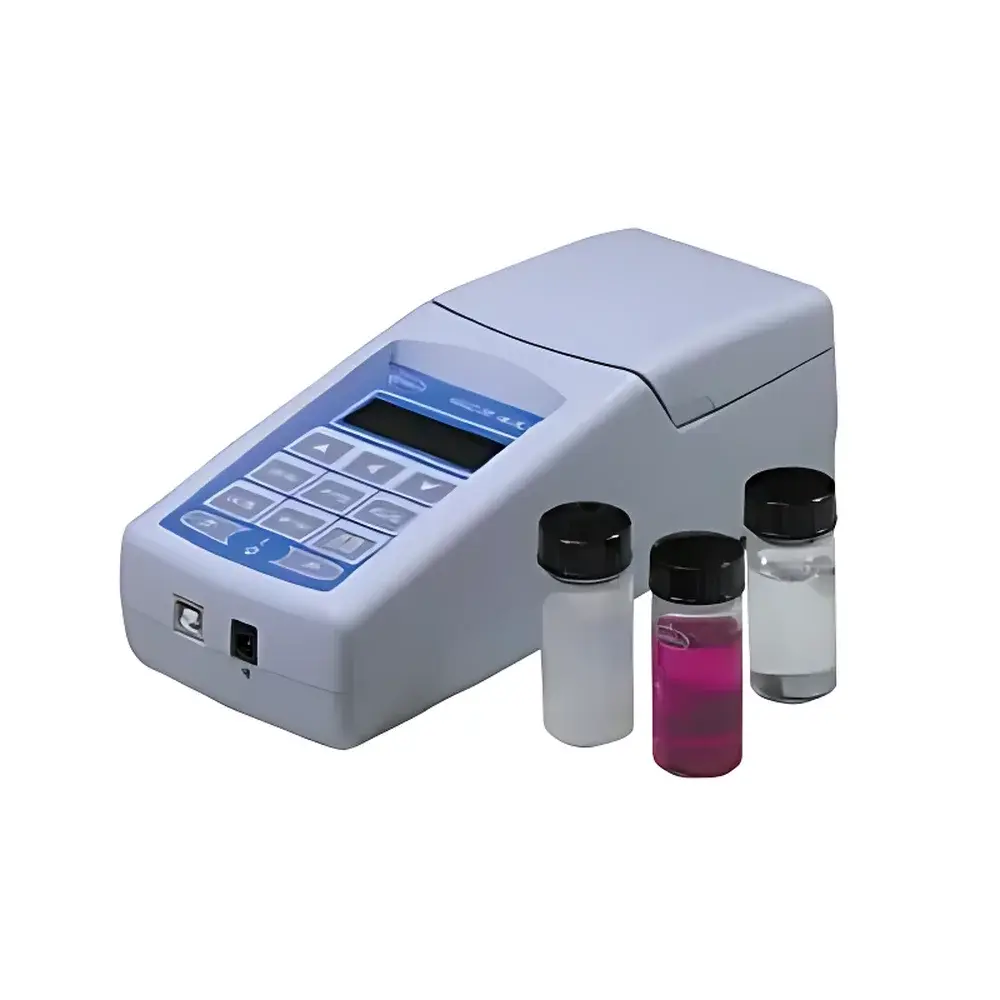
WGZ-2AB, WGZ-2B, WGZ-3B, WGZ-4000B Portable Turbidimeter
| Origin | Shanghai, China |
|---|---|
| Manufacturer Type | Distributor |
| Origin Category | Domestic (China) |
| Models | WGZ-2AB, WGZ-2B, WGZ-3B, WGZ-4000B |
| Pricing | Upon Request |
| Measurement Principle | 90° Nephelometric Scattering |
| Minimum Readout | 0.01 NTU (WGZ-2AB/3B), 0.001 NTU (WGZ-2B/4000B) |
| Measuring Range | 0–20 / 0–200 / 0–500 / 0–4000 NTU (model-dependent) |
| Basic Error | ±2% F.S. |
| Repeatability | ≤1% |
| Zero Drift | ±0.5% F.S. (0.1 NTU for WGZ-2AB/3B |
| Light Source | 100,000-hour LED |
| Compliance | ISO 7027 (Nephelometry at 90°) |
Overview
The WGZ-2AB, WGZ-2B, WGZ-3B, and WGZ-4000B series are portable nephelometric turbidimeters engineered for field-deployable, high-reproducibility turbidity measurement in accordance with ISO 7027:2016. These instruments operate on the principle of 90° scattered light detection—measuring the intensity of light scattered by suspended particles in aqueous or optically transparent liquid samples at a right angle to the incident beam path. This geometry ensures optimal sensitivity to low-concentration colloidal and particulate suspensions while minimizing interference from absorption or coloration. Designed for operational continuity in resource-constrained environments, each model integrates a maintenance-free, 100,000-hour lifetime LED light source emitting at the standardized 860 nm wavelength, compliant with ISO 7027’s spectral requirements. The optical architecture incorporates built-in chromatic compensation to correct for sample color interference—a critical feature when analyzing colored effluents, pharmaceutical process streams, or fermented beverages where absorbance can otherwise distort scattering-based quantification.
Key Features
- True portability with dual power options: rechargeable Li-ion battery (with low-voltage warning and auto-shutdown) and AC adapter support for lab or mobile station use.
- Backlit, high-contrast LCD display showing real-time date/time stamp, measured value, selected unit, and system status—all accessible via tactile membrane keypad.
- Intelligent range management: automatic or manual range switching across multi-segment NTU scales (e.g., WGZ-4000B covers 0–4000 NTU in four overlapping sub-ranges for optimized signal-to-noise ratio).
- Multi-point calibration protocol supporting 1–7 user-defined calibration points using traceable formazin or StablCal standards; includes auto-zero function and non-linear interpolation algorithms for enhanced accuracy across wide dynamic ranges.
- Dual operational modes: “Average Measurement” (configurable averaging over 3–99 cycles) and “Data Query Mode” for reviewing stored records with time-stamped metadata.
- Embedded clock-synchronized memory system retaining up to 20 recent measurement sets—including raw values, calibration logs, timestamps, and operator IDs—with non-volatile flash storage ensuring data integrity during power loss.
- Comprehensive unit flexibility: direct readout in NTU, FTU, EBC, ppm, mg/L, % transmittance, and custom “degree” units—ideal for cross-industry reporting alignment (e.g., brewing per EBC, wastewater per EPA Method 180.1, pharma per USP <730>).
Sample Compatibility & Compliance
The WGZ-series accommodates standard 25 mm round glass vials (10 mL volume) and accepts optional cuvette adapters for 10 mm, 20 mm, or 50 mm pathlength cells—enabling compatibility with high-turbidity slurry samples or low-volume clinical specimens. All models comply with ISO 7027:2016 for instrument performance, including angular tolerance (±2.5° around 90°), spectral bandwidth (40 dB). For regulated environments, the devices support GLP/GMP-aligned workflows: timestamped calibration events, operator-identifiable audit trails, and RS232 output compatible with LIMS integration (including FDA 21 CFR Part 11-compliant data export when paired with validated software). Applications span drinking water compliance (WHO, EPA, EU Directive 98/83/EC), biopharmaceutical process monitoring (USP <730>, Ph. Eur. 2.2.18), fermentation control in beverage manufacturing, and environmental field screening per ASTM D6508 and ISO 7027 Annex B.
Software & Data Management
Data export is facilitated via isolated RS232 serial interface (38.4 kbps max), supporting ASCII-formatted output with configurable delimiters and header fields. Optional PC software (provided on secure USB drive) enables batch calibration curve generation, statistical analysis (mean, SD, CV%), trend visualization, and PDF report generation—including embedded instrument ID, calibration certificate references, and digital signature fields. All firmware updates are delivered via signed binary packages with SHA-256 verification to ensure integrity. Internal memory retains full calibration history—including date, standard used, deviation from reference, and technician ID—satisfying internal QA documentation requirements without external dependency.
Applications
- Drinking water treatment: rapid verification of coagulation/flocculation efficiency and filter breakthrough at intake, intermediate, and distribution points.
- Pharmaceutical manufacturing: monitoring clarity of injectables, ophthalmic solutions, and API crystallization slurries per USP <730> and ICH Q5C.
- Beverage quality control: EBC-compliant haze measurement in beer, wine, and fruit juices; real-time tracking of chill-proofing stability.
- Environmental fieldwork: on-site assessment of sediment runoff, wastewater effluent compliance (e.g., EPA NPDES permits), and stormwater discharge monitoring.
- Hospital & public health labs: Legionella risk assessment in cooling tower water, dialysate purity verification, and vaccine suspension homogeneity checks.
- Industrial process water: boiler feedwater clarity assurance, semiconductor rinse water qualification, and food-grade CIP validation.
FAQ
What calibration standards are recommended for routine verification?
Formazin primary standard (traceable to NIST SRM 2134) or StablCal polymer suspensions—both compliant with ISO 7027 Annex A. Calibration intervals should follow risk-based SOPs, typically daily for high-frequency use or per batch in GMP settings.
Can the instrument measure colored samples without bias?
Yes. The integrated chromatic compensation algorithm applies real-time correction using dual-wavelength referencing (860 nm + auxiliary channel), effectively decoupling turbidity signal from absorbance artifacts—validated per ISO 7027 Clause 7.3.
Is RS232 output compatible with modern LIMS platforms?
Yes. ASCII output format (e.g., “TURB,2024-05-17,14:22:08,3.245,NTU,OK”) is parser-ready for common LIMS vendors; optional middleware drivers available for LabVantage, STARLIMS, and Thermo Fisher SampleManager.
How is zero drift managed during extended field deployments?
Automatic zero-tracking occurs at power-on and before each measurement cycle; zero stability is verified against sealed air reference vial—drift specification of ±0.02 NTU (WGZ-2B/4000B) or ±0.1 NTU (WGZ-2AB/3B) over 8 hours at 25°C.
Does the device meet regulatory requirements for audit trails in pharmaceutical labs?
Yes. All calibration, measurement, and configuration events are permanently timestamped and stored with immutable metadata—including operator code, ambient temperature, and firmware version—supporting ALCOA+ principles and 21 CFR Part 11 Subpart B compliance when used with validated software.





