
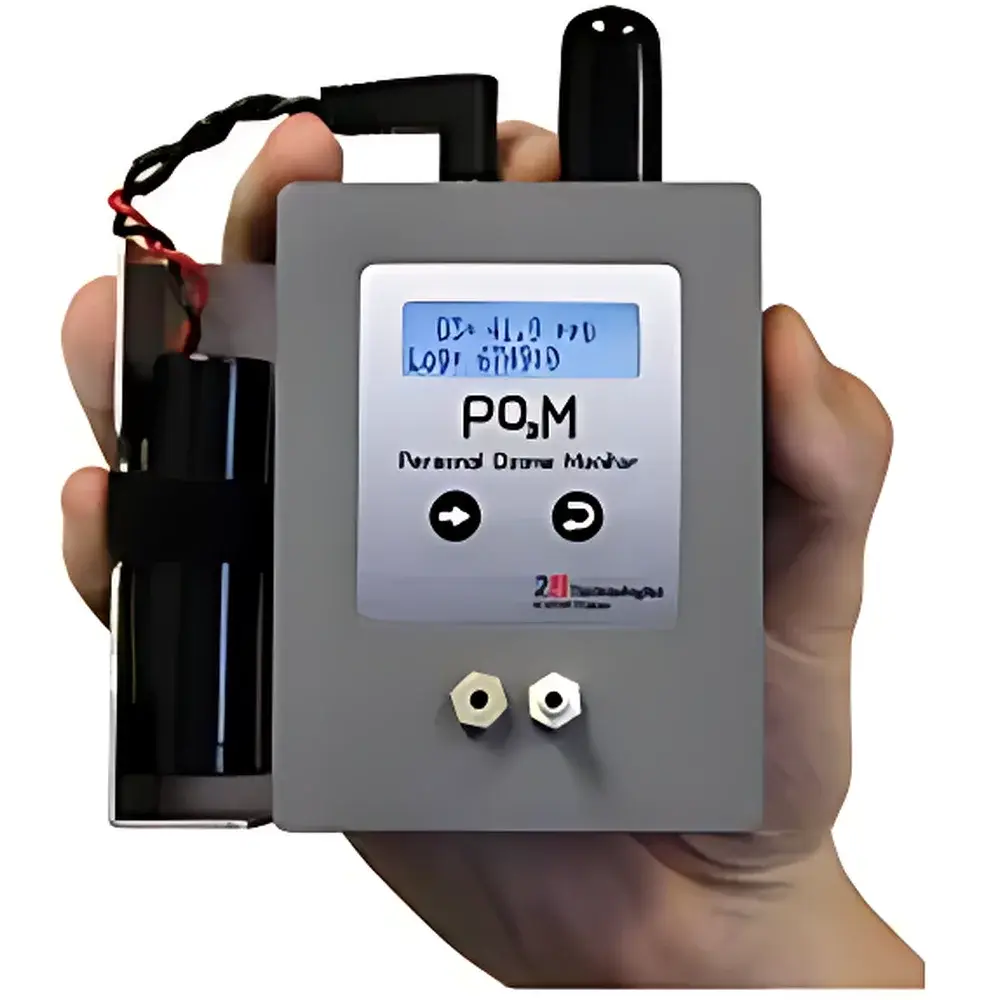
2B Technologies POM Portable UV Absorption Ozone Analyzer
| Origin | USA |
|---|---|
| Manufacturer Type | Authorized Distributor |
| Origin Category | Imported |
| Model | POM |
| Instrument Type | Portable |
| Measurement Range | 0–10 ppm |
| Limit of Detection | 0.1 ppb |
| Response Time (t₉₀) | 30 s |
| Zero Drift | <1% per day |
| Resolution | 1.5 ppb |
Overview
The 2B Technologies POM Portable UV Absorption Ozone Analyzer is a compact, field-deployable instrument engineered for high-precision ambient and occupational ozone (O₃) measurement using the well-established principle of ultraviolet absorption at 254 nm. As a Federal Equivalent Method (FEM) certified device (EPA EQOA-0815-227), the POM meets U.S. Environmental Protection Agency performance criteria for regulatory-grade ozone monitoring in ambient air. Its optical design employs a folded “U-shaped” absorption path—achieving an effective optical path length comparable to benchtop analyzers such as the 2B Model 202, 205, and 106-L—thereby delivering laboratory-grade sensitivity and reproducibility in a palm-sized form factor (10.2 × 7.6 × 3.8 cm, 360 g without battery). The analyzer operates on Beer–Lambert law-based quantification, where ozone concentration is derived from the attenuation of 254 nm UV light through a sample gas stream. Integrated temperature and pressure compensation ensures traceable accuracy across variable environmental conditions—from sea level to altitudes up to 13.5 km (150–1013 mbar), making it suitable for vertical profiling via balloon-, drone-, or aircraft-based platforms.
Key Features
- UV photometric detection at 254 nm with NIST-traceable calibration and documented uncertainty budget
- Folded optical path architecture enabling 1.5 ppb resolution and sub-ppb detection limits (3.0 ppb at 2σ, 10-s averaging)
- Onboard GPS module synchronizing georeferenced ozone readings with positional metadata (latitude, longitude, altitude, UTC timestamp)
- Dual operational modes: standard measurement (10-s integration, 0.1 Hz output) and fast mode (2-s integration, 0.5 Hz output)
- Internal data logging capacity of 8,192 records—supporting up to ~1 year of hourly averaged data or ~4.6 hours of continuous 2-s sampling
- DewLine™ anti-condensation technology preventing moisture interference during high-humidity deployments
- Robust thermal management enabling stable operation across 0–50 °C ambient temperatures
- Flexible power options: rechargeable 7.4 V Li-ion battery (5–8 h runtime) or universal AC/DC adapter (100–240 VAC input)
Sample Compatibility & Compliance
The POM is designed for direct analysis of ambient air, indoor air, and workplace atmospheres without pre-concentration or chemical scrubbing. It complies with EPA FEM EQOA-0815-227 for ambient ozone monitoring and supports GLP-aligned data integrity through timestamped, GPS-tagged records. All factory calibrations are NIST-traceable and documented in the included Certificate of Calibration. The instrument meets IEC 61000-4 electromagnetic compatibility standards and carries CE marking for conformity with EU health, safety, and environmental protection directives. While not explicitly validated for ISO 13843 or ASTM D5012, its measurement principle and performance characteristics align with best practices outlined in ISO 11325 (air quality — ozone — determination by UV absorption) and ASTM D3259 (standard test method for ozone in ambient air).
Software & Data Management
Data retrieval and configuration are managed via 2B’s proprietary Display Software (included on USB drive), which provides real-time visualization, export to CSV/Excel, and firmware updates. Communication occurs over RS-232 serial or USB virtual COM port at 19,200 baud. Logged data include ozone concentration (ppb), temperature (K), pressure (torr), GPS coordinates, and system diagnostics. The software supports batch processing of time-series datasets and enables user-defined averaging intervals (1 min, 5 min, 1 hr). For regulatory or audit purposes, raw output files retain immutable timestamps and instrument ID—facilitating compliance with FDA 21 CFR Part 11 requirements when deployed in validated workflows under documented SOPs.
Applications
- Personal exposure assessment in epidemiological studies linking ozone levels to respiratory health outcomes
- Occupational health and safety monitoring in industrial facilities where ozone is generated (e.g., water treatment, semiconductor fabrication, laser printing)
- Vertical ozone profiling using lightweight aerial platforms (weather balloons, UAVs, light aircraft) under strict mass and volume constraints
- Long-term unattended monitoring in remote or off-grid locations powered by solar-charged battery systems
- Dense urban sensor networks requiring low-power, GPS-enabled nodes for spatial interpolation and source attribution modeling
- Calibration transfer and field validation of reference-grade ozone monitors in mobile laboratories
FAQ
Is the POM certified as a Federal Equivalent Method (FEM) by the U.S. EPA?
Yes—the POM is listed as EPA EQOA-0815-227, satisfying performance requirements for ambient ozone monitoring under 40 CFR Part 53.
Does the instrument correct for temperature and pressure variations during measurement?
Yes—real-time temperature (K) and pressure (torr) measurements are used to dynamically correct ozone concentration values per the ideal gas law.
What is the recommended maintenance schedule for the zero air filter?
The included zero air filter should be replaced every 3–6 months depending on ambient particulate load; more frequent replacement is advised in dusty or high-humidity environments.
Can the POM operate continuously while connected to external power?
Yes—it supports uninterrupted operation via the 7.4 V DC external power input, with simultaneous battery charging if enabled.
Is GPS data stored internally alongside ozone readings?
Yes—each logged ozone value includes synchronized GPS-derived latitude, longitude, altitude, and UTC timestamp, all retained in non-volatile memory.
Related Products







