
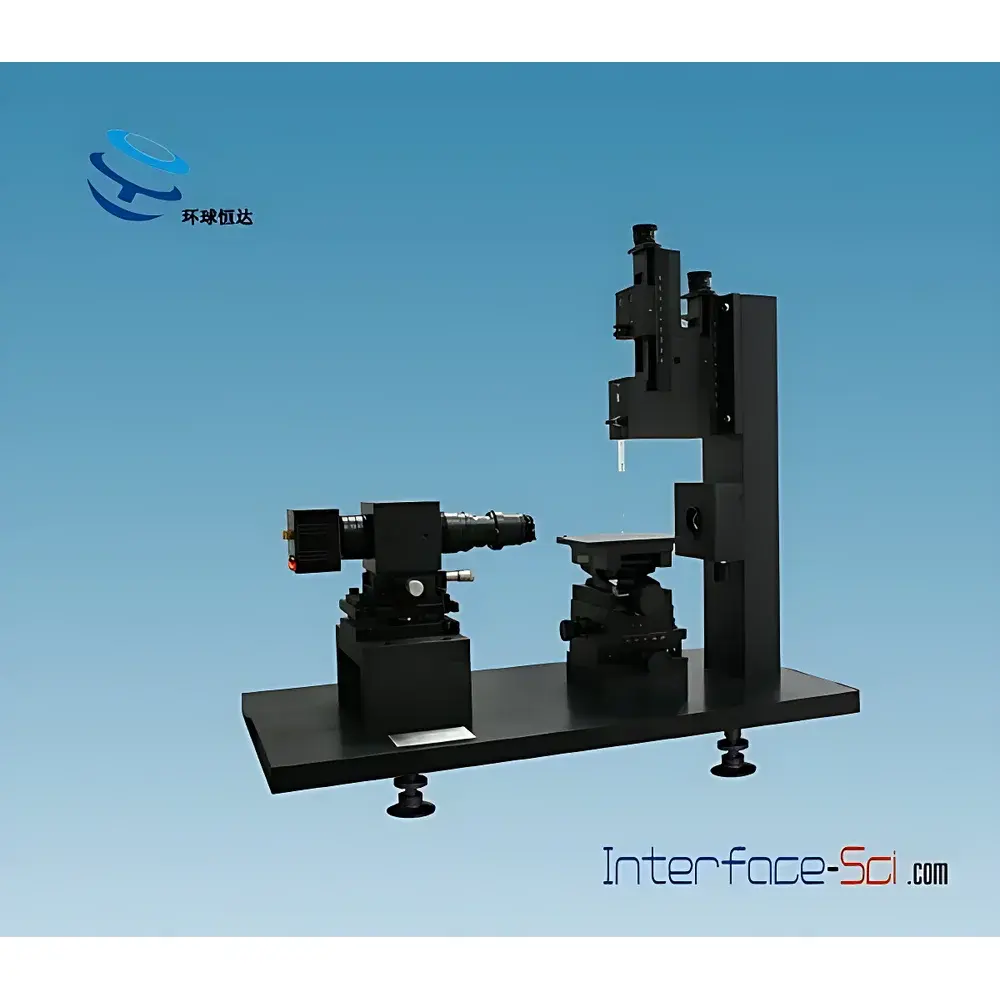
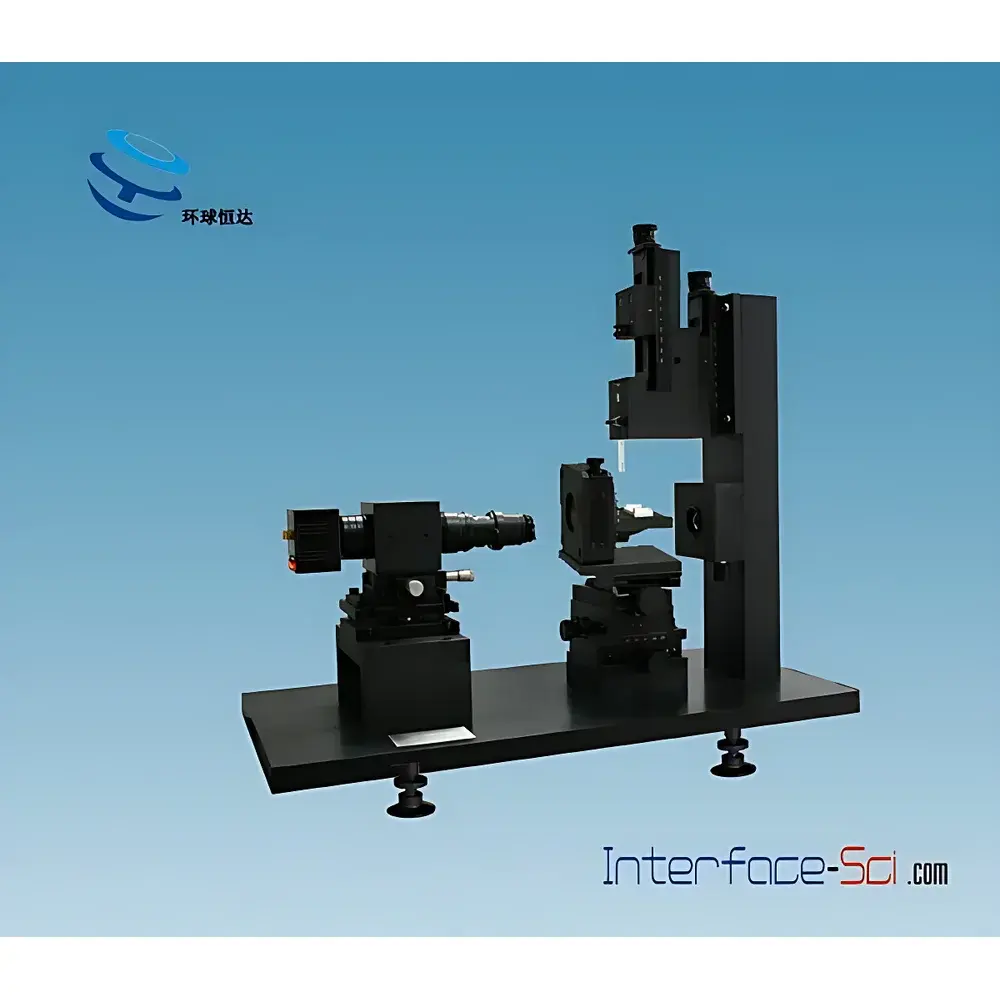
SCI-2000A Optical Contact Angle Goniometer with Dynamic Measurement Capability
| Origin | Beijing, China |
|---|---|
| Manufacturer Type | Authorized Distributor |
| Origin Category | Domestic (PRC) |
| Model | SCI-2000A |
| Price Range | USD 2,800–7,200 |
| Instrument Class | Dynamic Contact Angle Analyzer |
| Form Factor | Benchtop Laboratory System |
| Contact Angle Range | 0° < θ < 180° |
| Contact Angle Accuracy | ±1° (θ/2 method), ±0.1° (circle fitting) |
| Sample Stage Dimensions | 120 × 80 mm |
| Optical Magnification | 0.7×–5× continuous zoom |
| Surface/Interfacial Tension Range | 0.001–1000 mN/m |
| Surface/Interfacial Tension Accuracy | ±0.01 mN/m |
Overview
The SCI-2000A Optical Contact Angle Goniometer is a precision benchtop instrument engineered for quantitative characterization of solid–liquid interfacial phenomena. It operates on the principle of high-resolution optical imaging combined with advanced digital image analysis to determine contact angles—defined as the angle formed between the tangent to a liquid–vapor interface and the solid surface at the three-phase boundary. The system supports multiple measurement modes: sessile drop (static and dynamic), pendant drop (for surface/interfacial tension), captive bubble, and slide immersion (Wilhelmy plate alternative). Its modular architecture enables rigorous evaluation of wettability, surface energy heterogeneity, and dynamic interfacial behavior under controlled environmental conditions. Designed for compliance with ASTM D724 (paper wettability), ASTM D5946 (corona-treated polymer films), and ISO 15989 (water contact angle of treated films), the SCI-2000A serves as a foundational tool in R&D laboratories requiring traceable, reproducible interfacial metrology.
Key Features
- Modular mechanical platform featuring coordinated XYZ translation and 360° manual or motorized rotation (0.01° resolution) for precise control of sample orientation during advancing/receding and roll-off angle measurements.
- Optimized optical train: industrial-grade continuous zoom lens (0.7×–5×), low-distortion optics with extended depth of field, and uniform cold LED illumination with parallel-light collimation for high-fidelity droplet edge detection.
- Imaging system: standard 25 fps monochrome USB 2.0 CCD camera (1280 × 1024 resolution); optional high-speed variants up to 2000 fps for transient wetting kinetics analysis.
- Multi-mode dispensing system: manual micro-syringe (50 µL / 100 µL), Luer-lock compatible stainless steel needles (0.23–0.9 mm ID), and optional programmable syringe pump with linear actuation and anti-cross-contamination design.
- Comprehensive software suite supporting automated baseline detection, asymmetric droplet fitting, real-time curvature correction (convex/concave surfaces), and multi-point sequential acquisition with batch processing.
Sample Compatibility & Compliance
The SCI-2000A accommodates diverse sample geometries—including rigid substrates (glass, silicon wafers, metals), flexible films, fibers, textiles, pressed powders, and biological specimens—within its 120 × 80 mm stage (max. sample size: 180 × ∞ × 60 mm). Optional fixtures (fiber clamps, leaf holders, thin-film stages) extend applicability to non-planar or low-stiffness materials. All hardware and firmware are designed to support GLP-compliant workflows: audit trails for parameter changes, timestamped image metadata, exportable raw data (AVI, TIFF, CSV), and full traceability per FDA 21 CFR Part 11 requirements when paired with validated software configurations. Calibration protocols align with ISO/IEC 17025 principles for measurement uncertainty estimation.
Software & Data Management
The proprietary analysis software implements dual-method contact angle quantification: geometric (θ/2, circle fit, ellipse fit) and model-based (Young–Laplace fitting for pendant/captive drops). It integrates over 12 surface free energy models—including Owens–Wendt–Rabel, van Oss–Chaudhury–Good (acid–base), Neumann’s Equation of State, and Wu harmonic mean—enabling robust energy component decomposition for both low-energy polymers and high-energy ceramics/metals. A built-in library contains >300 reference liquids and >500 pre-characterized surface parameters. Data management includes relational database storage, Excel-compatible export (with embedded images and curve fits), AVI video capture (for process documentation), and automated report generation compliant with internal QA templates.
Applications
The SCI-2000A supports cross-disciplinary research and quality assurance across sectors including:
- Materials science: plasma treatment validation, hydrophobic/hydrophilic coating development, nanoparticle dispersion stability assessment.
- Electronics: cleanliness verification of PCBs, wafer surface conditioning, OLED encapsulation layer wettability screening.
- Life sciences: biocompatibility testing of implants, protein adsorption kinetics on biomaterials, pulmonary surfactant film characterization.
- Chemical formulation: surfactant efficacy evaluation in agrochemicals, inkjet ink rheology–wetting correlation, emulsion stability prediction.
- Energy & geoscience: rock core wettability analysis for enhanced oil recovery, aluminum foil hydrophilicity grading in HVAC systems.
FAQ
What measurement methods does the SCI-2000A support?
Sessile drop (static/dynamic), pendant drop, captive bubble, and immersion (slide) methods—all fully integrated within the software interface.
Can it measure interfacial tension between two immiscible liquids?
Yes—using the pendant drop method with Young–Laplace equation fitting, supported by BA-table and ADSA-PD algorithms.
Is the system compliant with regulatory documentation standards?
When configured with audit-trail-enabled software and calibrated reference standards, it meets requirements for GLP, GMP, and FDA 21 CFR Part 11 electronic records.
What is the minimum measurable surface tension value?
0.001 mN/m, validated using ultra-low-tension surfactant solutions and certified reference materials.
Does the instrument support automated multi-site measurement?
Yes—programmable XY stage movement (optional upgrade) enables unattended sequential analysis across predefined sample locations with synchronized image capture and calculation.



