Micronics PF204plus / PF216plus Portable Clamp-on Ultrasonic Flow Meter
| Origin | UK |
|---|---|
| Manufacturer Type | Authorized Distributor |
| Origin Category | Imported |
| Model | PF204plus / PF216plus |
| Pricing | Available Upon Request |
| Accuracy | ±0.5–2% of reading (ID 13–75 mm, flow velocity >0.2 m/s) |
| Pipe ID Range | PF204plus: 13–115 mm |
| PF216plus | 50–1000 mm |
| Sensor Operating Temperature | –20 °C to +135 °C (Groups A & B) |
| Output | Optically isolated 0/4–20 mA |
| pulse output | 1 pulse/sec, max 5 V |
| Velocity Range | 0.1–20 m/s |
| Display | 64 × 240 pixel graphical LCD |
| Power | Rechargeable battery (20 h typical runtime) or 110/240 VAC ±10% via PSU |
| Certifications | CE compliant |
| Enclosure | Polypropylene carry case with custom molded EPE foam insert |
Overview
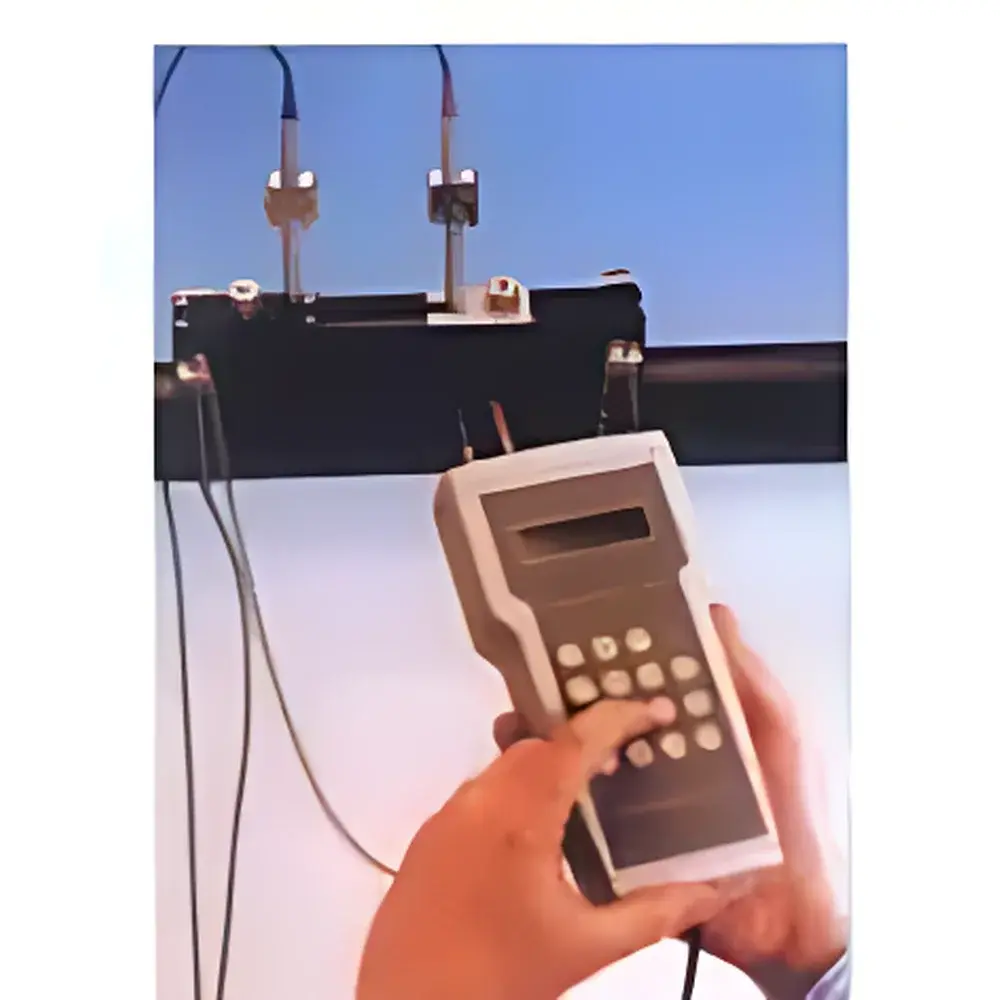
The Micronics PF204plus and PF216plus are handheld, clamp-on ultrasonic flow meters engineered for non-intrusive, high-reliability liquid flow measurement in pressurized piping systems. Based on the time-of-flight (TOF) principle, these instruments determine volumetric flow rate by measuring the differential transit time of ultrasonic pulses propagating upstream and downstream between two externally mounted transducers. This method eliminates the need for pipe cutting, welding, or process shutdown—enabling rapid deployment in live industrial pipelines. The PF series is calibrated for single-path measurement geometry and optimized for liquids with sound speed ≥ 800 m/s and acoustic attenuation within operational limits. Its robust architecture supports field use across diverse thermal and mechanical environments, with validated performance under ISO 6410-1 and EN 14154-2 reference conditions for portable ultrasonic flow instrumentation.
Key Features
- True portable design: Integrated rechargeable battery (20 h typical operation), lightweight housing, and ergonomic carry case for field mobility
- Non-invasive installation: Clamp-on transducers require no wetted parts, process isolation, or system depressurization
- Dual-model scalability: PF204plus covers small-diameter pipes (13–115 mm ID); PF216plus extends range to large-diameter infrastructure (50–1000 mm ID)
- Wide operating temperature tolerance: Transducer Groups A and B rated for –20 °C to +135 °C, suitable for steam condensate, hot oil, and chilled water applications
- Optically isolated analog output (0/4–20 mA) and TTL-compatible pulse output for integration into SCADA, DCS, or data loggers
- Graphical LCD (64 × 240 pixels) with intuitive 16-key interface supporting multi-language menu navigation and real-time waveform diagnostics
- CE-marked per Directive 2014/30/EU (EMC) and 2014/35/EU (LVD), conforming to essential requirements for portable measurement equipment in industrial settings
Sample Compatibility & Compliance
The PF204plus/PF216plus is validated for homogeneous, single-phase liquids with stable acoustic properties—including potable water, river water, glycol-water mixtures, hydraulic oils, diesel fuel, refined petroleum products, chemical process streams, and HVAC heat-transfer fluids. It is not suitable for aerated, highly viscous (>500 cSt), or particulate-laden media where ultrasonic signal scattering exceeds detection thresholds. Measurement accuracy meets stated tolerances when pipe wall material is uniform (e.g., carbon steel, stainless steel, copper, PVC, GRP), and when fluid temperature and velocity profiles comply with ISO 5167-1 Annex C guidance for ultrasonic flowmeter installation. The device supports GLP-aligned operation through timestamped data logging and configurable audit trails (when used with optional PC software). While not FDA 21 CFR Part 11–certified as a standalone unit, its output signals are compatible with validated control systems meeting GMP and pharmaceutical water system monitoring requirements.
Software & Data Management
Field configuration and data review are supported via the Micronics FlowView PC application (Windows 10/11), which connects via USB-to-serial adapter. The software enables transducer spacing calculation, signal quality assessment (SNR, echo amplitude, path stability index), zero-check calibration verification, and export of time-stamped flow logs in CSV format. All instrument settings—including pipe material, wall thickness, fluid type, and measurement units—are stored internally with non-volatile memory retention. Firmware updates are performed offline using signed binary packages, ensuring traceability and integrity. Data export files include metadata headers specifying model number, serial ID, calibration date, and operator-defined tags—facilitating integration into LIMS or enterprise asset management platforms.
Applications
- Commissioning and verification of HVAC hydronic circuits, chiller plants, and boiler feedwater systems
- Energy auditing and submetering in commercial buildings and district heating networks
- Pump performance testing and efficiency benchmarking per HI 40.6 standards
- Leak detection and flow balance analysis in municipal water distribution and industrial process loops
- Calibration cross-checking of inline magnetic, vortex, or turbine flowmeters
- Monitoring of cooling tower make-up, condensate return, and fire protection system integrity
- Validation of filtration system pressure drop vs. flow rate relationships
- Temporary flow monitoring during plant maintenance, retrofitting, or commissioning phases
FAQ
Can the PF204plus/PF216plus measure gas or steam flow?
No. These models are designed exclusively for liquid phase measurement. Gas and saturated steam exhibit insufficient acoustic coupling and excessive signal attenuation for reliable TOF-based velocity determination.
Is pipe insulation compatible with clamp-on sensor installation?
Yes—up to 25 mm of homogenous insulation (e.g., mineral wool, closed-cell foam) may be accommodated using extended transducer cables and appropriate coupling gel application protocols. Insulation must be dry and free of air gaps.
What is the minimum required straight pipe length upstream/downstream?
For optimal accuracy, 10D upstream and 5D downstream straight run is recommended per ISO 17089-2. Field correction factors are available in FlowView for installations with limited straight-run availability.
Does the device support Modbus RTU or HART communication?
No. Analog (4–20 mA) and pulse outputs are standard. Modbus RTU requires external protocol converter hardware interfaced via the analog output.
How often does the instrument require recalibration?
Micronics recommends annual functional verification against a traceable flow standard. No user-accessible internal calibration adjustments exist; factory recalibration is performed at authorized service centers using NIST-traceable reference rigs.