
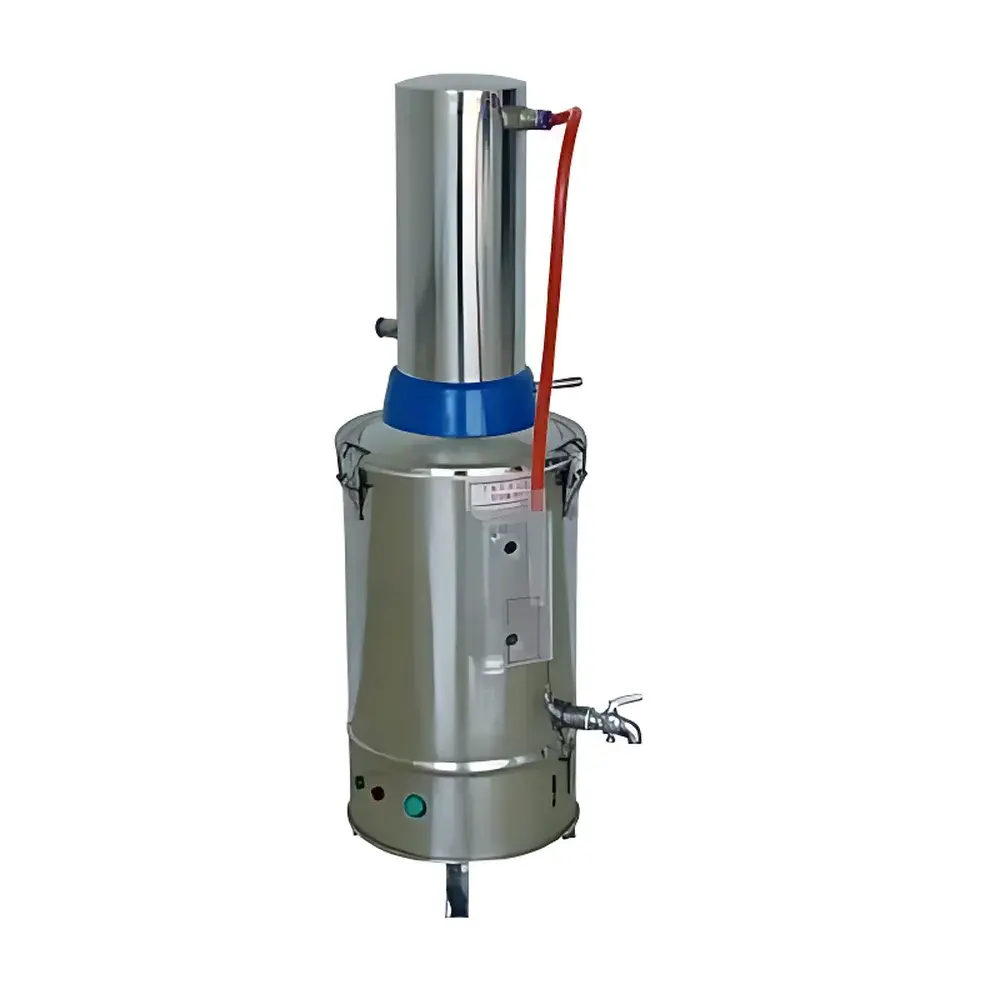
YN-ZD-Z-10 Stainless Steel Automatic Dry-Run Protection Electric Distillation Unit
| Key | Origin: Beijing, China |
|---|---|
| Manufacturer Type | Distributor |
| Model | YN-ZD-Z-10 |
| Price Range | USD 1,400–7,000 |
| Instrument Type | Standard Quartz Glass Distillation Apparatus |
| Output Rate | 10 L/h |
| Power Rating | 7.5 kW |
| Supply Voltage | 380 V AC |
| Construction Material | Electropolished 304 Stainless Steel |
| Safety Mechanism | Imported Dry-Run Detection Sensor |
Overview
The YN-ZD-Z-10 is a laboratory-grade electric distillation unit engineered for continuous, reliable production of purified water via thermal vaporization and condensation. Operating on the principle of single-stage atmospheric-pressure distillation, it utilizes immersed tubular heating elements to elevate feed water (standard municipal tap water) to boiling, generating steam that passes through a stainless steel vapor chamber and is subsequently condensed using an integrated recirculating water cooling system. The resulting condensate—free of non-volatile ions, organic contaminants, pyrogens, and particulates—is collected as Type III reagent water per ASTM D1193-20 and ISO 3696:1987 specifications. Designed for unattended operation in regulated environments, the unit incorporates fail-safe dry-run protection to prevent heater damage during low-water or no-flow conditions—a critical requirement for GLP-compliant laboratories and quality control facilities handling routine water purification tasks.
Key Features
- Electropolished 304 stainless steel construction throughout the boiler chamber, condenser jacket, and collection reservoir ensures long-term resistance to chloride-induced pitting and scaling under repeated thermal cycling.
- 7.5 kW high-efficiency immersion heating system delivers consistent 10 L/h distilled water output at ambient inlet water temperatures between 10–25°C, with thermal efficiency optimized via insulated vapor path geometry.
- Automated dry-run protection circuit integrates a certified imported flow/level sensor that monitors feed water continuity in real time; interruption triggers immediate power cutoff (<1.2 s response latency) and visual/audible alarm activation.
- Hermetically sealed vapor pathway minimizes steam leakage and eliminates cross-contamination risk—critical when producing water for endotoxin-sensitive applications such as cell culture media preparation or pharmaceutical rinse validation.
- Ergonomic front-panel controls include dual LED indicators (power-on and heating-active), manual reset button, and status-labeled terminal block for external interlock integration (e.g., with central cooling water monitoring systems).
Sample Compatibility & Compliance
The YN-ZD-Z-10 accepts standard municipal potable water as feedstock, complying with WHO Guidelines for Drinking-water Quality (4th ed.) and GB 5749–2022 (China’s National Hygienic Standard for Drinking Water). It does not require pretreatment for typical urban supply profiles but is incompatible with brackish, seawater, or highly turbid sources without upstream filtration. As a Class I electrical appliance per GB 4706.1–2005 (IEC 60335-1 equivalent), the unit meets IP22 ingress protection rating and carries CE-marked safety certification for industrial laboratory use. While not validated for USP Purified Water monograph compliance out-of-the-box, its output consistently achieves conductivity ≤5.1 µS/cm at 25°C when operated with stable feed water—enabling qualification per internal SOPs aligned with ISO/IEC 17025 calibration requirements.
Software & Data Management
This is a stand-alone electromechanical distillation apparatus with no embedded microprocessor, touchscreen interface, or digital data logging capability. All operational parameters are fixed by hardware design and calibrated during factory assembly. For traceability in regulated settings, users must implement external documentation protocols—including logbook entries for daily startup/shutdown times, feed water source verification, and periodic conductivity testing of output (recommended per ASTM D1193 Annex A1). Optional third-party temperature and flow transducers may be installed upstream/downstream for integration into building management systems (BMS) or LIMS via 4–20 mA analog outputs (not included).
Applications
- Routine preparation of solvent-grade water for buffer formulation, HPLC mobile phase dilution, and spectrophotometric blanking in analytical chemistry labs.
- Production of pyrogen-free water for autoclave chamber filling, glassware rinsing prior to sterility testing, and reconstitution of lyophilized standards in microbiology and pharmacopeial QC units.
- Supporting ISO 15189-accredited medical laboratories requiring documented water purity for hematology analyzers and clinical chemistry platforms.
- Teaching laboratories conducting fundamental thermodynamics experiments involving latent heat measurement, vapor pressure curves, and mass balance validation.
FAQ
What feed water quality is required for optimal performance?
Standard municipal tap water meeting GB 5749–2022 or EPA Safe Drinking Water Act criteria is sufficient. Pre-filtration (5 µm sediment + activated carbon) is recommended if feed water exhibits >1 NTU turbidity or >0.5 mg/L free chlorine.
Can this unit produce water compliant with USP Purified Water specifications?
No—USP requires additional treatment (e.g., reverse osmosis or deionization) and microbial control not provided by thermal distillation alone. This unit meets ASTM Type III and ISO Grade 3 water standards.
Is the 380 V power supply compatible with North American 208 V three-phase systems?
No. The unit is configured exclusively for 380 V ±10%, 50 Hz three-phase input. A dedicated step-up transformer is required for operation in regions with 208/240 V infrastructure.
How often should the boiler chamber be descaled?
Under typical hard water conditions (≥150 mg/L CaCO₃), descaling with 5% citric acid solution is recommended every 200–300 operating hours or quarterly—whichever occurs first.
Does the unit include a built-in conductivity meter?
No. Conductivity verification must be performed externally using a calibrated benchtop meter (e.g., Mettler Toledo SevenCompact™ or Thermo Scientific Orion Star A212) per ASTM D1129.



