
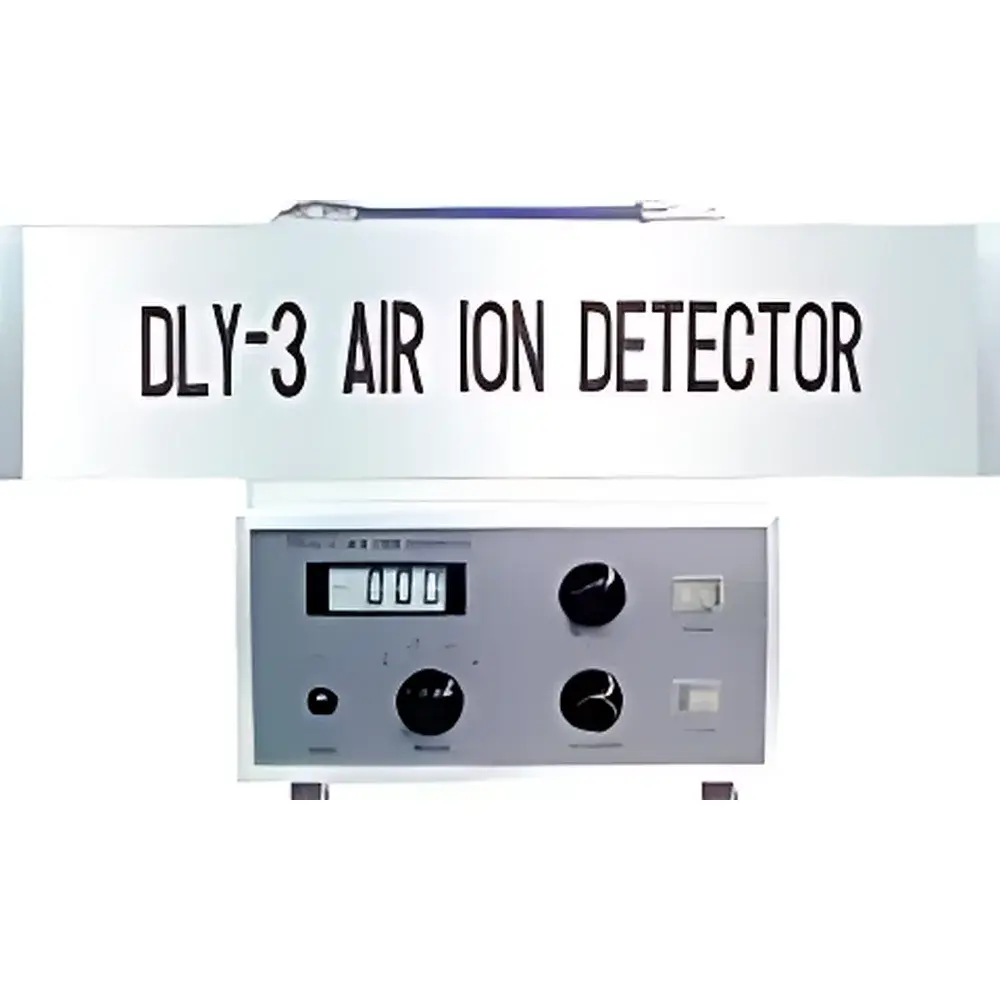
DLY-3G Anti-Humidity Air Negative Ion Concentration Analyzer
| Origin | Beijing, China |
|---|---|
| Manufacturer Type | Distributor |
| Origin Category | Domestic (China) |
| Model | DLY-3G |
| Price Range | USD 2,800 – 7,000 |
| Ion Concentration Range | 10–1.999×10⁹ ions/cm³ |
| Resolution | 10 ions/cm³ |
| Ion Mobility Ranges | 1.0 / 0.4 / 0.15 cm²/V·s (3-range selectable) |
| Sampling Air Velocity | 180 cm/s |
| Response Time Constant | ~15 s |
| Accuracy | ±10% (ion concentration & mobility) |
| Power Supply | DC 12 V or AC 220 V |
| Operating Environment | −0 to +40 °C, ≤90% RH |
| Compliance | GB/T 18809–2002 |
Overview
The DLY-3G Anti-Humidity Air Negative Ion Concentration Analyzer is a precision electrostatic detection instrument engineered for reliable operation in high-humidity ambient environments—such as coastal zones, forested regions, riverbanks, and mountainous ecosystems—where conventional negative ion analyzers frequently suffer from signal drift, insulation breakdown, and measurement instability. It operates on the principle of air ion collection via corona-free Gerdien tube geometry: atmospheric air is drawn at a controlled velocity (180 cm/s) through a cylindrical collector assembly, where negative ions migrate under a defined electric field toward a polarized collecting electrode. The resulting picoampere-level current is converted into ion concentration (ions/cm³) using calibrated gain factors and known airflow cross-section. Unlike standard instruments vulnerable to moisture-induced surface conduction across insulators and collector plates, the DLY-3G integrates an integrated self-recovery dehumidification system that actively mitigates condensation accumulation on critical dielectric surfaces without requiring manual disassembly or external desiccants.
Key Features
- Patented anti-humidity structural design with built-in thermal-assisted dehumidification module—automatically activated upon detection of elevated surface impedance decay
- Triple-range ion mobility selection (1.0, 0.4, and 0.15 cm²/V·s) enabling optimized sensitivity for small, medium, and large hydrated ion clusters
- High-stability electrometer circuitry with guarded input stage and low-noise JFET amplification, supporting resolution down to 10 ions/cm³
- Real-time response time constant of approximately 15 seconds—validated per GB/T 18809–2002 Annex B for dynamic environmental sampling
- Robust dual-power architecture: field-deployable DC 12 V operation (e.g., solar-battery systems) and lab-grade AC 220 V mains compatibility
- Sealed collector housing with hydrophobic coating on insulator surfaces and gold-plated stainless steel electrodes for long-term corrosion resistance
Sample Compatibility & Compliance
The DLY-3G is validated for continuous unattended monitoring of ambient air in natural and semi-urban settings, including forest canopies, seaside promenades, alpine meadows, and ecological reserve buffer zones. Its performance envelope meets the metrological requirements specified in GB/T 18809–2002 “Method for Measurement of Air Negative Ion Concentration”, including verification of linearity, repeatability (≤±10% full-scale deviation), and environmental robustness under ≥90% relative humidity at 25 °C. While not certified to ISO/IEC 17025 for accredited calibration labs, the instrument supports traceable calibration using NIST-traceable radioactive alpha sources (e.g., ²⁴¹Am) and is routinely deployed by provincial environmental monitoring stations and meteorological bureaus in China for routine air quality index supplementation. It complies with electromagnetic compatibility (EMC) Class B limits per GB 9254–2008 and safety requirements per GB 4793.1–2007.
Software & Data Management
The DLY-3G outputs analog voltage (0–5 V) proportional to logarithmic ion concentration and digital RS-232 serial data (ASCII protocol) at 9600 baud. Optional OEM firmware enables time-stamped data logging to SD card (via external interface module) with configurable sampling intervals (1 s to 30 min). Data files are structured as CSV-compatible records containing timestamp, raw current (pA), selected mobility range, temperature, and humidity (if external sensor integrated). While no proprietary PC software is bundled, the device is compatible with industry-standard SCADA platforms (e.g., LabVIEW, Wonderware), Python-based acquisition scripts (pySerial), and open-source environmental dashboards (e.g., Grafana + InfluxDB). Audit trails and configuration changes are not internally stored; users implementing GLP/GMP workflows must implement external logging protocols.
Applications
- Long-term ecological monitoring of negative ion dynamics in forest-atmosphere exchange studies
- Validation of air purification efficacy in green building certification (e.g., LEED IEQ Credit 3)
- Baseline assessment for national ecological red-line zoning and tourism resource evaluation
- Field validation of atmospheric electricity models in coastal boundary layer research
- Supporting epidemiological surveys correlating ambient ion levels with respiratory health indicators
- Calibration reference for low-cost sensor networks in citizen science air quality initiatives
FAQ
Does the DLY-3G require regular recalibration?
Yes—annual calibration against a traceable ion source is recommended per GB/T 18809–2002 Section 7.3. Field verification using portable check sources (e.g., ²⁴¹Am foil) is advised before critical deployments.
Can it operate continuously outdoors without shelter?
No. Although humidity-resistant, it is rated for indoor or weather-protected outdoor enclosures (IP54 minimum). Direct rainfall exposure or prolonged sub-zero operation (<0 °C) is not supported.
Is migration rate selection automated or manual?
Manual via front-panel toggle switch. Selection depends on expected ion size distribution: 1.0 cm²/V·s for small ions (3 nm).
What maintenance is required for the dehumidification system?
No consumables. The thermal dehumidification element is solid-state and rated for >10,000 activation cycles. Visual inspection of collector cleanliness every 3 months is recommended in dusty or saline environments.
Is USB connectivity available?
No. Communication is RS-232 only. USB-to-serial adapters (FTDI chipset) are widely compatible but not supplied.
Related Products







