
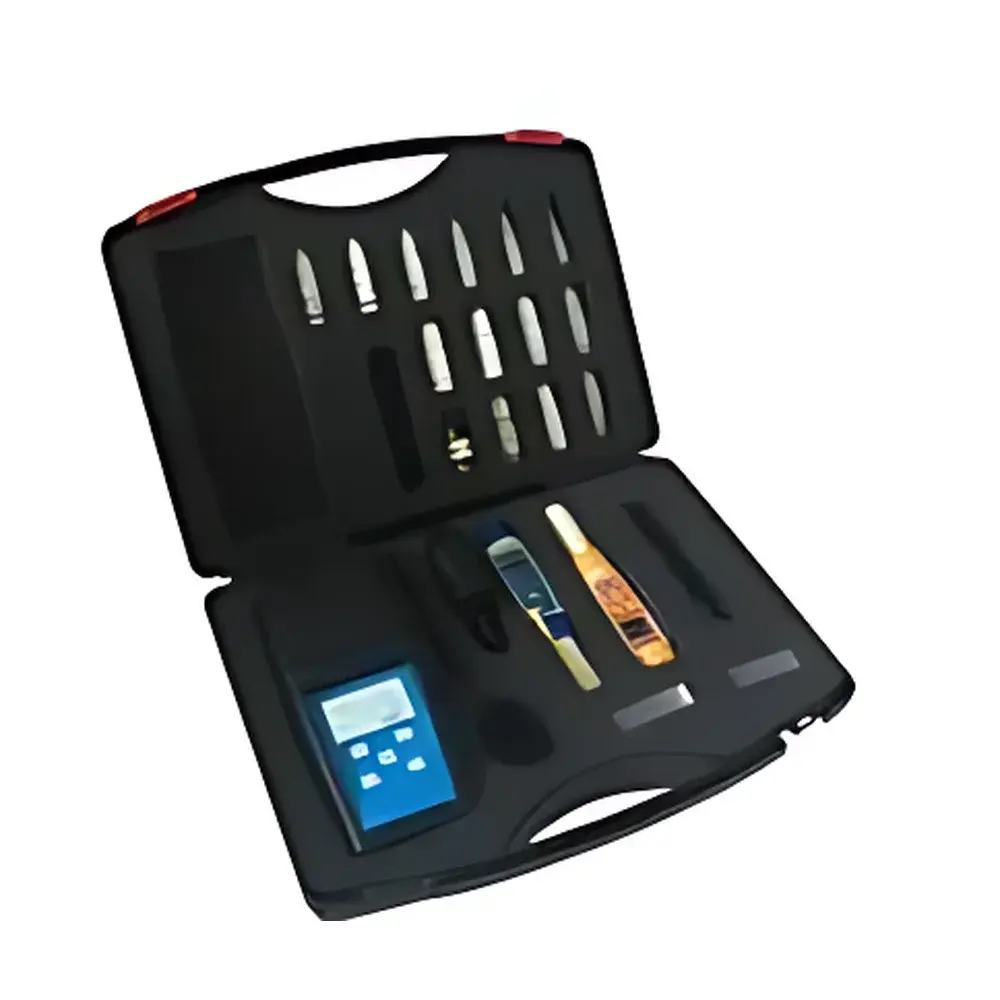
ZYKX-08 Portable 8-Parameter Aquaculture Water Quality Analyzer
| Brand | ZYKX |
|---|---|
| Origin | Beijing, China |
| Model | ZYKX-08 |
| Instrument Type | Portable/handheld water quality analyzer |
| Measured Parameters | pH, Nitrite (NO₂⁻), Hydrogen Sulfide (H₂S), Ammonia Nitrogen (NH₃-N), Dissolved Oxygen (DO), Temperature, Salinity, Residual Chlorine |
| Measurement Principle | Colorimetric (for NO₂⁻, NH₃-N, H₂S, residual chlorine) and electrochemical/optical probe-based (for DO, pH, temperature, salinity) |
| DO Range | 0–12 mg/L |
| pH Range | 0–14 |
| Temperature Range | 0–50 °C |
| Salinity Range | 0–50 ppt |
| Residual Chlorine Range | 0–2.5 mg/L |
| NH₃-N Range | 0–10 mg/L |
| NO₂⁻ Range | 0–0.3 mg/L |
| H₂S Range | 0–12 mg/L |
| DO Resolution | 0.001 mg/L |
| pH Resolution | 0.1 |
| Temperature Resolution | 0.1 °C |
| Salinity Resolution | 0.1 ppt |
| Repeatability | ≤2% |
| Accuracy | ±5% FS (full scale) |
| Power Supply | 4 × 1.5 V button cells |
| Housing | Anodized aluminum alloy |
| Compliance | Designed for field-deployable aquaculture monitoring per ISO 7027 (turbidity reference), ASTM D1293 (pH), ASTM D888 (DO), and EPA 365.3 (phosphate-free colorimetric methods) |
Overview
The ZYKX-08 Portable 8-Parameter Aquaculture Water Quality Analyzer is an integrated field instrument engineered for real-time, on-site assessment of critical water quality parameters in freshwater, brackish, and marine aquaculture systems. It combines dual measurement methodologies—precision colorimetry for chemical analytes (nitrite, ammonia nitrogen, hydrogen sulfide, and residual chlorine) and calibrated electrochemical/optical sensing for physical-chemical parameters (dissolved oxygen, pH, temperature, and salinity)—within a single ruggedized platform. The device operates on the principle of cold-light narrow-band interference filtration for colorimetric analysis, minimizing spectral interference and enhancing assay specificity under variable ambient lighting conditions typical of pond-side or vessel-based deployment. Its embedded microcontroller architecture enables fully automated measurement cycles, eliminating manual timing or reagent addition errors common in conventional test kits. Designed specifically for low-infrastructure environments, the ZYKX-08 delivers laboratory-grade data fidelity without reliance on external power grids or benchtop infrastructure.
Key Features
- Hybrid sensing architecture: Colorimetric cuvette-based detection for nitrite, ammonia nitrogen, hydrogen sulfide, and residual chlorine; combined with solid-state pH electrode, galvanic DO sensor, thermistor-based temperature probe, and conductivity-based salinity module.
- Field-optimized optical system: Cold LED light source with narrow-band interference filters (FWHM < 10 nm) ensures high photometric stability and resistance to ambient light drift during outdoor use.
- Ruggedized mechanical design: Anodized aluminum alloy housing (IP65-rated ingress protection) with no moving parts—engineered for shock, humidity, and salt-spray resistance in coastal and inland aquaculture settings.
- Intuitive human interface: Chinese-language LCD menu with minimal key navigation (4-button layout); icon-driven workflow guides users through calibration, measurement, and data review without prior technical training.
- Self-contained operation: Powered by four standard 1.5 V button cells (e.g., LR44), supporting >500 full-parameter measurement cycles per battery set; no AC adapter required for routine field use.
- Pre-calibrated sealed reagent tubes: Factory-preloaded, single-use colorimetric cuvettes minimize cross-contamination risk and eliminate volumetric pipetting errors—critical for consistent inter-operator reproducibility.
Sample Compatibility & Compliance
The ZYKX-08 accepts raw, unfiltered water samples from earthen ponds, recirculating aquaculture systems (RAS), hatchery tanks, and open-coast net pens. It is validated for use across salinity gradients from 0 to 50 ppt, enabling seamless transition between freshwater carp farming and marine shrimp cultivation. All colorimetric assays comply with foundational method principles referenced in EPA Method 365.3 (residual chlorine), ISO 15681-2 (phosphate-free nitrite determination), and APHA Standard Methods 4500-NH₃ F (ammonia nitrogen). Electrochemical sensors adhere to ASTM D1293 (pH), ASTM D888 (DO), and ISO 7888 (conductivity-based salinity). While not certified for regulatory submission under FDA 21 CFR Part 11, the instrument supports GLP-aligned operational practices—including user-defined calibration logs, date/time-stamped results, and non-erasable measurement history—facilitating internal QA/QC audits and farm-level recordkeeping per national aquaculture management guidelines.
Software & Data Management
Data output is limited to on-device storage (up to 200 measurement records with parameter values, timestamps, and operator ID tags) and manual transcription. No Bluetooth, USB, or cloud connectivity is integrated; this intentional design prioritizes reliability, electromagnetic immunity, and battery longevity in electromagnetically noisy farm environments (e.g., near aerators or feed dispensers). Measurement reports include full parameter sets per sample event, with automatic unit conversion (e.g., mg/L ↔ ppm for DO and Cl₂; ppt ↔ ‰ for salinity) and built-in error flags for out-of-range readings or low-battery warnings. Calibration status (pH offset, DO zero/span, colorimeter baseline) is retained in non-volatile memory and displayed at startup—ensuring traceability between field deployments.
Applications
- Daily health monitoring of intensive shrimp (Litopenaeus vannamei) and tilapia (Oreochromis niloticus) ponds, with emphasis on early detection of nitrite spikes (>0.1 mg/L) and hypoxic events (DO < 4 mg/L).
- Pre-release water quality verification in fish hatcheries, ensuring compliance with national stocking thresholds for ammonia nitrogen (<0.5 mg/L) and pH (6.5–8.5).
- Emergency response diagnostics during unexplained mortality events—simultaneous quantification of H₂S, NO₂⁻, and DO enables rapid root-cause hypothesis generation.
- Feed optimization support: Correlating diurnal DO/pH fluctuations with feeding schedules to adjust ration timing and reduce organic load.
- Regulatory self-monitoring for farms participating in ASC or GAP-certified supply chains, where documented water quality logs are required for annual certification renewal.
FAQ
What calibration standards are required for routine operation?
Factory pre-calibration covers all sensors; field recalibration uses ZYKX-certified buffer solutions (pH 4.01/7.00/10.01), DO zero solution (sodium sulfite), and salinity standard (5 ppt & 35 ppt KCl). Colorimetric modules require no user calibration—only periodic blank verification with deionized water.
Can the instrument measure seawater samples directly without dilution?
Yes. The salinity module is linearly validated up to 50 ppt, and all colorimetric chemistries are formulated for matrix tolerance across natural seawater ionic strength (≈45–55 g/kg total dissolved solids).
How often must the DO sensor membrane be replaced?
Under typical aquaculture use (≤2 hrs/day immersion), the galvanic DO probe membrane and electrolyte require replacement every 6 months or after 200 measurement cycles—whichever occurs first.
Is there a digital export option for measurement records?
No. Data must be manually recorded or photographed. This design eliminates firmware vulnerabilities, wireless interference risks, and battery drain associated with communication modules—prioritizing measurement integrity over connectivity.
Does the instrument meet ISO/IEC 17025 requirements for accredited testing?
No. It is intended for in-process monitoring and operational decision support—not for legally defensible analytical reporting. For accreditation-critical applications, lab-based ICP-OES or ion chromatography remains the reference standard.
Related Products







