
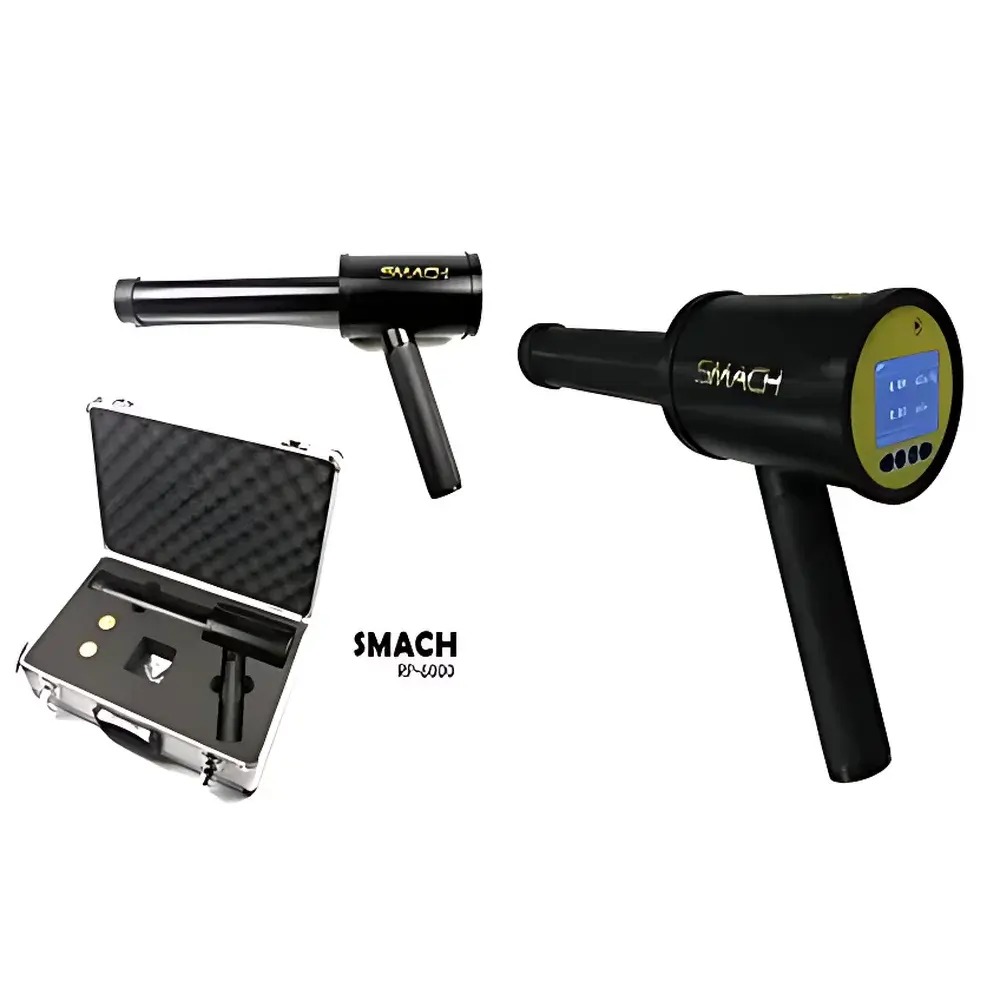
Zhonghe RP6000 Intelligent X- and γ-Ray Radiation Survey Meter
| Origin | Beijing, China |
|---|---|
| Manufacturer Type | Authorized Distributor |
| Origin Category | Domestic (China) |
| Model | RP6000 |
| Price Range | USD 700–1,400 |
| Instrument Class | Dose Rate / Integrated Dose Meter |
| Form Factor | Portable |
| Measured Medium | Ambient Air (Gas Phase) |
| Detector Type | NaI(Tl) Scintillation Crystal (φ30 × 25 mm) |
| Radiation Types | X-ray and Gamma-ray |
| Dose Rate Range | 0.01–200.00 µSv/h |
| Cumulative Dose Range | 0.00 µSv–9.99 Sv |
| Sensitivity | ≥350 CPS per µSv/h |
| Energy Response Range | 48 keV–3 MeV |
| Relative Accuracy | ≤±8% at 200.00 µSv/h |
| Measurement Duration | Adjustable from 5 to 120 seconds |
| Alarm Thresholds | User-Configurable for both dose rate and cumulative dose |
| Display Units | µSv/h (ambient dose equivalent rate), µGy/h (air kerma rate), µSv (cumulative dose), CPS (count rate) |
| Power Supply | Two D-size alkaline batteries |
| Power Consumption | ≤200 mW (excluding backlight) |
| Weight | 1.30 kg (including batteries) |
| Dimensions | 420 × 180 × 88 mm |
Overview
The Zhonghe RP6000 Intelligent X- and γ-Ray Radiation Survey Meter is a portable, microprocessor-controlled radiation monitoring instrument engineered for precise ambient dose equivalent (H*(10)) and air kerma rate measurement in occupational and environmental settings. It employs a high-efficiency thallium-doped sodium iodide (NaI(Tl)) scintillation detector (φ30 × 25 mm), optimized for photon detection across an energy range of 48 keV to 3 MeV—covering diagnostic X-ray, industrial gamma sources (e.g., 137Cs, 60Co), and natural background radiation. The device operates on the principle of scintillation photometry: incident photons interact with the crystal lattice, generating light pulses proportional to deposited energy; these are converted into electrical signals via a photomultiplier tube (PMT) or silicon photomultiplier (SiPM), digitized, and processed using pulse-height discrimination algorithms to ensure stable dose-rate estimation under varying spectral conditions. Designed for field-deployable use, the RP6000 meets fundamental requirements for radiological protection instrumentation per IEC 60846-1:2014 (Radiation protection instrumentation — Dose rate meters and ambient and/or directional dose equivalent (rate) meters for beta, X and gamma radiation) and supports routine compliance with national radiation safety regulations in industrial, medical, and environmental sectors.
Key Features
- High-sensitivity NaI(Tl) scintillation detector with ≥350 CPS/µSv/h response, enabling reliable low-level radiation detection down to 0.01 µSv/h.
- Wide dynamic dose rate range (0.01–200.00 µSv/h) and extended cumulative dose capacity (up to 9.99 Sv), suitable for both routine surveillance and emergency response scenarios.
- Energy-compensated response over 48 keV–3 MeV ensures minimal dependence on photon energy spectrum—critical for mixed-field environments such as nuclear medicine departments or NORM-contaminated sites.
- Real-time and programmable timed measurement modes (5–120 s intervals), supporting standardized survey protocols and time-weighted average assessments.
- Dual-alarm architecture: independent, user-definable thresholds for instantaneous dose rate and integrated dose, with audible, visual, and vibration alerts.
- Full-featured data logging: timestamped alarm events, dose history, and measurement records stored internally for post-survey audit and reporting.
- Bilingual (English/Chinese) menu interface with intuitive navigation, reducing operator training time and minimizing misconfiguration risk.
- Backlit color LCD display with adjustable brightness—optimized for daylight readability and low-light operation in confined or underground spaces.
- Rugged aluminum alloy housing (IP54-rated ingress protection), shock-absorbing design, and ergonomic form factor (1.30 kg) for extended handheld use in field surveys.
- Comprehensive self-diagnostic system: real-time battery voltage monitoring, detector fault detection, dose-rate overload warning, and low-power indication.
Sample Compatibility & Compliance
The RP6000 is calibrated for measurement in ambient air and does not require sample preparation or containment—making it ideal for direct environmental scanning, surface contamination screening (indirectly via airborne particulate assessment), and area monitoring. Its NaI(Tl) detector provides adequate sensitivity for detecting radionuclides commonly encountered in regulatory contexts, including 137Cs (662 keV), 60Co (1.17 & 1.33 MeV), 192Ir (300–612 keV), and natural uranium series emissions. While not a spectroscopic instrument, its energy response curve is validated against reference 137Cs and 60Co sources per ISO 4037-2:2019 (X and gamma reference radiation). The device supports GLP-aligned documentation workflows through exportable log files and satisfies functional prerequisites for routine radiation safety program implementation under national regulations aligned with IAEA Safety Standards Series No. GSR Part 3 and ICRP Publication 103 recommendations.
Software & Data Management
The RP6000 stores up to 2,000 measurement records—including dose rate, cumulative dose, timestamp, measurement duration, and alarm status—in non-volatile memory. Data can be retrieved via the onboard menu for immediate review or exported to PC via optional USB-to-serial adapter (not included). Exported CSV files contain ISO 8601 timestamps, SI units, and metadata required for traceable recordkeeping. Though no proprietary desktop software is bundled, the structured output format enables seamless integration with laboratory information management systems (LIMS), radiation safety databases, and Excel-based trending analysis. Audit trail functionality includes automatic logging of all parameter changes, alarm triggers, and calibration resets—supporting internal QA/QC reviews and readiness for regulatory inspections under frameworks requiring documented procedural control (e.g., ISO/IEC 17025, ANSI N42.22).
Applications
- Radiation protection surveys in hospitals (radiology, nuclear medicine, radiotherapy bunkers), including leakage testing and controlled area boundary verification.
- Environmental monitoring around nuclear facilities, uranium mining sites, and legacy waste disposal zones per national environmental radiation monitoring guidelines.
- Industrial radiography safety oversight—verifying shielding integrity and personnel exposure during pipeline or weld inspection operations.
- Emergency response deployment by civil defense or nuclear regulatory authorities during radiological incidents or orphan source recovery.
- Academic and research laboratories conducting low-activity experiments involving sealed gamma sources or X-ray generators.
- Regulatory compliance audits in metallurgy, oil & gas (NORM/TENORM assessment), and recycling industries handling contaminated scrap metal.
FAQ
Is the RP6000 suitable for measuring alpha or beta radiation?
No. The instrument is optimized for X- and gamma-ray photons only. Alpha and beta particles are fully attenuated by the detector housing and cannot be detected. For beta/gamma mixed fields, additional thin-window probes are required.
Does the RP6000 meet international calibration traceability standards?
Yes. The unit is factory-calibrated using 137Cs and 60Co reference sources traceable to national metrology institutes (e.g., NIM China). Users must perform periodic verification per local regulatory guidance (e.g., annual check against a secondary standard).
Can the alarm thresholds be locked to prevent unauthorized modification?
No hardware lock is provided; however, password-protected configuration mode is available in firmware version 2.1+, restricting access to critical parameters during field use.
What is the typical battery life under continuous operation?
With backlight disabled and average measurement frequency (one reading per minute), two D-cell alkaline batteries provide ≥1,200 hours of operational time—approximately six months of typical field use.
Is firmware upgrade supported?
Yes. Firmware updates are delivered via serial interface using manufacturer-provided utility software and require connection to a Windows PC. Updates include enhanced energy compensation algorithms and expanded logging capacity.







