
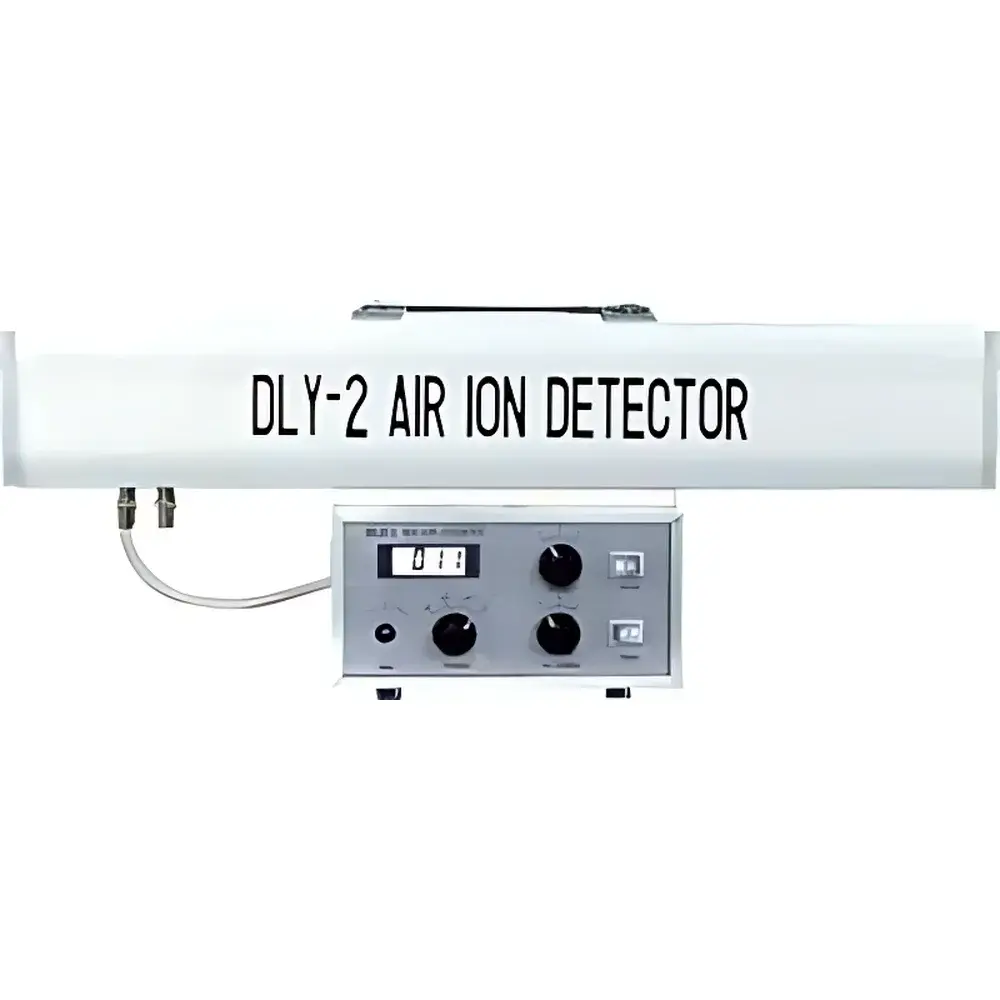
DLY-2 Air Negative Ion Concentrator Analyzer
| Origin | Beijing, China |
|---|---|
| Manufacturer Type | Authorized Distributor |
| Origin Category | Domestic (PRC) |
| Model | DLY-2 |
| Pricing | Upon Request |
| Ion Concentration Range | 10–1.999×10⁹ ions/cm³ |
| Minimum Resolution | 10 ions/cm³ |
| Ion Mobility Ranges | 0.15, 0.04, and 0.004 cm²/V·s (3-step selection) |
| Air Sampling Velocity | 180 cm/s or 35 cm/s (dual-mode) |
| Response Time Constant | ≈15 s |
| Measurement Accuracy | ±10% for ion concentration |
| Power Supply | DC 12 V (rechargeable sealed lead-acid battery) or AC 220 V (50 Hz) |
| Operating Environment | −0 to +40 °C |
| Compliance | GB/T 18809–2002 |
Overview
The DLY-2 Air Negative Ion Concentrator Analyzer is a precision electrostatic detection instrument engineered for quantitative measurement of unipolar and bipolar air ions—including small, medium, and large ions—in ambient and controlled environments. It operates on the well-established parallel-plate air ion collector principle originally advanced by Dr. Beckett and refined through Wesix methodology. The core sensing element is a proprietary gold-plated ion collector, which ensures high charge transfer efficiency (>92% theoretical yield under standard conditions), low surface recombination loss, and long-term electrochemical stability. Ion migration is resolved via selectable mobility ranges—0.15, 0.04, and 0.004 cm²/V·s—enabling discrimination between ion classes based on atmospheric mobility spectra. Air is drawn at precisely regulated velocities (180 cm/s for high-flow environmental surveys; 35 cm/s for low-turbulence indoor or chamber applications), minimizing boundary layer distortion and ensuring representative sampling. The analyzer outputs real-time ion density in units of ions per cubic centimeter (ions/cm³), displayed directly on a high-contrast LCD interface with no post-processing required.
Key Features
- Triple-range ion mobility selector (0.15 / 0.04 / 0.004 cm²/V·s) for differentiated classification of small, medium, and large air ions
- Gold-coated parallel-plate collector with optimized electrode geometry and surface passivation for enhanced charge collection efficiency and reduced drift
- Dual-mode airflow control: 180 cm/s for outdoor/field deployment; 35 cm/s for laboratory-grade stability in low-velocity settings
- High-resolution detection limit of 10 ions/cm³ across the full dynamic range (10–1.999×10⁹ ions/cm³)
- Robust thermal and humidity tolerance: functional operation up to 90% RH; short-term exposure supported beyond this threshold
- Integrated sealed lead-acid power system (DC 12 V) compatible with AC 220 V mains or automotive 12 V sources—designed for extended field autonomy
- Lightweight, anodized aluminum chassis (IP54-rated enclosure) providing mechanical rigidity, EMI shielding, and corrosion resistance
Sample Compatibility & Compliance
The DLY-2 is validated for direct measurement of naturally occurring and artificially generated air ions in diverse matrices—including forest canopies, urban atmospheres, indoor HVAC environments, therapeutic ionizer output streams, and cleanroom ventilation ducts. It conforms strictly to the Chinese National Standard GB/T 18809–2002, “Method for Measuring Air Ion Concentration”, which specifies calibration traceability to NIM (National Institute of Metrology, PRC)-certified reference ion generators and defines operational protocols for mobility-selective counting. While not certified to ISO 16000-27 or ASTM D8192, its design principles align with internationally accepted electrostatic collection theory and is routinely deployed in GLP-compliant academic and public health research workflows where documented repeatability and inter-laboratory comparability are required.
Software & Data Management
The DLY-2 operates as a standalone, embedded-system instrument with no external software dependency. All measurements are rendered in real time on the integrated LCD display, showing instantaneous ion density, selected mobility mode, sampling velocity, and battery status. Data logging is manual via operator-recorded timestamped readings. For integration into automated monitoring networks, optional RS-232 or TTL-level serial output (available via accessory interface module) supports ASCII-formatted data streaming at 1 Hz update rate. Raw output includes ion count, mobility setting identifier, and internal temperature reading—enabling post-hoc correction using empirically derived temperature compensation coefficients published in peer-reviewed literature (e.g., Journal of Aerosol Science, Vol. 42, 2011). No proprietary drivers or cloud services are involved; all data remains under full user control.
Applications
- Atmospheric electricity and aerosol science research—quantifying ion production rates, attachment kinetics, and cluster formation dynamics
- Evaluation of negative ion generator performance in medical device validation and wellness product development
- Environmental impact assessment of green infrastructure (e.g., urban forests, waterfalls, coastal zones) on local ion balance
- Indoor air quality auditing in hospitals, schools, and office buildings—correlating ion concentrations with VOC levels and particulate load
- Calibration reference for secondary ion sensors and portable electrostatic monitors used in regulatory field surveys
- University teaching labs for hands-on instruction in gaseous ion physics, atmospheric electrodynamics, and sensor metrology
FAQ
What ion mobility ranges does the DLY-2 support, and how are they selected?
The instrument provides three discrete mobility settings—0.15, 0.04, and 0.004 cm²/V·s—selected manually via front-panel toggle switch. Each corresponds to a distinct electric field gradient and residence time configuration optimized for small (mobility >0.1 cm²/V·s), medium (0.01–0.1 cm²/V·s), and large ions (<0.01 cm²/V·s).
Is the DLY-2 suitable for continuous unattended operation?
Yes, when powered by AC 220 V or connected to a regulated 12 V DC source, the unit supports 24/7 operation. Battery runtime under DC-only mode is approximately 8–10 hours at 35 cm/s sampling velocity.
Does the instrument require periodic recalibration?
Per GB/T 18809–2002, annual verification against a certified ion source is recommended. Field zero-checking using filtered air (HEPA + activated carbon) is advised before each measurement session.
Can the DLY-2 measure positive and negative ions simultaneously?
No—it measures one polarity per acquisition cycle. Polarity is selected via hardware polarity reversal switch; sequential positive/negative runs are required for net charge analysis.
What is the minimum detectable ion concentration, and how is it verified?
The specified resolution is 10 ions/cm³, confirmed during factory acceptance testing using monodisperse ion aerosols generated from a calibrated ²¹⁰Po source under laminar flow conditions.







