
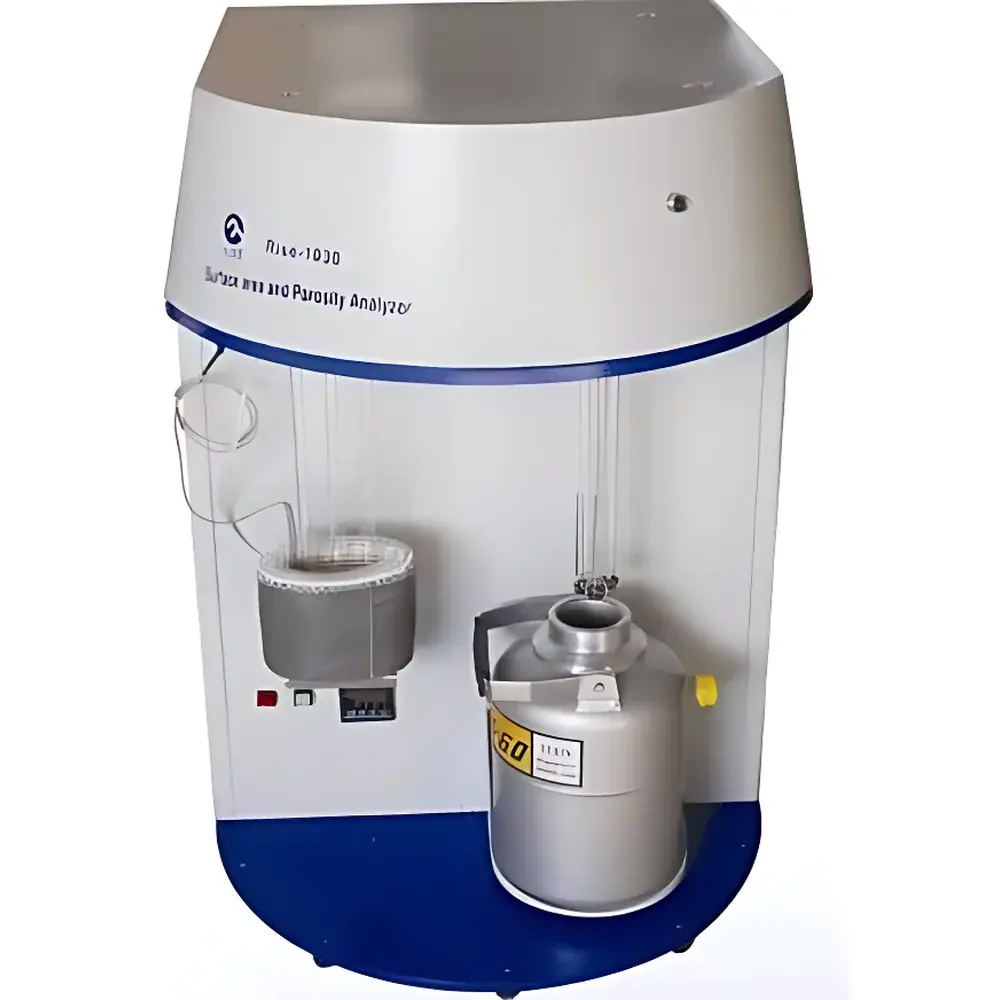
Rise-1001 Automated Specific Surface Area and Pore Size Analyzer
| Origin | Beijing, China |
|---|---|
| Manufacturer Type | Authorized Distributor |
| Origin Category | Domestic (China) |
| Model | Rise-1001 |
| Pricing | Available Upon Request |
Overview
The Rise-1001 Automated Specific Surface Area and Pore Size Analyzer is a research-grade instrument engineered for high-precision characterization of porous and powdered materials using the static volumetric gas adsorption method at cryogenic temperature (77 K). It operates in strict compliance with ISO 9277 (BET surface area), ISO 15901 (pore size distribution), and GB/T 19587 (Chinese national standard for nitrogen adsorption), ensuring metrological traceability and interlaboratory reproducibility. The system quantifies gas adsorption/desorption isotherms by measuring pressure differentials in a calibrated, ultra-high-vacuum manifold following controlled dosing of high-purity nitrogen. Adsorbed quantity is derived from mass balance calculations under equilibrium conditions, enabling rigorous application of theoretical models—including BET, Langmuir, BJH, t-plot, DFT, and Monte Carlo—to extract quantitative textural parameters.
Key Features
- Modular all-stainless-steel vacuum manifold with leak-tight, low-outgassing architecture—designed to minimize dead volume and eliminate contamination pathways common in multi-joint conventional systems.
- Dual-stage vacuum system comprising a primary rotary vane pump and either a diffusion pump or turbomolecular pump, achieving a base pressure of ≤1.0 × 10⁻⁶ Torr—essential for accurate low-pressure (<10−5 P/P0) monolayer and micropore analysis.
- Triple-range, high-stability absolute pressure sensing: three imported piezoresistive transducers covering 0–120 kPa (0.1% FS), 0–1 kPa (0.1% FS), and 0–100 Pa (0.1% FS); plus PT-100 temperature sensor (±0.1 °C) for thermal stabilization.
- Proprietary metal Dewar flask (2.0 L capacity) with optimized internal geometry, sustaining stable liquid nitrogen bath conditions for >150 hours without refilling—eliminating thermal drift and mechanical fragility associated with glass Dewars.
- 22-bit analog-to-digital conversion for pressure acquisition, supporting sub-Pa resolution across full dynamic range and enabling robust statistical treatment of low-coverage data points.
- Fully automated isotherm acquisition: computer-controlled gas dosing, equilibration timing, pressure monitoring, and valve sequencing—no manual intervention required during measurement cycles.
Sample Compatibility & Compliance
The Rise-1001 accommodates standard 6–10 mm OD sample tubes and supports pretreatment protocols including vacuum heating (up to 350 °C) and inert gas purging. It is validated for use with catalysts, zeolites, MOFs, activated carbons, silica gels, alumina, clays, soils, and pharmaceutical excipients. Data integrity meets GLP/GMP-aligned workflows: audit-trail-enabled software logs all user actions, parameter changes, and calibration events. While not pre-certified for FDA 21 CFR Part 11, the system architecture supports implementation of electronic signature and record retention policies required for regulated environments. All reported outputs conform to ISO/IEC 17025 documentation practices when paired with accredited laboratory procedures.
Software & Data Management
The proprietary analysis suite provides integrated isotherm acquisition, baseline correction, and model-based interpretation. Supported theoretical frameworks include single-point and multi-point BET (with linear regression diagnostics), Langmuir monolayer capacity, BJH desorption branch analysis for meso/macropores (2–50 nm), t-plot and αs-plot for micropore volume/surface area, DA and HK methods for narrow micropore distribution (<2 nm), and advanced non-local density functional theory (NLDFT) and grand canonical Monte Carlo (GCMC) kernels for slit/cylindrical/heterogeneous pore geometries. Raw isotherms and derived parameters export directly to Excel-compatible CSV files; PDF reports include annotated isotherms, model fit residuals, cumulative/micro-pore distributions, and summary tables compliant with journal submission standards (e.g., Microporous and Mesoporous Materials, Journal of Colloid and Interface Science).
Applications
This analyzer serves core R&D and QC functions across heterogeneous catalysis, energy storage (battery electrodes, hydrogen sorbents), environmental science (soil porosity, contaminant adsorption), pharmaceutical solid-state characterization (excipient surface area, tablet compaction behavior), and nanomaterial synthesis validation. Typical use cases include: verifying MOF activation completeness via micropore volume recovery; correlating catalyst support surface area with metal dispersion; assessing thermal stability of mesoporous silica templates; quantifying aging-induced pore collapse in fluid cracking catalysts; and benchmarking carbon black surface area against ASTM D3037 specifications.
FAQ
What adsorption theory models are natively supported?
BET (single- and multi-point), Langmuir, BJH (mesopore), t-plot/αs-plot (micropore), Dubinin–Astakhov, Horvath–Kawazoe, NLDFT, and GCMC—each with user-selectable kernel libraries for carbon, silica, and alumina surfaces.
Is remote diagnostic support available?
Yes—the instrument includes secure, opt-in remote maintenance capability via encrypted VNC tunnel, enabling real-time troubleshooting and software updates without on-site service calls.
Can multiple samples be processed sequentially without operator input?
The system handles one analysis per cycle, but up to six samples can be pre-loaded and degassed in parallel using the integrated sample preparation station; automated transfer to the analysis port is not included in the base configuration.
What vacuum level is required for reliable micropore analysis?
A base pressure ≤1.0 × 10⁻⁶ Torr is mandatory to resolve adsorption below P/P0 = 10−6; the Rise-1001 achieves this consistently using its dual-pump architecture and all-metal sealed manifold.
Does the software comply with regulatory data integrity requirements?
While the software does not ship with out-of-the-box 21 CFR Part 11 validation packages, its audit trail, electronic logbook, and immutable raw data storage architecture provide the foundational controls necessary for laboratory-developed validation under ISO 17025 or internal QA protocols.



