
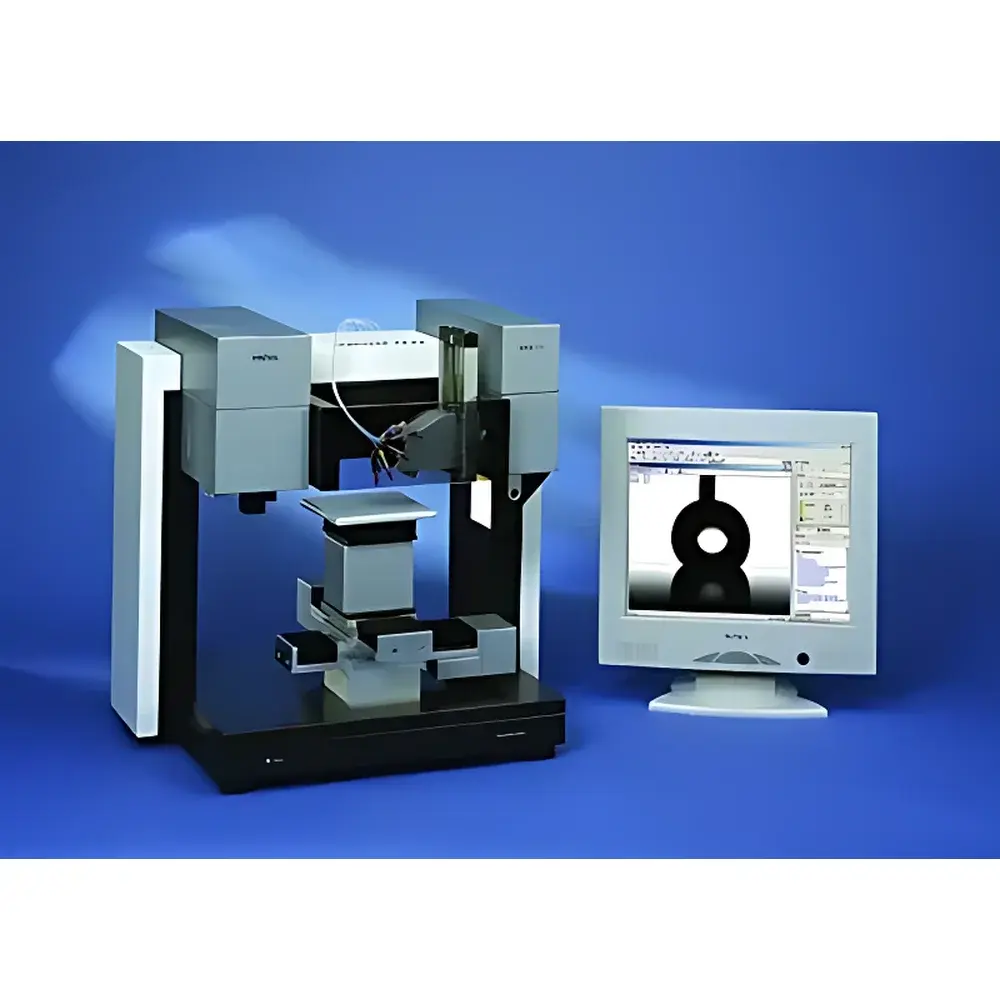
Krüss DSA100 Video-Based Optical Contact Angle Analyzer
| Origin | Germany |
|---|---|
| Manufacturer Type | Authorized Distributor |
| Origin Category | Imported Instrument |
| Model | DSA100 |
| Instrument Type | Benchtop Laboratory System |
| Contact Angle Measurement Range | 0–180° |
| Contact Angle Resolution | ±0.01° |
| Contact Angle Accuracy | 0.1° |
| Sample Stage Dimensions | 300 × 150 mm (standard), extendable to 500 × 48 mm |
| Optical Magnification | 0.7× (adjustable via zoom lens |
| FOV diagonal | 1.6–11 mm) |
| Surface/Interfacial Tension Measurement Range | 0.01–1000 mN/m |
| Surface/Interfacial Tension Resolution | 0.01 mN/m |
| High-Speed Camera Options | 60 fps (standard), up to 1000 fps (optional), customizable to 10,000+ fps |
| Temperature Control Range (Peltier) | –30 to +160 °C |
| Extended Thermal Stage (TC21) | –60 to +400 °C |
| Humidity Control Chamber | 5–95% RH |
| Automated Sample Handling | Up to 8 positions |
| Software Analysis Methods | Sessile Drop, Tilting Plate, Pendant Drop, Oscillating Drop, Single-Fiber Mode |
| Surface Energy Calculation Models | Owens-Wendt-Rabel, van Oss-Chaudhury-Good, Fowkes, Extended Fowkes, Wu, Zisman, Neumann |
Overview
The Krüss DSA100 is a modular, high-precision video-based optical contact angle analyzer engineered for rigorous surface and interfacial property characterization in research laboratories and industrial quality control environments. It operates on the principle of digital image analysis of liquid droplets deposited on solid substrates—leveraging high-resolution imaging, calibrated optics, and pixel-level edge detection algorithms to determine contact angle with sub-degree resolution. The system supports multiple measurement methodologies—including static sessile drop, dynamic advancing/receding angles via tilting stage, pendant drop for interfacial tension, oscillating drop for interfacial rheology, and specialized single-fiber mode—enabling quantitative evaluation of wettability, surface heterogeneity, and interfacial viscoelasticity. Designed and manufactured in Germany by KRÜSS GmbH, the DSA100 complies with metrological best practices aligned with ISO 19403 (Contact angle measurement), ASTM D7334 (Surface wettability of coatings), and ISO 14782 (Determination of surface free energy). Its architecture supports full traceability, audit-ready data logging, and integration into GLP/GMP-compliant workflows when paired with validated software configurations.
Key Features
- Modular hardware platform permitting incremental automation upgrades—from manual positioning to fully motorized XYZ sample stages and multi-position auto-samplers.
- Patented optical alignment system enabling real-time adjustment of observation angle without mechanical repositioning of camera or light source.
- Motorized micro-adjustment of syringe position independent of sample stage, minimizing cross-contamination during sequential measurements.
- High-intensity, low-thermal LED illumination with stray-light suppression optics and automatic vignetting correction for consistent contrast across entire field of view.
- Integrated Peltier-controlled temperature stage (–30 to +160 °C) with rapid thermal equilibration (< 1 K/min stability) and optional extended-range TC21 heating/cooling module (–60 to +400 °C).
- Humidity-controlled environmental chamber (5–95% RH) for studies under defined atmospheric conditions, critical for hygroscopic or ambient-sensitive materials.
- Software-configurable acquisition triggers synchronized with motorized dispensing, stage movement, and environmental parameter logging.
- Expandable sample handling: standard 300 × 150 mm stage; optional large-format support (up to 500 × ∞ × 48 mm); electrically actuated silicon wafer stage for 8-inch and 12-inch semiconductor substrates.
Sample Compatibility & Compliance
The DSA100 accommodates diverse sample geometries and material classes—including flat films, porous membranes, fibers (down to 5 µm diameter), powders (via powder dispersion method), rough or curved surfaces, and temperature-sensitive polymers. Its open-stage design permits direct mounting of custom fixtures, electrochemical cells, or in situ reaction chambers. All measurement protocols adhere to internationally recognized standards: contact angle results are traceable to NIST-traceable reference liquids (e.g., water, diiodomethane, ethylene glycol); surface energy calculations implement peer-reviewed thermodynamic models (Owens-Wendt, van Oss-Chaudhury-Good) with uncertainty propagation reporting. For regulated industries, the system supports 21 CFR Part 11–compliant electronic signatures, role-based access control, and immutable audit trails when deployed with Krüss’s validated DSA4 software suite.
Software & Data Management
Krüss DSA4 software provides a unified interface for instrument control, image acquisition, automated analysis, and report generation. It implements six distinct contact angle calculation algorithms—including ellipse fitting, tangent fitting, Young-Laplace curve fitting, and baseline-free dynamic methods—each selectable per measurement sequence. Surface tension is derived from pendant drop shape analysis using numerical solutions of the Young-Laplace equation. The software includes programmable measurement sequences (e.g., time-resolved contact angle decay, cyclic tilt experiments), batch processing for multi-sample datasets, and export of raw images, metadata, and processed values in CSV, PDF, and XML formats. All data files embed EXIF-like headers containing instrument configuration, calibration timestamps, environmental parameters, and operator ID—ensuring full experimental reproducibility and regulatory compliance.
Applications
- Quantitative assessment of plasma, corona, flame, or chemical surface treatments in polymer and metal finishing.
- Adhesion prediction and formulation optimization in adhesive, ink, and coating development.
- Surface purity verification of medical device substrates and pharmaceutical excipients via contact angle hysteresis analysis.
- Wettability screening of filtration membranes, battery separators, and catalyst supports.
- Interfacial rheology characterization of surfactant-laden oil-water interfaces using oscillating drop methodology.
- Dynamic wetting behavior of textile fibers and nonwovens under controlled humidity and temperature.
- Quality assurance of semiconductor wafers, including hydrophobic/hydrophilic patterning validation and cleaning process monitoring.
FAQ
What measurement methods does the DSA100 support?
Sessile drop, tilting plate (advancing/receding contact angle), pendant drop (surface/interfacial tension), oscillating drop (interfacial dilatational rheology), and single-fiber contact angle measurement.
Can the DSA100 measure contact angles on rough or heterogeneous surfaces?
Yes—through advanced baseline detection algorithms, multi-point contact line analysis, and optional curvature-adaptive fitting routines that account for local topography-induced distortion.
Is the system compatible with Good Manufacturing Practice (GMP) requirements?
When configured with DSA4 software in validated mode, it supports electronic signatures, audit trail logging, user access levels, and data integrity controls compliant with FDA 21 CFR Part 11 and EU Annex 11.
What is the maximum sample height accommodated by the standard stage?
The standard stage accepts samples up to 150 mm in height; optional elevated Z-axis extension kits increase vertical clearance to 300 mm.
Does Krüss provide calibration services and certified reference standards?
Yes—Krüss offers factory calibration certificates traceable to PTB (Physikalisch-Technische Bundesanstalt) and distributes NIST-traceable contact angle reference slides and surface tension standard liquids.



