
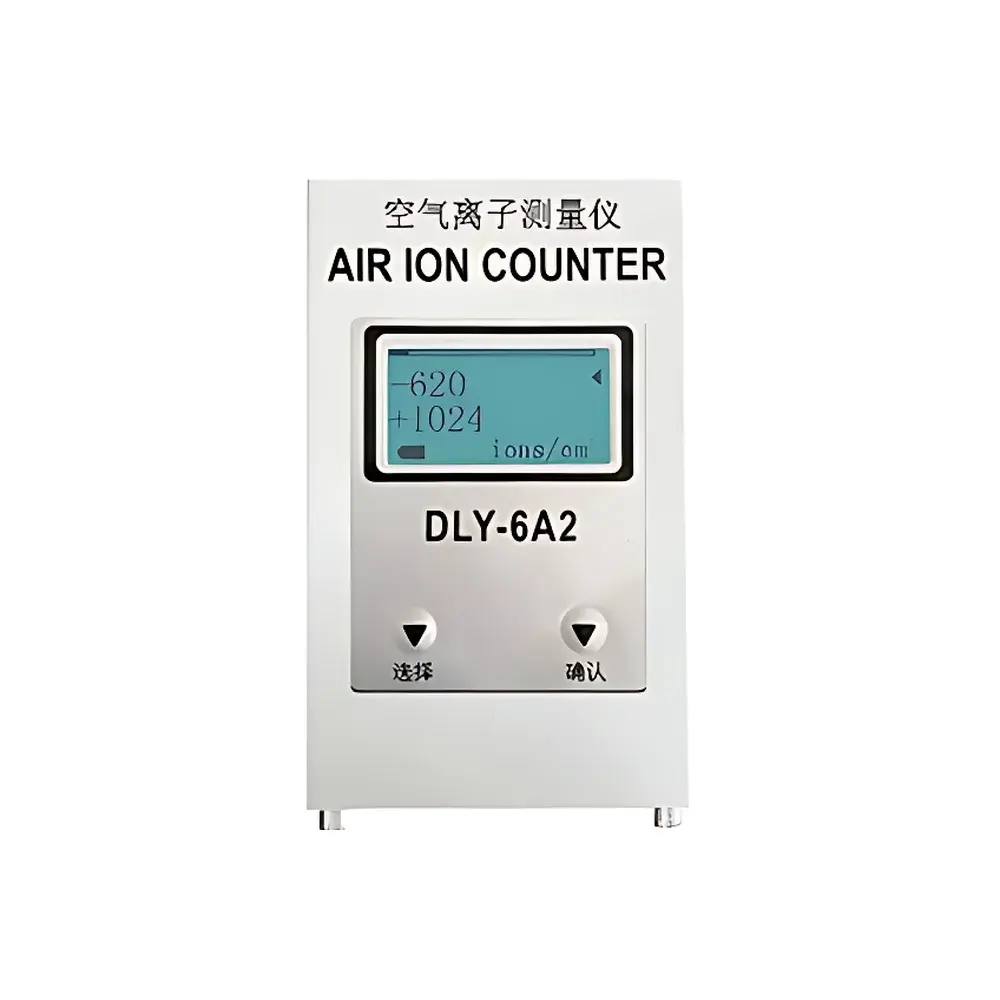
DLY-6A2 Intelligent Air Ion Analyzer
| Origin | Beijing, China |
|---|---|
| Manufacturer Type | Authorized Distributor |
| Origin Category | Domestic (PRC) |
| Model | DLY-6A2 |
| Price Range | USD 1,400 – 2,800 |
| Measurement Range | 1–1.5×10⁶ ions/cm³ |
| Polarity Detection | Positive and/or Negative Ions |
| Resolution | 2 ions/cm³ |
| Measurement Cycle | 60 seconds |
| Selectable Modes | Negative Ion Only / Positive Ion Only / Bipolar (Simultaneous ±) |
| Ion Mobility | 0.4 cm²/(V·s) |
| PC Connectivity | USB-to-Serial (CP210x VCP Driver), Windows XP/7/8/10 Compatible |
| Data Output | Real-time & Averaged Values, Time-Series Curve Plotting, Local Disk Storage (CSV/Proprietary Binary) |
Overview
The DLY-6A2 Intelligent Air Ion Analyzer is a precision electrostatic detection instrument engineered for quantitative measurement of small air ions—specifically unipolar or bipolar gaseous ions in ambient environments. It operates on the principle of Gerdien tube aspiration electrophoresis: ambient air is drawn through a cylindrical collector electrode at a controlled flow rate, where ions of defined mobility (0.4 cm²/(V·s)) are selectively deposited under a stabilized DC electric field. The resulting ion current is converted to concentration via calibrated amplification and digital signal processing, yielding values in ions per cubic centimeter (ions/cm³). Designed for field-deployable environmental monitoring, the DLY-6A2 delivers trace-level sensitivity (2 ions/cm³ resolution) and stable operation across variable temperature and humidity conditions typical of outdoor parks, forested zones, indoor wellness spaces, and urban air quality assessment sites.
Key Features
- Auto-ranging measurement capability from 1 to 1.5 × 10⁶ ions/cm³—no manual range switching required during dynamic environmental transitions
- Three operational modes: negative-ion-only, positive-ion-only, and simultaneous bipolar acquisition—enabling comparative analysis of ion balance (e.g., α-ratio)
- Fixed ion mobility filter (0.4 cm²/(V·s)), compliant with ISO 16000-30:2022 Annex B guidelines for small air ion characterization
- 60-second standardized measurement cycle—aligned with recommended averaging intervals for statistical representativeness in atmospheric ion studies
- Integrated microprocessor-controlled aspiration system with thermal compensation for volumetric flow stability
- USB-based communication interface utilizing Silicon Labs CP210x virtual COM port drivers—fully compatible with 32-bit and 64-bit Windows platforms (XP through Windows 10)
Sample Compatibility & Compliance
The DLY-6A2 is intended for direct sampling of ambient air without pre-filtration or conditioning. It is not designed for aerosol-laden or high-particulate environments (>10⁵ particles/m³) without optional inlet filtration. The instrument meets electromagnetic compatibility (EMC) requirements per GB/T 18268.1–2010 (equivalent to IEC 61326-1) for laboratory and field use. While not certified for regulatory compliance reporting under EPA, EU Air Quality Directive (2008/50/EC), or WHO guidelines, its measurement methodology aligns with research-grade protocols cited in peer-reviewed literature (e.g., Journal of Aerosol Science, Atmospheric Environment). Calibration verification is performed using a traceable radioactive source (²¹⁰Po) or electrometer-based reference standard prior to deployment.
Software & Data Management
The KT.exe desktop application provides full bidirectional control and archival functionality. Upon establishing serial communication, users can remotely configure measurement duration, polarity selection, and data logging interval. All acquired datasets are stored locally in dual formats: real-time point values (1 Hz equivalent) and user-defined time-averaged records (e.g., 1-, 5-, or 10-minute means). Data export supports CSV for third-party statistical analysis (e.g., Python pandas, MATLAB, R). The software implements basic audit trail features—including timestamped parameter changes and connection/disconnection logs—supporting GLP-aligned documentation practices. No cloud synchronization or remote access capabilities are included; all data remains resident on the host PC, ensuring data sovereignty and alignment with institutional IT security policies.
Applications
- Ecological monitoring: Quantifying negative ion enhancement in forest canopies, waterfalls, and coastal zones for biometeorological correlation studies
- Indoor environmental quality (IEQ) assessment: Evaluating ion generation efficacy of HVAC-integrated ionizers and portable air purifiers
- Occupational hygiene: Screening ion imbalances in enclosed workspaces (e.g., server rooms, cleanrooms, printing facilities) linked to static charge accumulation
- Educational laboratories: Teaching fundamental principles of atmospheric electricity, gas-phase ion chemistry, and electrostatic instrumentation
- Wellness infrastructure validation: Supporting evidence-based design of therapeutic environments (e.g., spa centers, rehabilitation clinics)
FAQ
What ion mobility does the DLY-6A2 use, and why is it fixed at 0.4 cm²/(V·s)?
The instrument employs a fixed-mobility collector optimized for small air ions (diameter < 1.6 nm), consistent with the most prevalent naturally occurring cluster ions (e.g., CO₃⁻·(H₂O)ₙ, NO₃⁻·(H₂O)ₙ). This value complies with ISO 16000-30’s recommended mobility window for standardized environmental ion assessment.
Can the DLY-6A2 measure heavy ions or charged aerosols?
No. Its design excludes ions with mobility below ~0.05 cm²/(V·s), effectively filtering out intermediate and large ions associated with submicron particles. It is not a particle counter nor an SMPS-compatible mobility analyzer.
Is firmware upgrade supported?
Firmware updates are provided exclusively by the authorized distributor and require physical connection and proprietary utility—no over-the-air or user-accessible bootloader interface is implemented.
Does the device meet FDA 21 CFR Part 11 requirements?
No. The DLY-6A2 and KT.exe software lack electronic signature, role-based access control, and immutable audit trail features required for regulated pharmaceutical or clinical applications.
What maintenance is required for long-term accuracy?
Annual verification against a NIST-traceable ion source or certified electrometer is recommended. The collector electrode should be cleaned with isopropyl alcohol every 3–6 months in high-dust environments; no consumables or recalibration kits are shipped with the base unit.
Related Products







