
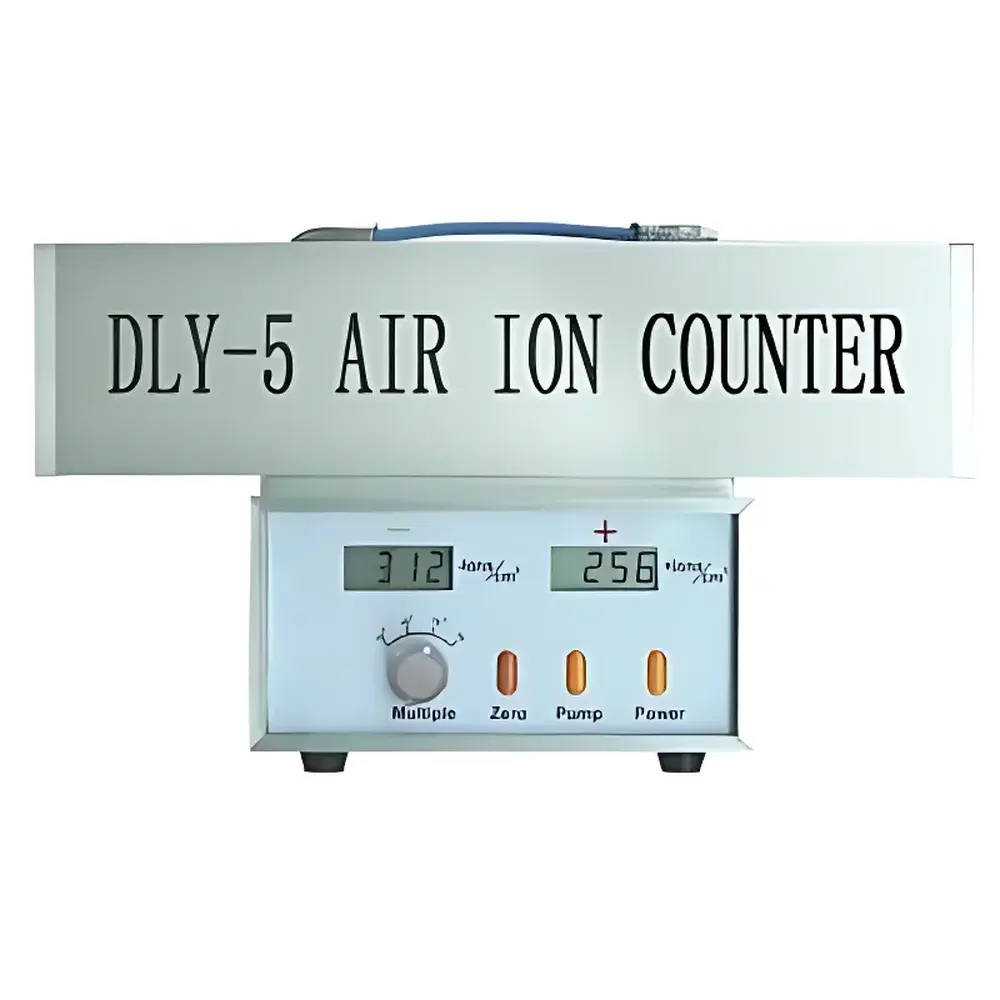
DLY-5 Air Negative Ion Concentration Analyzer
| Origin | Beijing |
|---|---|
| Manufacturer Type | Distributor |
| Origin Category | Domestic |
| Model | DLY-5 |
| Pricing | Upon Request |
Overview
The DLY-5 Air Negative Ion Concentration Analyzer is a precision electrostatic detection instrument engineered for quantitative measurement of small and medium-sized air ions—primarily negative ions—in ambient and controlled environments. It operates on the principle of parallel-plate air ion collection, where charged particles are drawn into a defined electric field and deposited onto a gold-plated collector electrode. The resulting ion current is converted to concentration values (ions/cm³) using calibrated amplification and compensation algorithms. Designed in accordance with internationally recognized methodologies—including those referenced in ISO 16000-23 (Indoor air — Part 23: Determination of air ion concentrations) and aligned with measurement protocols used by NIST-traceable reference laboratories—the DLY-5 ensures metrological consistency with global research-grade instrumentation. Its dual-channel detection architecture enables simultaneous acquisition of both positive and negative ion concentrations, supporting ratio analysis critical for evaluating air ion balance, corona discharge efficiency, or therapeutic environmental assessments.
Key Features
- Gold-plated Wesix-type parallel-plate ion collector for high charge transfer efficiency (>98%) and long-term stability under variable humidity conditions
- Dual independent LCD displays showing real-time positive and negative ion concentrations side-by-side, facilitating instantaneous polarity ratio calculation
- Automatic zero-point compensation system that eliminates baseline drift during extended field deployments or temperature fluctuations
- Wide dynamic detection range: 10 to 1.999 × 10⁹ ions/cm³, with a minimum detectable resolution of 10 ions/cm³
- Mobility-selective sampling with effective ion mobility of 0.15 cm²/V·s—optimized for small ions (diameter < 1.6 nm) relevant to atmospheric chemistry and human exposure studies
- Integrated rechargeable lithium battery pack, compatible with both 220 V AC mains and 12 V DC automotive power sources; smart charging circuitry prevents overcharge and thermal degradation
- Robust anodized aluminum alloy chassis (IP54-rated ingress protection), lightweight (<1.8 kg), and ergonomically designed for handheld or tripod-mounted operation indoors and outdoors
Sample Compatibility & Compliance
The DLY-5 is validated for use in ambient air, indoor spaces (offices, hospitals, wellness centers), forested and mountainous microclimates, and near ion-generating devices such as corona-based air purifiers or waterfall simulation systems. It does not require sample filtration or pre-conditioning, enabling direct real-time monitoring. While not certified for regulatory compliance reporting under EPA Method TO-15 or EU Directive 2008/50/EC, its measurement traceability aligns with GLP-aligned laboratory practices. Instrument calibration follows manufacturer-recommended procedures using standardized radioactive ²¹⁰Po sources or electrospray-generated monodisperse ion aerosols traceable to national metrology institutes. Data outputs conform to SI unit conventions and support export to CSV for post-processing in MATLAB, Python (Pandas), or Excel-based QA/QC workflows.
Software & Data Management
The DLY-5 operates as a standalone field instrument without embedded firmware-based data logging. However, analog voltage outputs (0–5 V DC proportional to log₁₀[ion concentration]) are provided for integration with external DAQ systems (e.g., National Instruments USB-6009, LabJack T7). Optional RS-232 serial interface (TTL-level) supports ASCII command protocol for remote triggering, mode switching, and snapshot retrieval. All measurements adhere to ALCOA+ principles when recorded manually or via connected systems: Attributable, Legible, Contemporaneous, Original, Accurate, and complete with audit trail metadata (date/time stamp, operator ID, location tag). For GxP environments, users may implement supplementary electronic lab notebook (ELN) integration to satisfy FDA 21 CFR Part 11 requirements for electronic records and signatures.
Applications
- Environmental health research: correlation of negative ion concentrations with particulate matter (PM₂.₅), ozone, and VOC levels in urban and rural settings
- Biomedical and clinical studies: evaluation of air ion exposure effects on respiratory function, autonomic nervous system activity, and subjective well-being metrics
- Industrial hygiene assessment: verification of ionizer performance in cleanrooms, semiconductor fabrication facilities, and printing operations
- Educational laboratories: hands-on instruction in atmospheric electricity, electrostatics, and environmental sensor physics at undergraduate and graduate levels
- Ecological monitoring: longitudinal tracking of ion profiles in forests, caves, and coastal zones to study natural ion generation mechanisms
FAQ
What ion size range does the DLY-5 measure?
The DLY-5 is optimized for small and medium air ions—specifically those with electrical mobilities near 0.15 cm²/V·s, corresponding to hydrated cluster ions (e.g., O₂⁻·(H₂O)ₙ, CO₃⁻·(H₂O)ₙ) typically below 1.6 nm in mobility-equivalent diameter.
Is the instrument suitable for continuous unattended monitoring?
Yes—when powered via AC adapter or external 12 V DC supply, the DLY-5 maintains stable operation for >72 hours; however, periodic manual zero-checking is recommended every 8–12 hours for highest accuracy in variable-humidity environments.
Does it comply with ISO or ASTM standards for air ion measurement?
While not formally certified to ISO 16000-23 or ASTM D7359, its physical design, collection geometry, and calibration methodology are functionally equivalent to instruments referenced in these standards and widely accepted in peer-reviewed literature.
Can it distinguish between ion species (e.g., O₂⁻ vs. OH⁻)?
No—the DLY-5 measures total charge flux and reports concentration in ions/cm³ without mass or chemical speciation capability. It is a broad-spectrum electrostatic counter, not a mass spectrometer or differential mobility analyzer.
What maintenance is required?
Annual verification of collector plate cleanliness and gold-layer integrity is advised; routine cleaning uses isopropyl alcohol and lint-free swabs. Battery health should be assessed every 18 months; replacement cells are user-swappable.







