
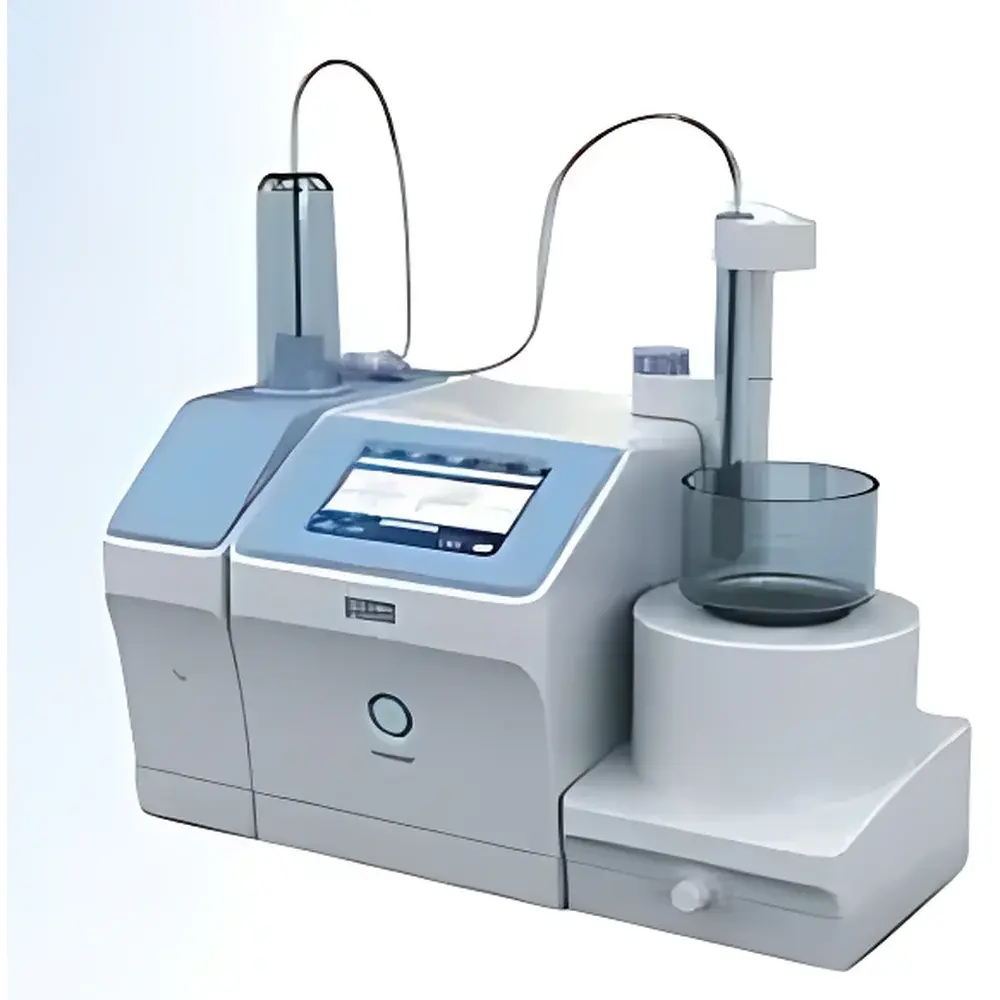
T11 Smart Potentiometric Titration System
| Origin | Beijing, China |
|---|---|
| Manufacturer Type | Authorized Distributor |
| Product Origin | Domestic (China) |
| Model | T11 |
| Price Range | USD 700 – 7,000 |
| Instrument Type | General-purpose Potentiometric Titrator |
| Application Scope | Universal |
| pH Measurement Range | 0–14 |
| mV Measurement Range | ±2000 mV |
| pH Resolution | 0.01 |
| mV Resolution | 0.1 mV |
| pH Accuracy | ±0.01 |
| mV Accuracy | ±0.2 mV |
| Titration Accuracy | ±0.15% (10 mL), ±0.2% (20 mL) |
| Minimum Dispensing Volume | 10 µL |
| Stepper Motor Resolution | 1/60,000 steps |
| Temperature Interface | Pt1000 (Resolution: 0.1 °C, Max Error: ±0.2 °C) |
| Electrode Interfaces | 2 x indicator electrode, 2 x reference electrode, 2 x polarizable electrode |
| Color Sensor | 16-bit RGB tri-color sensor |
| Dimensions | 200 × 200 × 260 mm |
| Weight | 4.3 kg |
Overview
The T11 Smart Potentiometric Titration System is a modular, microprocessor-controlled automatic titrator engineered for precision potentiometric, pH-metric, and colorimetric endpoint detection in routine and research-grade chemical analysis laboratories. Based on the fundamental principle of potentiometric equivalence point determination—monitoring the potential difference between a reference and an indicator electrode as titrant is incrementally added—the T11 delivers high reproducibility in acid-base, redox, precipitation, and complexometric titrations. Its architecture integrates real-time electrochemical signal acquisition with adaptive dosing control, enabling robust performance across diverse sample matrices without manual intervention. Designed to meet the operational rigor of QC/QA labs, academic teaching facilities, and industrial R&D environments, the system supports GLP-compliant workflows through traceable parameter logging and hardware-level calibration validation.
Key Features
- High-resolution 7-inch color capacitive touchscreen with bilingual (English/Chinese) GUI and 12 customizable soft-key shortcuts for rapid method recall and instrument control.
- Modular “building-block” design: single main unit can wirelessly coordinate up to 12 independent titration modules via Bluetooth 5.0 or IEEE 802.11n Wi-Fi, enabling parallel multi-channel analysis or sequential multi-step titrations.
- Precision dosing mechanism featuring corrosion-resistant, monolithic ceramic-plunger burettes with 1/60,000-step stepper motor drive; minimum dispensing volume of 10 µL ensures fine-grained endpoint resolution.
- Dual-mode endpoint detection: potentiometric (±2000 mV range, 0.1 mV resolution) and spectrophotometric (16-bit RGB color sensor with calibrated white-light illumination) for unambiguous identification of visual endpoints in non-aqueous or turbid samples.
- Comprehensive electrode connectivity: dual indicator, dual reference, and dual polarizable electrode ports support three-electrode configurations and differential measurements per ASTM D1129 and ISO 17025 guidelines.
- Integrated Pt1000 temperature compensation interface (0.1 °C resolution, ±0.2 °C accuracy) enables automatic activity correction in pH and redox calculations per NIST SRM protocols.
Sample Compatibility & Compliance
The T11 accommodates aqueous, alcoholic, acetonitrile-based, and mixed-solvent systems typical in pharmaceutical assay validation (USP ), water quality testing (EPA 300.0), and food acidity standardization (AOAC 973.41). Its sealed electrode interfaces and chemically inert fluid path (PTFE, PEEK, and sapphire components) resist degradation from halides, cyanides, sulfides, and strong acids/bases. The system conforms to IEC 61010-1:2010 safety requirements for laboratory electrical equipment and supports audit-ready documentation per FDA 21 CFR Part 11 when paired with validated PC software. Full traceability—including operator ID, timestamped method parameters, raw electrode potential logs, and digital signature fields—is embedded at firmware level.
Software & Data Management
The T11 operates natively via onboard firmware but synchronizes seamlessly with Windows-based TitraSoft™ v3.x desktop software (included) for advanced method development, statistical reporting (RSD, confidence intervals), and PDF/CSV export. Data integrity safeguards include immutable audit trails, electronic signatures, and role-based access control (administrator, analyst, reviewer). All measurement records are time-stamped with NTP-synchronized clocks and encrypted during transfer. Software complies with ISO/IEC 17025:2017 clause 7.5.2 for data handling and supports automated report generation aligned with ISO 10523 (pH of water) and ISO 8655-6 (burette verification).
Applications
- Pharmaceutical: assay of active ingredients (e.g., aspirin hydrolysis, amine salt quantification), excipient purity testing, and dissolution profile verification.
- Environmental: chloride determination in wastewater (Mohr method), COD titration, alkalinity/hardness profiling per APHA Standard Methods 2320B.
- Food & Beverage: titratable acidity in juices and dairy, sulfur dioxide in wine (Ripper method), peroxide value in oils.
- Chemical Manufacturing: concentration verification of HCl, NaOH, EDTA stock solutions; catalyst residue analysis in polymer synthesis.
- Academic Research: teaching potentiometric fundamentals, kinetics studies of slow-reacting systems via dynamic titration mode.
FAQ
Does the T11 support GLP-compliant electronic record keeping?
Yes—when used with TitraSoft™ and configured with user authentication, audit trail logging, and digital signature capture, it fulfills core GLP data integrity requirements per OECD Principles of Good Laboratory Practice.
Can the system perform back-titrations or multi-step titrations?
Yes—its programmable sequence engine allows conditional branching (e.g., “if pH > 7.5, add 0.1 M HNO₃; else proceed to redox step”) and intermediate reagent additions without manual intervention.
Is calibration verification traceable to national standards?
All pH and mV calibrations store certificate references (e.g., NIST-traceable buffer IDs) and auto-log calibration slope, offset, and asymmetry potential—exportable as CSV for metrology review.
What maintenance is required for long-term accuracy?
Quarterly verification using certified reference solutions (e.g., NIST SRM 186c for pH, potassium ferricyanide for redox) and annual stepper motor calibration via gravimetric dispensing check are recommended per ISO 8655-6.
How is electrode drift compensated during extended analyses?
The firmware applies real-time slope correction using internal reference stability monitoring and optional periodic zero-point recalibration triggered by user-defined time or volume thresholds.




