
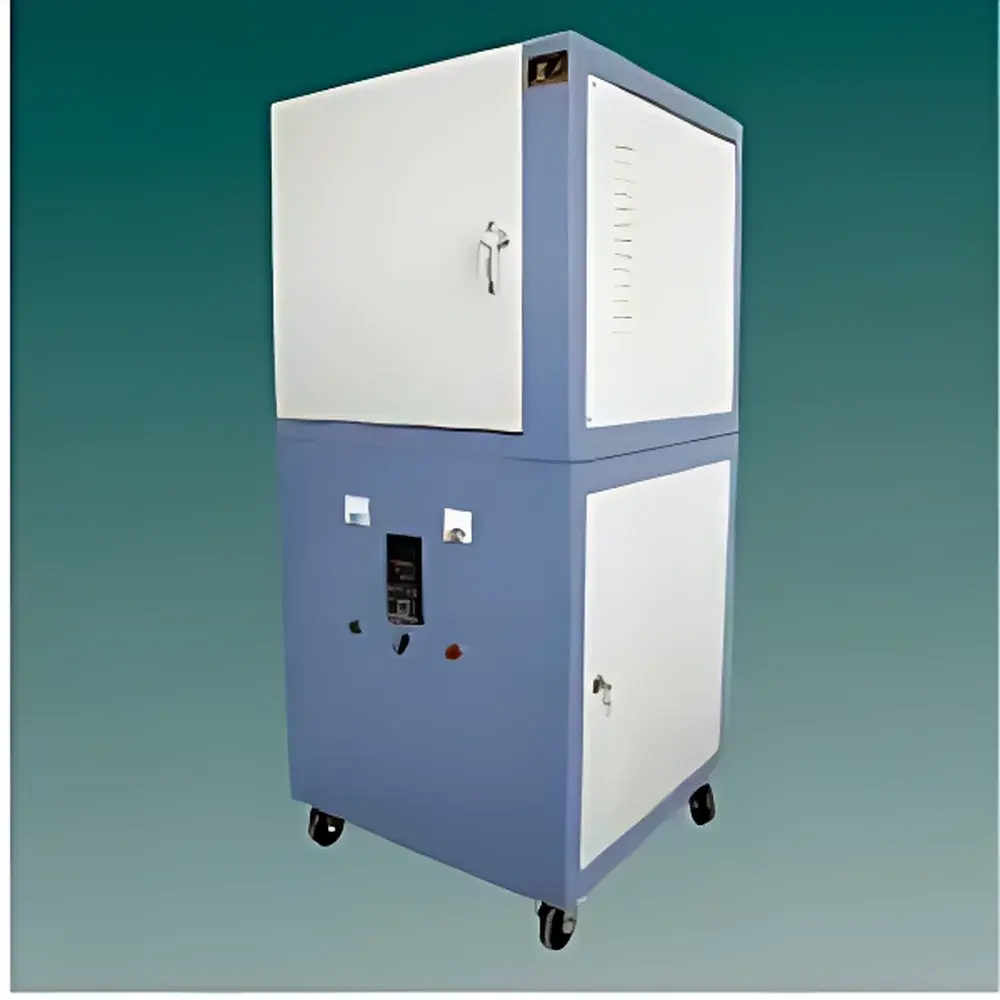
SGM3816 High-Temperature Box-Type Resistance Furnace
| Origin | Henan, China |
|---|---|
| Manufacturer Type | Authorized Distributor |
| Origin Category | Domestic (China) |
| Model | SGM3816 |
| Pricing | Available Upon Request |
| Max Temperature | 1600 °C |
| Temperature Uniformity | ±6 °C |
| Temperature Stability | ±1 °C |
| Heating Rate | 5–20 °C/min |
| Control Accuracy | ±1 °C display resolution |
| Programmable Ramp/Soak | Up to 50 segments |
| Power Efficiency | >50% reduction vs. conventional muffle furnaces |
Overview
The SGM3816 High-Temperature Box-Type Resistance Furnace is an engineered thermal processing system designed for precise, repeatable, and energy-efficient high-temperature applications in materials science laboratories, metallurgical R&D, ceramic sintering, and advanced powder processing. Operating on resistive heating principles via high-purity Kanthal A1 or similar alloy heating elements embedded within a dual-layer ceramic fiber insulation architecture, the furnace achieves stable operation up to 1600 °C while minimizing thermal mass and heat loss. Its proprietary double-chamber furnace lining—comprising low-density, high-purity alumina-silica ceramic fiber modules—ensures structural integrity under prolonged thermal cycling, eliminating common failure modes such as fiber collapse, particle shedding, or microcracking at elevated temperatures. Unlike traditional brick-lined muffle furnaces, the SGM3816 delivers rapid thermal response without compromising long-term dimensional stability or contamination control—critical for ashing, calcination, annealing, and pre-sintering protocols requiring strict thermal history management.
Key Features
- Dual-chamber ceramic fiber insulation system with patented structural reinforcement, enabling sustained operation at 1600 °C without degradation, cracking, or dust generation
- Modular microprocessor-based temperature controller with PID auto-tuning, manual/auto mode switching without process interruption, and real-time overtemperature cut-off protection
- 50-segment programmable ramp-and-soak capability supporting complex thermal profiles—including multi-stage heating, dwell, and controlled cooling sequences
- High-resolution digital display with ±1 °C readout accuracy and integrated temperature offset calibration function for traceable instrument verification
- Optimized thermal efficiency: 5–20 °C/min heating rate with >50% energy savings versus conventional refractory-lined furnaces of comparable volume and temperature rating
- Low thermal inertia design ensures minimal overshoot (1–3 °C), tight temperature stability (±1 °C), and uniform chamber distribution (±6 °C across working zone)
Sample Compatibility & Compliance
The SGM3816 accommodates a broad range of sample forms—including crucibles (alumina, quartz, graphite), ceramic tiles, metal powders, catalyst precursors, and geological specimens—within its configurable internal cavity (multiple standard dimensions available from 200×150×150 mm to 500×300×350 mm). The inert, non-reactive ceramic fiber chamber minimizes catalytic surface interactions and eliminates metallic contamination risks associated with metal-sheathed heating elements. All models comply with IEC 61000-6-3 (EMC emissions) and IEC 61000-6-2 (immunity) standards. The control system supports audit-ready operation per GLP and GMP environments through optional data logging with time-stamped temperature records, user-access logs, and alarm event history—fully compatible with 21 CFR Part 11-compliant software platforms when integrated with external validation-grade data acquisition systems.
Software & Data Management
While the base unit operates via front-panel keypad and LCD interface, the SGM3816 supports RS485/Modbus RTU communication for integration into centralized lab automation networks. Optional PC-based configuration software enables remote profile editing, real-time temperature monitoring, historical trend visualization, and CSV export of time-temperature datasets. Firmware includes built-in calibration memory for up to three independent thermocouple compensation points, facilitating periodic verification against NIST-traceable reference standards. All temperature alarms, power faults, and controller resets are timestamped and stored in non-volatile memory for post-process review—supporting ISO/IEC 17025 documentation requirements for accredited testing laboratories.
Applications
- Thermal gravimetric analysis (TGA) sample preparation and residue quantification
- Sintering of oxide ceramics (Al2O3, ZrO2, SiC) and advanced composites
- Calcination of metal oxides, battery cathode precursors (e.g., LiCoO2, NMC), and catalyst supports
- Ash content determination per ASTM D3174, ISO 1171, and USP
- Heat treatment of tool steels, superalloys, and refractory metals under controlled atmosphere (when used with optional purge ports)
- Pre-firing of dental and biomedical prosthetic substrates requiring precise thermal ramp control
FAQ
What is the maximum continuous operating temperature of the SGM3816?
The furnace is rated for continuous operation at 1600 °C, with thermal stability maintained across all standard cavity configurations.
Does the SGM3816 support inert or reducing atmospheres?
Yes—optional gas inlet/outlet ports are available for nitrogen, argon, or forming gas purging; compatibility with reducing atmospheres requires quartz or molybdenum disilicide (MoSi2) heating element variants.
How is temperature uniformity validated across the working zone?
Uniformity is verified using a 9-point thermocouple mapping procedure per ASTM E2203, conducted at 1000 °C and 1600 °C during factory acceptance testing.
Can the controller be calibrated in-house?
Yes—the system supports user-accessible offset adjustment and multi-point calibration via dedicated service mode, aligned with ISO/IEC 17025 traceability protocols.
Is firmware upgrade capability included?
Firmware updates are delivered via USB flash drive or RS485 interface using manufacturer-provided utilities, with version rollback and integrity checksum verification.



