
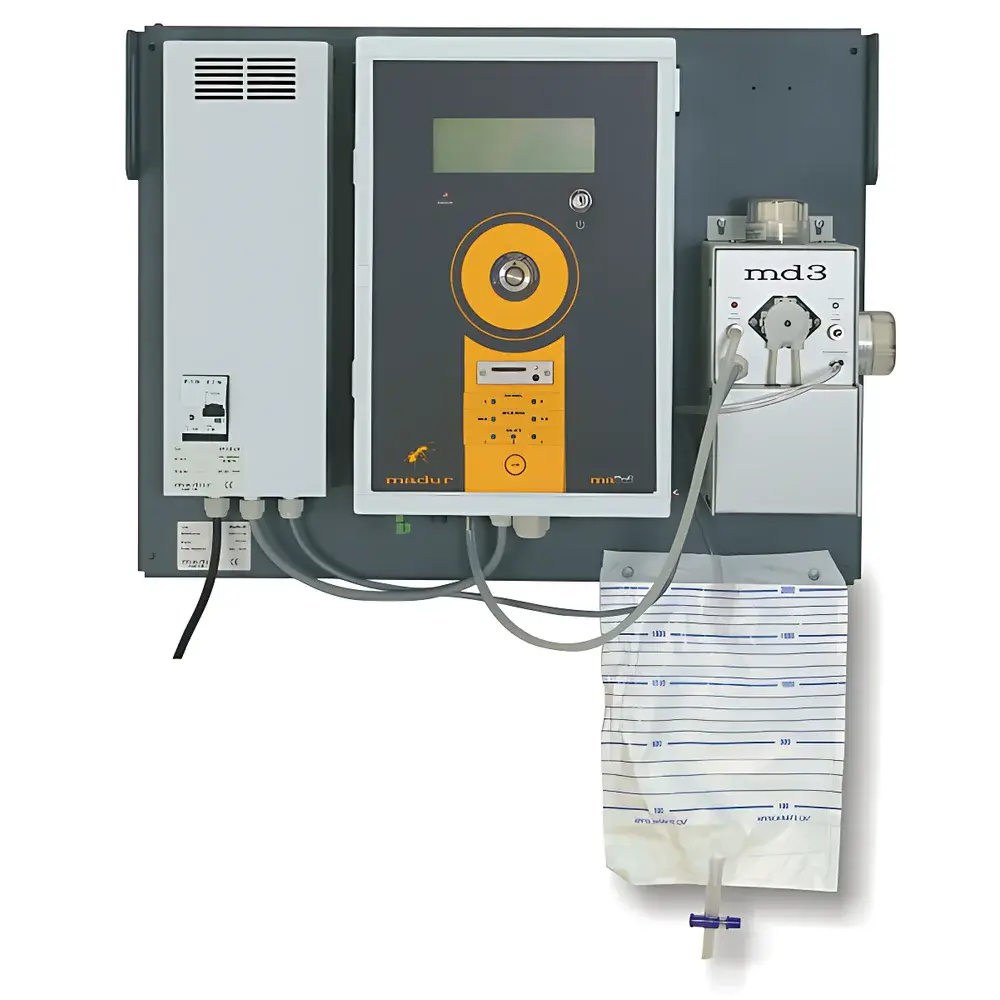
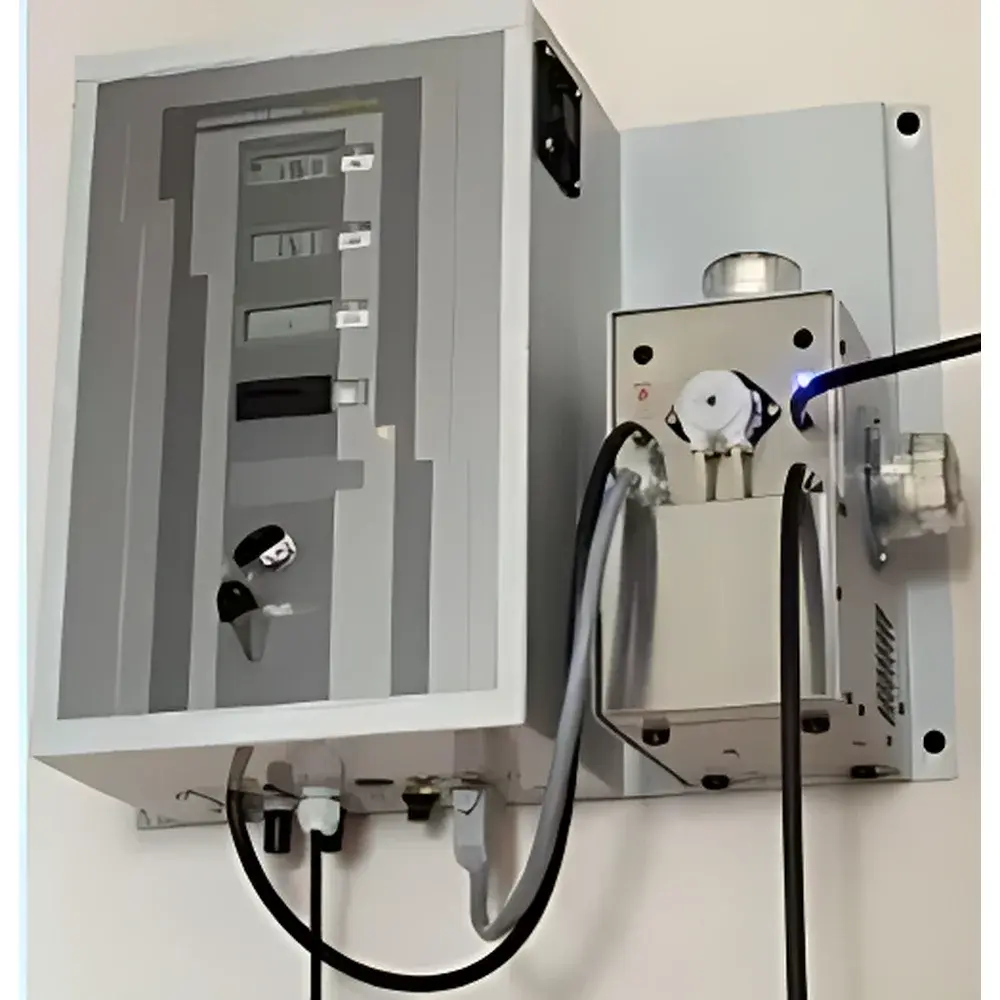
MaMoS-100-400 Fixed-Position In-Situ Flue Gas Analyzer (Austrian-Made)
| Origin | Austria |
|---|---|
| Manufacturer Type | Authorized Distributor |
| Origin Category | Imported |
| Model | maMoS-100-400 |
| Instrument Type | Continuous Emission Monitoring System (CEMS) |
| Measurement Accuracy | ≤5% FS |
| Repeatability | ≤2% FS |
| Response Time (T90) | 45 s |
| Stability | ≤5% FS over 30 days |
| Sensor Options | Electrochemical (O₂, CO, NO, NO₂, SO₂, H₂S, Cl₂, H₂) & NDIR (CO, CO₂, CH₄, N₂O) |
| Housing | IP54-rated ABS enclosure |
| Power Supply | 24 V AC, ~8 W |
| Operating Temperature | 0–40 °C |
| Storage Temperature | −20–+55 °C |
| Dimensions (H×W×D) | 380 × 300 × 140 mm |
| Weight | ~4 kg |
| Zero/Measurement Cycle | Fully automated dual-phase sequence with independent timing control |
| Output Signals | 4–20 mA and 0–10 V per channel |
| Digital Interface | RS232 |
| NDIR Response Time | T90 < 10 s |
| Built-in Sample Conditioning | Peltier-cooled dryer, particulate filter, condensate peristaltic pump |
| Calibration | Factory-calibrated sensors |
Overview
The MaMoS-100-400 is a fixed-position, in-situ flue gas analyzer engineered for continuous, real-time monitoring of combustion exhaust and process gases in industrial and environmental applications. Designed and assembled in Austria, it operates on a modular sensor architecture supporting up to four parallel measurement channels—configurable with either electrochemical (EC) or non-dispersive infrared (NDIR) sensing technologies. Unlike extractive CEMS requiring complex sample transport lines and conditioning skids, the MaMoS-100-400 is optimized for direct installation at the stack or duct interface, minimizing transport lag and condensation artifacts. Its core measurement principle relies on amperometric detection for reactive gases (e.g., O₂, CO, NOₓ, SO₂, H₂S) and broadband infrared absorption spectroscopy for diatomic and polyatomic species (e.g., CO₂, CH₄, N₂O). The system implements a fully automated, user-defined dual-phase operational cycle—zero calibration and active measurement—ensuring long-term baseline stability without manual intervention. All sensors are pre-calibrated at the manufacturer’s facility against traceable reference standards; EC sensors are individually characterized for cross-sensitivity compensation, while NDIR modules incorporate temperature-stabilized optical paths and factory-set spectral baselines, eliminating the need for field recalibration under normal operating conditions.
Key Features
- Modular multi-gas configuration: Supports simultaneous monitoring of up to four gases using interchangeable EC or NDIR sensor cartridges—no firmware reconfiguration required.
- Integrated sample conditioning: Onboard Peltier-cooled condenser (−5 °C dew point), hydrophobic particulate filter (≤1 µm retention), and condensate removal via peristaltic pump ensure consistent gas-phase delivery to sensors.
- Microprocessor-controlled automation: Dual-phase cycle (zero + measurement) programmable per channel with independent timing—enabling adaptive calibration frequency based on regulatory requirements or process variability.
- Robust mechanical design: IP54-rated ABS housing rated for indoor and sheltered outdoor deployment; vibration-damped mounting brackets included.
- Comprehensive analog and digital I/O: Four isolated 4–20 mA outputs (linear, HART-compatible), four 0–10 V voltage outputs, two programmable dry-contact relays per channel, and RS232 serial interface for data logging or SCADA integration.
- Thermal compensation: Real-time ambient and sensor head temperature monitoring with embedded polynomial correction algorithms applied to all EC and NDIR readings.
Sample Compatibility & Compliance
The MaMoS-100-400 is validated for use with flue gases containing particulate loadings ≤10 mg/m³, moisture content ≤25 vol%, and operating pressures within ±10 kPa of atmospheric. It meets EN 15267-3 (QAL1 certification framework for automated measuring systems) and complies with EN 14181 (periodic quality assurance procedures for CEMS). While not certified to MCERTS or EPA PS-11 by default, its architecture supports audit-ready operation when deployed with documented calibration logs, maintenance records, and traceable span gas certificates. The instrument satisfies functional requirements of ISO 14001 environmental management systems and aligns with EU Industrial Emissions Directive (2010/75/EU) Annex VI monitoring specifications for combustion plants ≥50 MWth. All electrical interfaces conform to IEC 61000-6-2 (immunity) and IEC 61000-6-4 (emissions).
Software & Data Management
The analyzer includes embedded firmware with configurable data logging (up to 30 days of 1-minute averaged values stored internally), event-triggered alarms (e.g., sensor timeout, condensate overflow), and password-protected parameter access levels (operator, technician, administrator). RS232 output delivers ASCII-formatted packets compliant with Modbus RTU protocol for seamless integration into third-party DCS or historian platforms. Optional PC-based configuration software (Windows 10/11 compatible) enables remote setup of zero/measurement intervals, relay logic, linearization curves, and alarm thresholds. Audit trails—including timestamped calibration events, sensor replacement logs, and output verification tests—are retained in non-volatile memory and exportable via serial dump. The system supports GLP-compliant operation through user ID tagging, electronic signature prompts, and immutable log timestamps synchronized to internal RTC.
Applications
- Biogas upgrading plants: Simultaneous monitoring of CH₄, CO₂, O₂, H₂S, and H₂ for digester optimization and desulfurization control.
- Cement and glass kilns: Real-time tracking of O₂ (combustion efficiency), CO (incomplete combustion), and NOₓ (thermal/deNOₓ feedback).
- Municipal solid waste incinerators: Regulatory compliance monitoring per EN 13284-1 for CO, O₂, SO₂, and HCl (via Cl₂ proxy).
- Greenhouse climate control: Low-range CO₂ (0–2000 ppm) and CH₄ (0–5%) monitoring for ventilation actuation and emission reporting.
- Boiler house CHP units: Stack gas analysis for heat rate optimization and emissions inventory (Tier 2 reporting under GHG Protocol).
FAQ
Does the MaMoS-100-400 require periodic field calibration?
No. Electrochemical and NDIR sensors are factory-calibrated against NIST-traceable standards and retain calibration for ≥6 months under typical operating conditions. Only zero checks (using ambient air or certified zero gas) are recommended weekly; full span calibration is optional and performed only if drift exceeds 5% FS.
Can the instrument operate in high-humidity flue gas streams?
Yes. The integrated Peltier cooler maintains sample dew point below −5 °C, and the hydrophobic filter prevents liquid water ingress. For sustained operation above 30% relative humidity at sampling point, optional heated sampling line extension is recommended.
Is the RS232 interface compatible with modern SCADA systems?
Yes. It transmits ASCII data packets at 9600 baud, 8N1, with Modbus RTU framing. Protocol documentation and register maps are provided in the technical manual for PLC integration.
What is the expected service life of electrochemical sensors?
Typical lifetime is 24–36 months depending on exposure concentration and operating temperature. Sensors are hot-swappable; replacement requires no tooling and takes <90 seconds per module.
Does the device support 21 CFR Part 11 compliance?
While the base firmware does not include electronic signature or audit trail encryption, the system can be operated in a Part 11-compliant environment when paired with validated third-party data acquisition software that enforces role-based access, audit logging, and electronic signatures.
Related Products







