
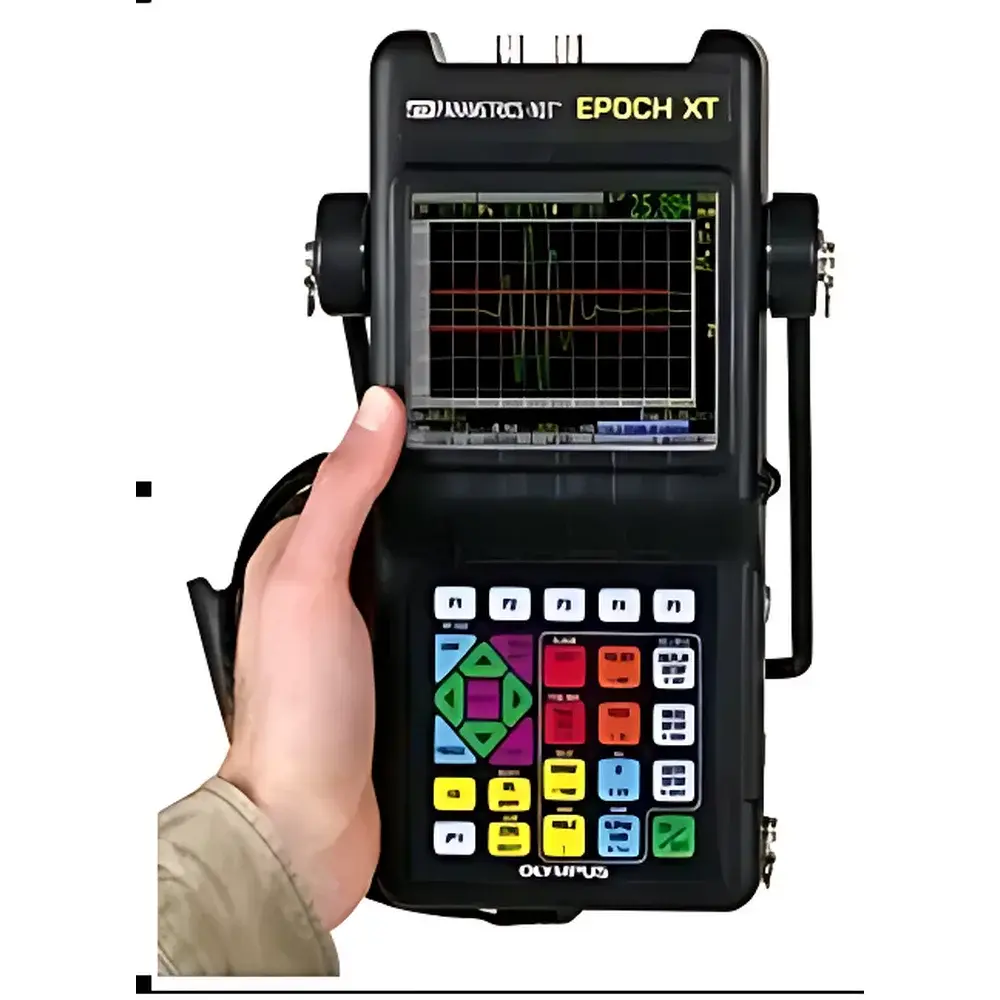
Olympus EPOCH XT Digital Ultrasonic Flaw Detector
| [Origin | USA |
|---|---|
| Manufacturer Type | Authorized Distributor |
| Origin Category | Imported |
| Model | EPOCH XT |
| Pricing | Upon Request] |
Overview
The Olympus EPOCH XT Digital Ultrasonic Flaw Detector is an industrial-grade, portable ultrasonic testing (UT) instrument engineered for high-reliability non-destructive evaluation (NDE) in demanding field and shop-floor environments. Based on pulse-echo and through-transmission principles, it utilizes time-of-flight diffraction (TOFD)-compatible signal processing and advanced digital signal acquisition to detect, locate, and characterize discontinuities—including cracks, lack of fusion, porosity, and laminations—in metals, composites, and other sound-conductive materials. Designed and validated in accordance with EN 12668-1:2010 for ultrasonic equipment performance requirements, the EPOCH XT delivers consistent sensitivity, linearity, and repeatability across its full dynamic range. Its ruggedized architecture supports operation in extreme ambient conditions—from -30 °C to +50 °C—while maintaining stable calibration and measurement integrity under mechanical shock, dust ingress, and transient moisture exposure.
Key Features
- IP67-rated enclosure for full protection against dust and immersion up to 1 m for 30 minutes
- Square-wave pulser with adjustable voltage and width for optimized transducer excitation
- 0–110 dB gain range with 0.1 dB resolution and amplitude linearity of ±0.25% FSH
- Two independent, fully configurable time-based gates with peak, leading-edge, and first-peak detection modes
- Measurement resolution down to 0.01 mm (0.0004 in) for thickness and flaw depth applications
- Pulse repetition frequency (PRF) continuously adjustable from 10 Hz to 1 kHz in 10 Hz increments
- Four user-definable display layouts supporting A-scan, B-scan, and dual-gate overlays
- Integrated DAC/TVG curve generation with dynamic correction for distance-amplitude and time-varied gain compensation
- Color TFT LCD display with adjustable brightness and multiple color palettes for improved waveform contrast
- Weight: 1.95 kg (4.3 lb); ergonomic design with foldable stand, chest-mount D-rings, and ambidextrous strap attachment
- Sealed I/O ports including dual USB (Type-A host + Type-B device), 16-pin hardware I/O, BNC/Lemo transducer connectors, and AC adapter interface
Sample Compatibility & Compliance
The EPOCH XT is compatible with standard contact, angle-beam, immersion, and delay-line transducers operating across 0.5–20 MHz frequency ranges. It supports material velocity calibration for steel, aluminum, titanium, plastics, and custom user-defined media. The instrument complies with EN 12668-1:2010 for performance verification of ultrasonic flaw detectors and meets MIL-STD-810G for environmental durability. Its sealed battery compartment, tool-free hot-swap capability (with NiMH, alkaline, or optional Li-ion packs), and conformal-coated internal PCBs ensure operational continuity in offshore, pipeline, power generation, and aerospace maintenance settings. All firmware and calibration data are traceable per ISO/IEC 17025 requirements when used within a documented quality management system.
Software & Data Management
- GAGEVIEW Pro software enables bidirectional data transfer, report generation, and database archiving compliant with ASTM E2373 and ISO 10893-13
- Onboard file management supports up to 99 alphanumeric inspection files with customizable naming conventions and hierarchical folder structures
- Real-time data logging includes A-scan waveforms, gate positions, amplitude values, sound path distances, and operator annotations
- DAC/TVG curves support AWS D1.1/D1.5 structural welding code compliance, including notch-type reference standards and evaluation levels
- Optional DGS/AVG analysis module provides distance-gain-size assessment using probe-specific nomograms per DIN EN 1714
- Curved Surface Correction (CSC) algorithm compensates for beam skew and lateral wave effects on cylindrical or spherical components
- All stored data include embedded timestamps, instrument ID, calibration status flags, and user login metadata—supporting audit readiness under FDA 21 CFR Part 11 and GLP/GMP frameworks
Applications
The EPOCH XT serves critical inspection workflows across multiple regulated sectors. In oil & gas, it performs weld integrity verification on API 1104-compliant piping and pressure vessels. In power generation, it conducts turbine blade root inspections and heat exchanger tube sheet assessments per ASME Section V Article 4. Within rail transportation, it validates axle and wheelset integrity in accordance with EN 1369 and UIC 801-2. Aerospace MRO teams deploy it for composite bondline evaluation and fastener hole inspection per NAS 410 and NADCAP requirements. Its portability, battery endurance (>8 hours with NiMH), and cold-weather operability make it suitable for remote infrastructure audits—including wind turbine tower base welds, bridge gusset plates, and subsea manifold assemblies.
FAQ
Does the EPOCH XT support TOFD imaging?
Yes—it acquires raw RF data at sufficient sampling rates and digitizing resolution to support post-processing TOFD analysis via third-party software such as OmniScan or R/D Tech’s TOFD Suite.
Can calibration certificates be provided with traceability to NIST?
Yes—Olympus-certified calibration services include NIST-traceable documentation upon request, aligned with ISO/IEC 17025-accredited procedures.
Is firmware upgrade capability available in the field?
Yes—updates are delivered via USB flash drive and installed without requiring return-to-factory service.
What transducer connectivity options are supported?
Standard BNC; optional Lemo 00 (LEMO-FGG.0B.304.CLAD51) with IP67-rated mating connector available.
How is data security ensured during export to GAGEVIEW Pro?
All communication uses encrypted USB CDC protocol; no wireless transmission is performed, eliminating cybersecurity risks associated with Wi-Fi or Bluetooth interfaces.



