
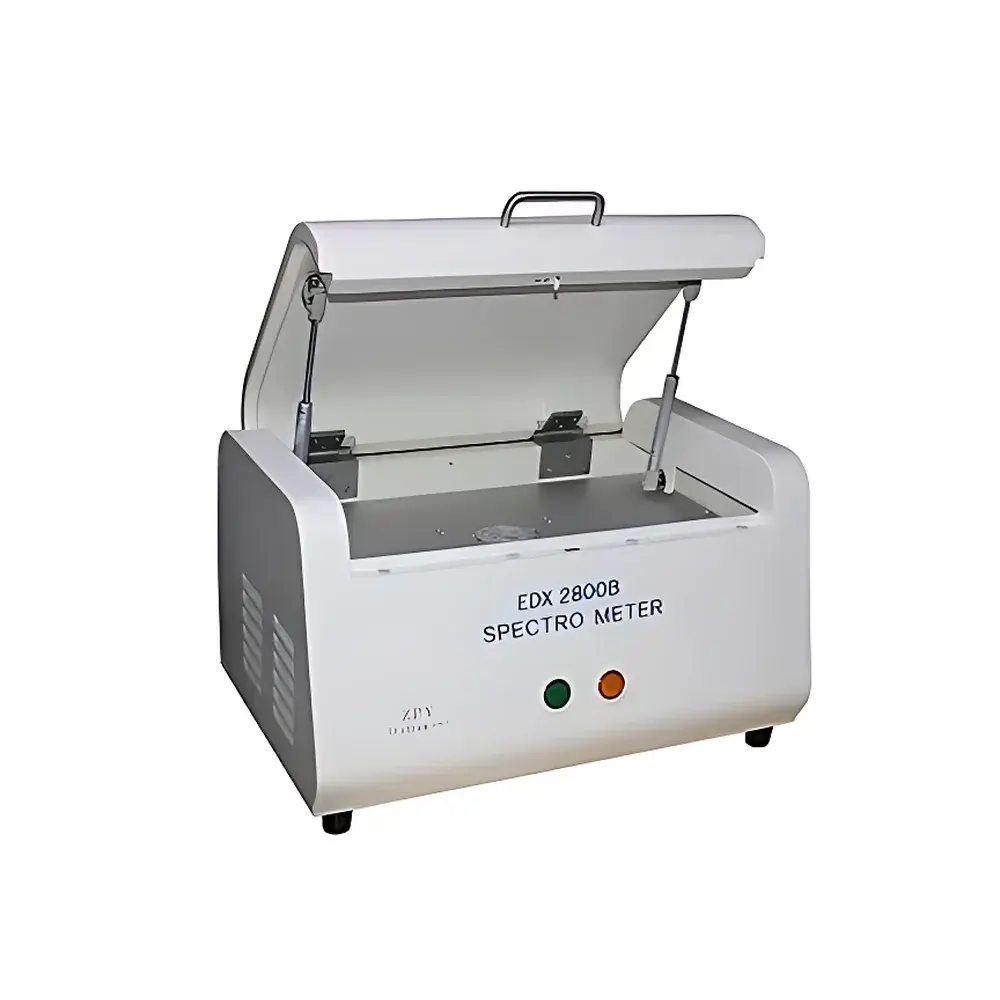
EDX 2800B Energy Dispersive X-Ray Fluorescence Spectrometer (ED-XRF) for Alloy and RoHS Compliance Analysis
| [Origin | Beijing, China |
|---|---|
| Manufacturer Type | Authorized Distributor |
| Product Origin | Domestic (PRC) |
| Model | EDX 2800B |
| Form Factor | Benchtop / Floor-Standing |
| Industry-Specific Use | Electronics Manufacturing & QC |
| Elemental Range | S (16) to U (92) |
| Quantification Range | 1 ppm – 99.99 wt% |
| Energy Resolution | 149 ± 5 eV (at Mn Kα) |
| Repeatability (RSD) | ≤ 0.1% for major elements |
| Measurement Time | 100–300 s per sample |
| Operating Temperature | 15–30 °C |
| Relative Humidity | 40–50% RH |
| Power Supply | AC 220 V ± 5 V, 50/60 Hz |
| Detector | Si-PIN semiconductor, Peltier-cooled |
| X-ray Tube | 50 kV max, 1 mA max, air-cooled, 50 W nominal |
| Multichannel Analyzer | 2048-channel MCA with digital pulse processing |
| Collimator Options | 8 automatic sizes (0.2–8 mm Ø) |
| Filter Options | 6 programmable primary beam filters |
| Calibration | Auto-curve selection, matrix-matched standards included |
| Software | XRAYAnalyzer v3.x, compliant with GLP data integrity requirements] |
Overview
The EDX 2800B Energy Dispersive X-Ray Fluorescence (ED-XRF) Spectrometer is an industrial-grade benchtop/floor-standing analytical instrument engineered for non-destructive elemental quantification in solid and powdered samples. Based on the fundamental principle of energy-dispersive X-ray fluorescence—where primary X-rays excite characteristic secondary (fluorescent) X-rays from sample atoms—the system detects and resolves emitted photons by energy using a high-resolution Si-PIN semiconductor detector. Its design targets routine compliance testing against regulatory frameworks including EU RoHS Directive 2011/65/EU, EN 71-3 (toy safety), and 94/62/EC (packaging restrictions), while also supporting alloy composition verification, plating thickness estimation (via fundamental parameters), and halogen-free material screening (Cl, Br). The instrument operates without liquid nitrogen cryogenics, relying instead on thermoelectric (Peltier) cooling for detector stability—a key enabler of low-maintenance, continuous laboratory operation.
Key Features
- High-fidelity Si-PIN detector with energy resolution of 149 ± 5 eV at Mn Kα (5.89 keV), enabling robust peak separation for adjacent elements (e.g., Cr/Mn, As/Se, Cd/In).
- Integrated SES (Spectral Enhancement System) signal processing architecture, incorporating real-time digital pulse shaping and noise suppression to improve signal-to-background ratio and detection limits.
- Automated multi-parameter optical path control: eight motorized collimators (0.2–8 mm diameter) and six selectable primary-beam filters optimize excitation conditions for diverse sample matrices—metals, polymers, ceramics, and coated substrates.
- Intelligent calibration engine: auto-selection of matrix-matched working curves based on preliminary qualitative scan; eliminates manual curve assignment errors and enhances cross-sample reproducibility.
- Dual-layer radiation safety architecture: interlocked shielded chamber with lead-lined acrylic viewport, real-time dose monitoring, and hardware-enforced beam-off protocols during lid opening.
- Thermal management system: active airflow + PID-controlled X-ray tube temperature regulation ensures stable tube output over extended acquisition cycles, extending source lifetime beyond 10,000 operating hours.
- USB 2.0 high-speed interface with deterministic latency, supporting full-spectrum streaming (2048-channel raw data) and synchronized metadata logging for audit-ready traceability.
Sample Compatibility & Compliance
The EDX 2800B accommodates heterogeneous sample geometries via its open large-chamber design (W × D × H: 300 × 300 × 120 mm), accepting irregularly shaped electronics assemblies, bulk metal ingots, plastic housings, and coated fasteners without size-induced bias. Sample presentation requires no vacuum or helium purge—analysis occurs under ambient air, minimizing preparation time and operational overhead. Method validation adheres to ASTM E1621–22 (“Standard Guide for XRF Analysis of Environmental Samples”) and IEC 62321–5:2013 (“Determination of certain substances in electrotechnical products — Part 5: XRF screening”). Data integrity supports GLP/GMP workflows through software-enforced user authentication, electronic signatures, and 21 CFR Part 11–compliant audit trails (including parameter change logs, spectrum timestamps, and calibration history).
Software & Data Management
XRAYAnalyzer v3.x provides a Windows-native GUI built on .NET Framework with dual-language support (English/Chinese, with localized UI strings exportable for third-party localization). Core modules include: (i) automated qualitative identification (peak deconvolution with library matching against NIST SRM databases); (ii) quantitative analysis using fundamental parameters (FP) or empirical calibration with EC681K reference standards; (iii) layered structure modeling for coating thickness and composition; (iv) customizable reporting templates (PDF, Excel, XML) with embedded spectra, uncertainty estimates (k=2), and pass/fail flags against user-defined specification limits. All raw spectral files (.spe) are stored with SHA-256 checksums; database backups follow ISO/IEC 27001-aligned encryption protocols.
Applications
Primary deployment domains include incoming material inspection in electronics manufacturing (PCB solder paste, connector plating, housing polymers), supplier qualification audits per IPC-J-STD-006, recycling stream sorting (WEEE scrap metals), and R&D formulation development for halogen-free laminates. Secondary applications encompass rapid grade verification of stainless steels (Cr/Ni/Mo), aluminum alloys (Si/Fe/Cu/Mg), and precious metal content assessment (Ag, Au, Pt group elements). The instrument’s 1 ppm detection limit for regulated elements—validated per IEC 62321–5 Annex B—meets contractual requirements for RoHS-compliant component certification.
FAQ
Does the EDX 2800B require liquid nitrogen or other cryogens?
No. It employs a Peltier-cooled Si-PIN detector, eliminating consumables and enabling unattended overnight operation.
Can it quantify light elements below sodium (Na)?
No. The instrument’s detection range begins at sulfur (Z = 16); lighter elements (e.g., C, N, O, F, Na, Mg, Al) are outside its operational window due to absorption in air and detector entrance window.
Is spectral deconvolution performed in real time?
Yes. The embedded 2048-channel MCA performs on-the-fly pulse height analysis and baseline correction prior to host transfer.
How is calibration maintained across environmental fluctuations?
The system includes internal reference source monitoring and automatic gain stabilization routines triggered every 30 minutes during idle periods or before each measurement sequence.
What documentation is provided for regulatory submissions?
Factory-certified performance verification reports (including resolution, repeatability, and detection limit test results), IQ/OQ protocols, and software validation summaries are supplied with each unit.
Related Products




