
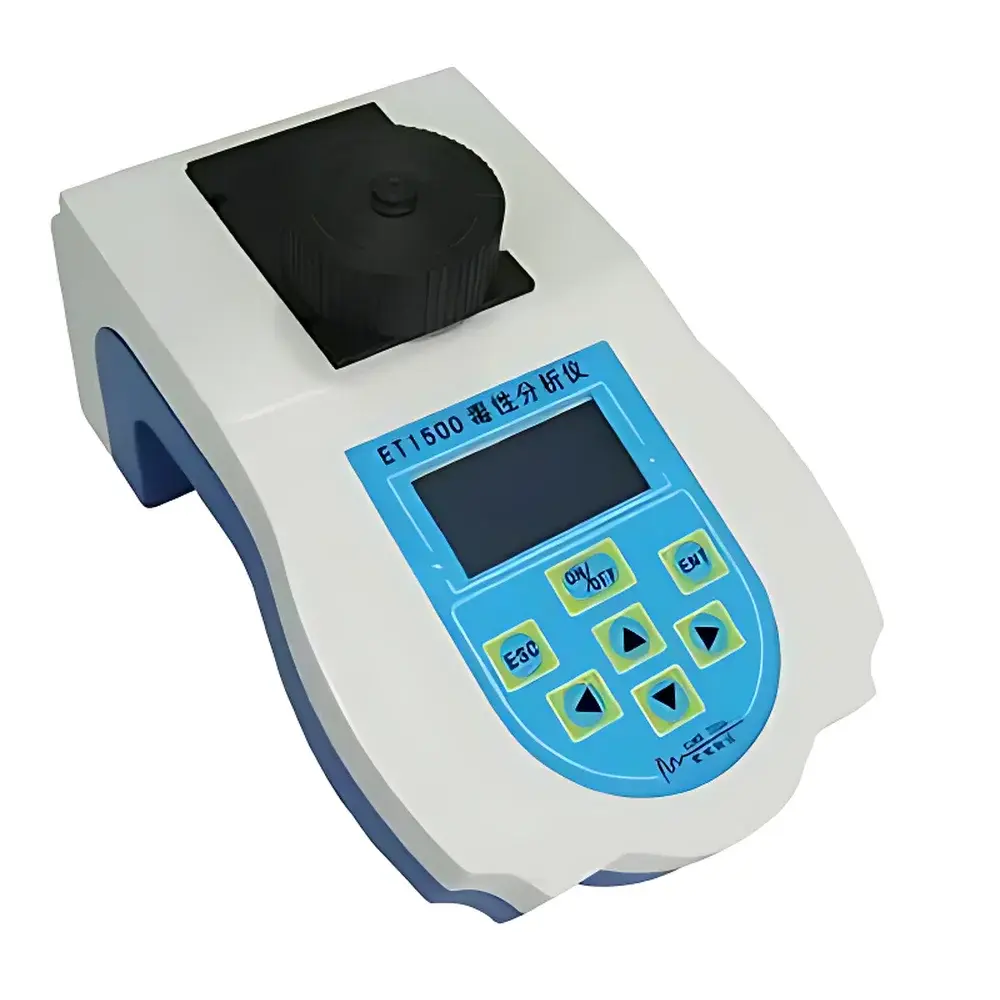
ET1500 Toxicity Analyzer
| Origin | Beijing |
|---|---|
| Manufacturer Type | Distributor |
| Origin Category | Domestic |
| Model | ET1500 |
| Price | Upon Request |
| Dynamic Range | ≥10⁶ |
| Sample Tube Dimensions | Ø12 mm, Height 47–75 mm |
| Communication Interface | RS232C |
| Measurement Duration | 0–99 s (1 s increments) |
| Data Storage Capacity | ≥2000 test records |
| Operating Temperature | 15–40 °C |
| Display | Backlit LCD |
| Power Supply | 220 V ±10 %, 50 Hz, 35 W |
| Rechargeable Battery | 3.7 V, 5000 mAh |
| Operating Humidity | 10–90 % RH (non-condensing) |
| Dimensions (L×W×H) | 320 × 170 × 180 mm |
| Weight | 2 kg (including battery) |
Overview
The ET1500 Toxicity Analyzer is a portable, bioluminescence-based toxicity detection system engineered for rapid, quantitative assessment of acute toxicity in aqueous environmental and food safety samples. It operates on the principle of bacterial bioluminescence inhibition: genetically stable, freeze-dried Vibrio fischeri (or equivalent luminescent marine bacteria) emit visible light (λ ≈ 490 nm) during normal metabolic activity. When exposed to toxicants—including heavy metals (e.g., Cu²⁺, Hg²⁺, Cd²⁺), organic pollutants (e.g., phenols, pesticides, PAHs), and microbial metabolites—the respiratory chain and luciferase enzyme activity are suppressed, resulting in measurable reduction in photon emission. The degree of luminescence inhibition correlates with toxicant concentration and potency, enabling semi-quantitative and comparative toxicity evaluation within minutes. Designed for field-deployable operation and laboratory-grade reproducibility, the ET1500 meets the functional requirements of ISO 11348-3 (Water quality — Determination of the inhibitory effect of water samples on the light emission of Vibrio fischeri) and supports GLP-aligned workflows through audit-ready data logging.
Key Features
- High-sensitivity bioluminescence detection with dynamic range ≥10⁶, enabling sub-mg/L detection thresholds for common toxicants when used with optimized buffer systems
- Integrated rechargeable lithium-ion battery (3.7 V, 5000 mAh) supporting >8 hours of continuous field operation without AC power
- Compact, ruggedized housing (320 × 170 × 180 mm; 2 kg total mass) with IP54-rated enclosure for dust and splash resistance
- Backlit monochrome LCD display with intuitive Chinese-language interface—designed for ease of use by non-specialist operators in municipal, industrial, and emergency response settings
- Programmable measurement duration (0–99 s, 1 s increments) to accommodate kinetic response profiles of diverse toxicants
- Onboard data storage for ≥2000 test records, including timestamp, sample ID, inhibition percentage, and raw luminescence counts
- RS232C serial interface for direct connection to Windows-based PCs; compatible with optional data export software for CSV/Excel reporting and trend analysis
Sample Compatibility & Compliance
The ET1500 accepts liquid samples in standard 12 mm diameter × 47–75 mm height glass or plastic cuvettes, eliminating the need for specialized consumables. It accommodates raw and filtered water (drinking water, surface water, wastewater influent/effluent), beverage extracts, leachates, and homogenized food suspensions—provided turbidity is reduced below 50 NTU via centrifugation or membrane filtration to minimize optical interference. The system complies with the operational framework of ISO 11348-3 and aligns with U.S. EPA Method 1002.0 (Microtox® assay principles). While not certified under FDA 21 CFR Part 11, its data integrity features—including immutable timestamped records and password-protected configuration—support internal validation for ISO/IEC 17025-accredited laboratories conducting routine screening per regulatory guidance (e.g., WHO Guidelines for Drinking-water Quality, Annex 2).
Software & Data Management
Data acquisition and reporting are managed via embedded firmware with no external dependencies. All measurements are stored with metadata (date/time, operator ID, sample ID, exposure time, raw RLU values, % inhibition vs. control). Export via RS232C enables integration into LIMS environments using custom scripts or third-party serial-to-CSV utilities. Optional companion software (sold separately) provides dose–response curve fitting (Probit or logistic models), EC₅₀ estimation, and batch comparison reports. Audit trails are maintained internally; however, full electronic signature and change-control capabilities require integration with validated enterprise systems.
Applications
- Rapid screening of drinking water distribution networks for accidental or intentional contamination events
- Real-time monitoring of influent and effluent toxicity at wastewater treatment plants to assess biological treatment efficiency and shock load impact
- Pre-screening of industrial effluents prior to discharge compliance verification
- Food safety labs evaluating extract toxicity from packaging materials or processing residues
- Environmental emergency response teams conducting on-site triage during chemical spills or algal bloom incidents
- Educational institutions performing standardized ecotoxicology experiments aligned with undergraduate curriculum standards
FAQ
What bacterial strain is used in the ET1500 assay kits?
The system uses lyophilized Vibrio fischeri ATCC 49387 or an equivalently characterized strain, selected for consistent luminescence output and sensitivity to broad-spectrum toxicants.
How long do the lyophilized bacterial reagents remain stable?
When stored desiccated at –20 °C, viability exceeds 12 months; reconstituted working suspension remains stable for up to 7 days at 4 °C.
Can the ET1500 distinguish between heavy metal and organic toxicity?
Yes—through sequential testing with heavy metal-specific chelating buffers (e.g., EDTA) and organic-phase extraction protocols, users can infer contaminant class based on differential inhibition recovery patterns.
Is calibration required before each use?
No routine calibration is needed; however, daily performance verification using a certified control standard (e.g., 2,4-DNP reference solution) is recommended to ensure assay consistency.
Does the instrument meet international regulatory acceptance criteria?
While the ET1500 itself is not CE-marked or FDA-cleared, its methodology conforms to ISO 11348-3, and results are accepted as screening data by numerous national environmental agencies for preliminary hazard identification.
Related Products




