
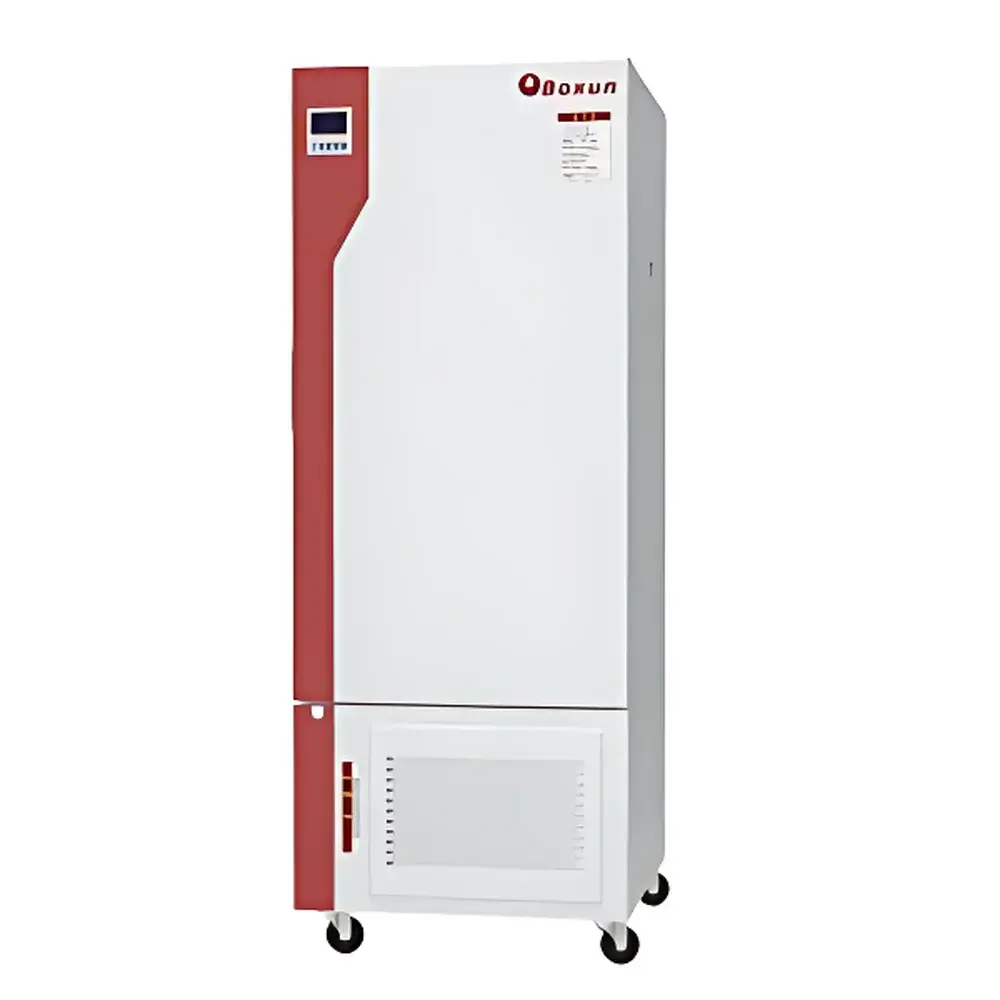
BOXUN BIC-400 Plant Growth Chamber
| Brand | BOXUN |
|---|---|
| Origin | Shanghai, China |
| Manufacturer Type | Direct Manufacturer |
| Region of Origin | Domestic (China) |
| Model | BIC-400 |
| Price Range | USD 2,800–7,000 (FOB) |
| Temperature Control Range | 0–60 °C (dark), 10–60 °C (with illumination) |
| Temperature Resolution | 0.1 °C |
| Temperature Uniformity | ±1 °C at 37 °C |
| Temperature Fluctuation | ±0.5 °C |
| Humidity Control Range | 60–90 % RH |
| Humidity Fluctuation | ±5 % RH |
| Illuminance Range | 0–15,000 lx (6-step adjustable) |
| Airflow Design | Dual-mode (laminar + vertical convection) |
| Programmability | 30 segments × 99 cycles |
| Power Input | 1900 W |
| Interior Dimensions (W×D×H) | 554 × 610 × 1148 mm |
| Exterior Dimensions (W×D×H) | 783 × 905 × 1818 mm |
| Standard Shelves | 4 adjustable stainless steel trays |
| Interface | RS-485 serial port |
| Safety Features | Mechanical door lock, auto-defrost (energy-free), over-temperature alarm, power-fail data retention & auto-recovery |
Overview
The BOXUN BIC-400 Plant Growth Chamber is a fully programmable, multi-parameter environmental simulation system engineered for reproducible plant physiology, photobiology, seed germination, and controlled-environment agriculture research. It operates on a dual-control principle: independent regulation of temperature, relative humidity, and spectral-light intensity within a thermally insulated, corrosion-resistant chamber. Unlike standard incubators, the BIC-400 integrates a closed-loop refrigeration architecture with an energy-free automatic defrost mechanism—eliminating thermal disturbance during frost cycle interruption—and employs a hybrid airflow strategy (laminar front-to-back plus vertical convection lift) to achieve ±1 °C uniformity at 37 °C across all shelf levels. Its design complies with foundational requirements for GLP-compliant environmental simulation, supporting long-term stability validation per ISO 17025 calibration traceability protocols when operated with certified reference sensors.
Key Features
- Intelligent microprocessor-based control system with backlit LCD interface displaying real-time temperature, humidity, illuminance, and elapsed time
- Dual-mode air circulation: laminar flow across sample plane + vertical convection lift ensures homogeneous thermal and moisture distribution across all four adjustable stainless-steel shelves
- Integrated refrigeration system using R134a-free eco-friendly refrigerant and premium-brand hermetic compressor for low-noise, high-efficiency cooling
- Six-level programmable LED-based illumination (0–15,000 lx) with three-dimensional light-diffusion layout minimizing shadowing and edge attenuation
- High-precision capacitive humidity sensor (imported) coupled with finned electric heating humidifier and external 5-L water reservoir enabling >72 h continuous operation without refill
- RS-485 communication port compliant with Modbus RTU protocol for integration into centralized lab monitoring networks or third-party SCADA systems
- Power-loss resilience: non-volatile memory retains all setpoints and program sequences; automatic recovery upon re-powering without manual reset
- Mechanical door lock and over-temperature cut-off circuit provide fail-safe physical and thermal protection
Sample Compatibility & Compliance
The BIC-400 accommodates standard botanical growth vessels—including Petri dishes, Magenta boxes, tissue culture jars, and 10-cm pots—across its 554 mm (W) × 610 mm (D) × 1148 mm (H) interior volume. Its stainless-steel mirror-finish inner chamber resists microbial adhesion and facilitates validated cleaning procedures required under ISO 14644 cleanroom-compatible workflows. The unit meets CE marking directives for electrical safety (EN 61010-1) and electromagnetic compatibility (EN 61326-1). While not certified to USDA APHIS or OECD TG 208 out-of-the-box, its programmable environmental profiles align with test condition specifications in ASTM E1822 (Standard Practice for Environmental Chambers Used in Biological Testing) and support method development for EPA OPPTS 850.4400 (Plant Pest Bioassay Guidelines).
Software & Data Management
The embedded controller supports full-cycle programming: up to 30 time-temperature-humidity-illumination segments per cycle, repeatable over 99 cycles. Optional RS-485-to-USB adapters enable connection to Windows-based data logging software (e.g., BOXUN LabLink v3.x), which records timestamped parameter histories at user-defined intervals (1 s to 60 min resolution) and exports CSV/Excel-compatible files. Audit trail functionality includes operator ID tagging, parameter change logs, and event timestamps—meeting minimum documentation requirements for FDA 21 CFR Part 11 compliance when deployed with appropriate access controls and electronic signature modules. Firmware updates are delivered via SD card slot (not included).
Applications
- Photoperiodic studies on Arabidopsis thaliana, rice, maize, and legume species under controlled day/night regimes
- Seed dormancy release experiments requiring precise stratification (cold/moist) followed by germination-triggering warm/light transitions
- Phytochemical accumulation profiling under variable UV-B or PAR intensities
- Microbial co-culture stability testing in rhizosphere-mimicking humidity gradients
- Pre-acclimation protocols for tissue-cultured plantlets prior to greenhouse transfer
- Validation of growth media formulations under standardized climatic stress conditions (e.g., drought simulation via RH ramping)
FAQ
What is the maximum allowable ambient temperature for stable operation?
The BIC-400 is rated for ambient temperatures between 10 °C and 30 °C. Operation above 30 °C may reduce dehumidification capacity and extend compressor duty cycles.
Can the chamber maintain humidity below 60% RH?
No—this model is designed for high-humidity plant growth applications only. For sub-60% RH capability, consider the BOXUN BIC-400D variant with desiccant-assisted drying module.
Is the illumination spectrum customizable?
The standard configuration uses broad-spectrum white LEDs. Custom narrowband (e.g., 450 nm blue, 660 nm red) or UV-A modules are available as factory-installed options under OEM agreement.
Does the unit include validation documentation?
Factory calibration certificates (temperature/humidity/illuminance) are provided with each shipment. IQ/OQ documentation templates compliant with ISO 9001 and GxP environments are available upon request.
What maintenance intervals are recommended?
Compressor oil inspection every 24 months; condenser coil cleaning every 6 months; humidity sensor recalibration annually using NIST-traceable hygrometers.





