
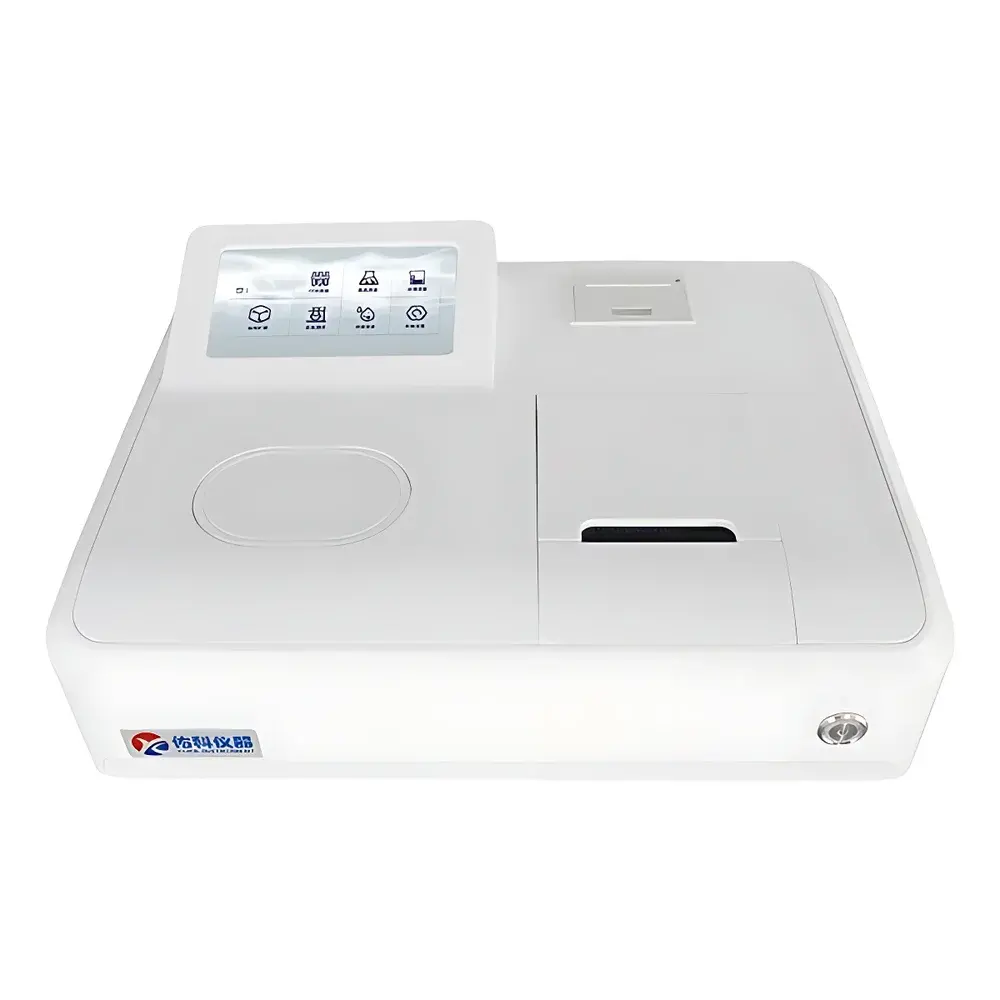
Yoke IT-1003 Total Phosphorus Analyzer
| Brand | Yoke |
|---|---|
| Origin | Shanghai, China |
| Manufacturer Type | Direct Manufacturer |
| Model | IT-1003 |
| Application | Laboratory-Based Water Quality Analysis |
| Measurement Principle | Molybdate Spectrophotometry (UV-Vis, 700 nm) |
| Measurement Range | 0.01–15 mg/L (multi-range auto-segmentation) |
| Accuracy | ≤8% RSD at mid-range (1–5 mg/L) |
| Detection Limit | 0.01 mg/L |
| Resolution | 0.01 mg/L |
| Display | 5.6-inch capacitive color touchscreen (800×480) |
| Data Storage | ≥5,000 records (internal) |
| Calibration Curves | 5 factory-loaded + 195 user-expandable |
| Connectivity | USB 2.0, RS-232 serial port |
| Light Source | Long-life cold LED (≥100,000 h), narrow-band interference filter system |
| Processor | ARM9 core with 512 MB flash memory |
| Compliance | GB/T 11893–1989 (Total Phosphorus in Water – Molybdenum Antimony Spectrophotometric Method) |
Overview
The Yoke IT-1003 Total Phosphorus Analyzer is a dedicated benchtop spectrophotometric instrument engineered for precise, routine quantification of total phosphorus (TP) in environmental water samples—including surface water, wastewater effluent, drinking water sources, and industrial process streams. It operates on the internationally recognized molybdate antimony spectrophotometric method (aligned with GB/T 11893–1989 and equivalent to ISO 6878:2004 and ASTM D515-18), wherein orthophosphate—released after persulfate digestion of all phosphorus species—is complexed with ammonium molybdate and potassium antimonyl tartrate under acidic conditions to form a phosphomolybdenum blue complex. Absorbance is measured at 700 nm using a stable cold LED light source and high-transmission narrow-band optical filters, ensuring minimal spectral drift and long-term photometric stability. Designed exclusively for laboratory use, the IT-1003 delivers trace-level sensitivity (LOD = 0.01 mg/L) and reproducible quantification across three calibrated sub-ranges (0.01–0.5, 0.5–5, and 5–15 mg/L), enabling accurate analysis without manual dilution or range switching.
Key Features
- 5.6-inch high-resolution color touchscreen interface with intuitive graphical navigation—designed for rapid method selection, real-time calibration verification, and one-touch data review.
- Dual-wavelength optical architecture with precision narrow-band interference filters and thermally stabilized LED source (rated >100,000 hours), eliminating lamp replacement and minimizing baseline drift.
- Onboard ARM9 processor with 512 MB non-volatile memory—supports fast spectral acquisition, multi-curve interpolation, and real-time correction for pathlength and background scatter.
- Built-in thermal line printer for immediate hardcopy output of current measurements, calibration logs, and stored datasets—fully traceable and audit-ready.
- Comprehensive curve management: 5 pre-validated factory curves compliant with GB/T 11893–1989; up to 195 user-defined calibration sets with adjustable slope (K-factor) and intercept parameters for matrix-specific compensation.
- Integrated USB 2.0 and RS-232 interfaces enable seamless data export to LIMS, Excel, or third-party QA/QC software—no proprietary drivers required.
- Optimized for use with standardized pre-dosed reagent kits (e.g., Lab-YY TP Digestion & Color Development Kits), reducing analyst error and improving inter-laboratory comparability.
Sample Compatibility & Compliance
The IT-1003 accepts standard 10 mm or 20 mm rectangular quartz or high-transmission glass cuvettes (10–50 mL volume). It accommodates clarified, filtered, or digested aqueous matrices per EPA 365.1, ISO 6878, and GB/T 11893–1989 protocols. Sample pretreatment—including alkaline persulfate oxidation (for total phosphorus conversion)—must be performed externally using certified digestion blocks or autoclaves. The instrument itself meets IEC 61010-1 safety requirements for laboratory electrical equipment and complies with electromagnetic compatibility (EMC) standards EN 61326-1. While not FDA 21 CFR Part 11–certified out-of-the-box, its audit trail functionality—including timestamped calibration events, user ID logging (via optional password protection), and immutable data storage—supports GLP/GMP-aligned documentation practices when deployed within validated laboratory workflows.
Software & Data Management
All measurement data—including absorbance values, concentration results, calibration coefficients, date/time stamps, and operator IDs—are stored in a structured binary format within internal flash memory. Users may export datasets as CSV via USB drive in real time or batch mode. No cloud connectivity or remote access is implemented—ensuring full data sovereignty and compliance with institutional cybersecurity policies. The embedded firmware supports firmware updates via USB, with version-controlled release notes and checksum validation. Data integrity is preserved through cyclic redundancy checks (CRC-32) on all stored records, and no data overwrite occurs unless explicitly confirmed by the operator.
Applications
- Regulatory monitoring of TP in municipal wastewater discharge (per China’s GB 18918–2002 Class I–III limits)
- Source water quality assessment for reservoirs and rivers under national surface water standards (GB 3838–2002)
- Process control in phosphate removal units and tertiary treatment facilities
- Research-grade phosphorus cycling studies in limnology and aquatic biogeochemistry
- QA/QC verification of commercial TP test kits and field-deployable sensors
- Academic teaching labs requiring ISO/GB-compliant, hands-on spectrophotometric methodology instruction
FAQ
Does the IT-1003 perform digestion automatically?
No. Digestion of organic and condensed phosphorus species into orthophosphate must be conducted separately using external high-temperature persulfate oxidation equipment prior to analysis.
Can the instrument store calibration curves for multiple analytes simultaneously?
Yes—up to 200 total curves (5 factory + 195 user-defined) can be retained in non-volatile memory, each assignable to specific reagent lots or sample matrices.
Is the 0.01 mg/L detection limit achievable in all sample types?
The stated LOD applies to deionized water blanks under optimal optical conditions; real-world matrices (e.g., colored or turbid wastewater) may require dilution or additional filtration to maintain accuracy.
What cuvette pathlengths are supported?
The optical bench is configured for 10 mm and 20 mm standard rectangular cuvettes; custom pathlengths require firmware recalibration and are not recommended without technical validation.
How frequently must the instrument be recalibrated?
Factory calibration remains stable for ≥6 months under normal lab conditions; however, daily verification with a mid-range standard (e.g., 2.5 mg/L P) is advised per ISO/IEC 17025 quality requirements.







