
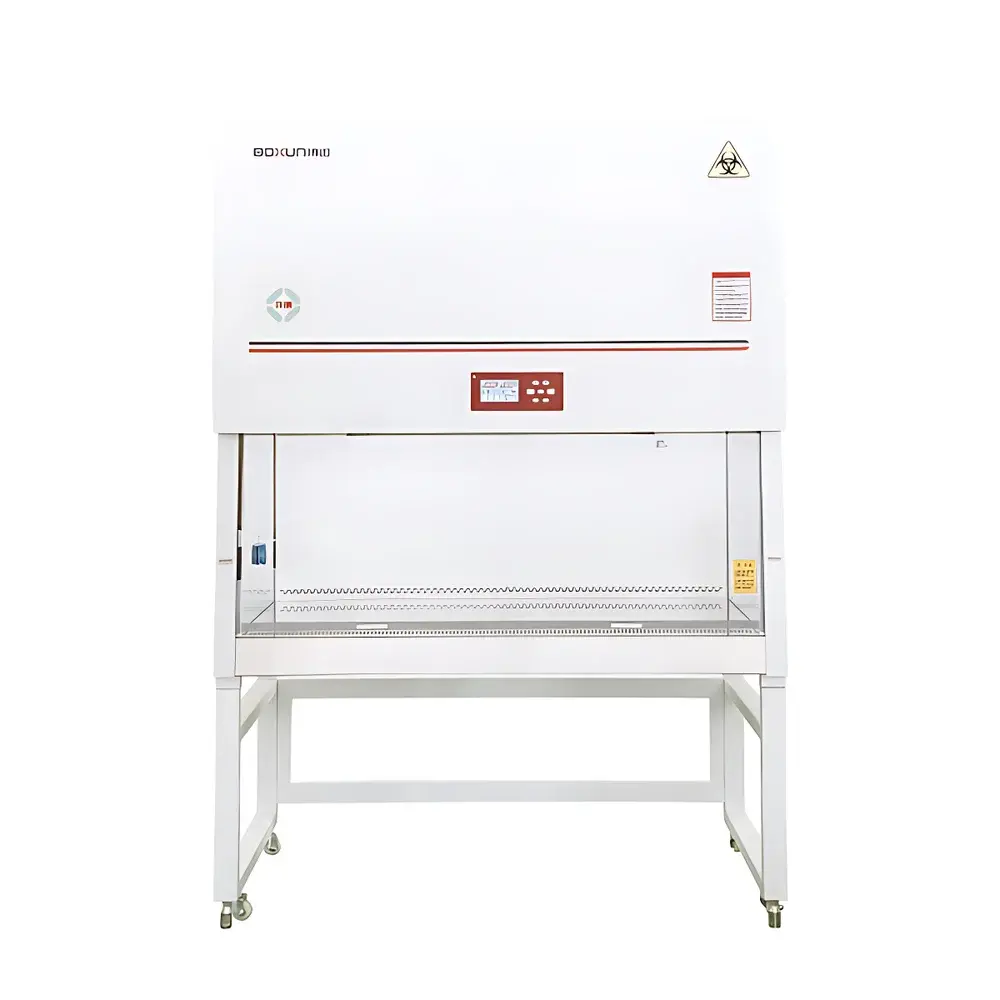
BOXUN BGSC-1360A2 Class II Type A2 Biological Safety Cabinet
| Brand | BOXUN |
|---|---|
| Origin | Shanghai, China |
| Manufacturer Type | Direct Manufacturer |
| Regional Category | Domestic (China) |
| Model | BGSC-1360A2 |
| Instrument Type | Class II Type A2 Biological Safety Cabinet |
| External Dimensions (L×W×H) | 1500 × 770 × 2135 mm |
| Internal Work Area Dimensions (L×W×H) | 1360 × 580 × 595 mm |
| HEPA Filter Efficiency (at 0.3 µm) | ≥99.995% |
| Airflow Pattern | 70% recirculated, 30% exhausted |
| Average Inflow Velocity | 0.55 m/s |
| Average Downflow Velocity | 0.35 m/s |
| Downflow Velocity Control Accuracy | ±0.02 m/s |
| Noise Level | ≤67 dB(A) |
| Vibration Half-Peak Amplitude | ≤5 µm |
| Average Illuminance | ≥650 lux |
| Operating Temperature Range | 10–30 °C |
| Relative Humidity Limit | ≤70% RH (at 25 °C) |
| Atmospheric Pressure Range | 80–105 kPa |
| Personnel Protection Factor (KI test) | ≥1 × 10⁵ |
| Product Protection (Colony Count) | ≤5 CFU/test |
| Cross-Contamination Protection (Impactor Sampler) | ≤2 CFU/test |
| Lighting/UV Lamp | 30 W × 1 / 30 W × 1 |
| Total Power Consumption | 1.4 kW (including outlet load) |
| Electrical Supply | AC 220 V ±10%, 50/60 Hz |
| Compliance Standard | YY 0569–2011 |
Overview
The BOXUN BGSC-1360A2 is a certified Class II, Type A2 biological safety cabinet engineered for simultaneous personnel, product, and environmental protection in microbiological, cell culture, and molecular biology laboratories. It operates on the principle of inward airflow (inflow) for operator protection and downward laminar airflow (downflow) for product sterility—both conditioned through dual-stage filtration. Air entering the work area is drawn across the front aperture at a nominal inflow velocity of 0.55 m/s, then passes through a pre-filter and a certified HEPA filter (ISO 5, ≥99.995% efficiency at 0.3 µm), with 70% recirculated and 30% exhausted via a dedicated ducted or thimble-connected system. Its aerodynamic design adheres strictly to YY 0569–2011—the Chinese national standard aligned with NSF/ANSI 49 and EN 12469 requirements—ensuring validated containment performance under variable filter loading and operational conditions.
Key Features
- Intelligent AirClean™ Control System featuring a high-resolution color LCD interface displaying real-time inflow/downflow velocities, HEPA service life estimation, and status indicators for UV lamp, lighting, blower, and power outlets—with bilingual (English/Chinese) fault alerts and calendar/time synchronization.
- Programmable UV sterilization scheduling with calendar-based activation, minimizing ozone exposure and eliminating manual oversight errors.
- Dual interlock safety: UV lamps deactivate automatically when the main lighting is switched on; front sash position is continuously monitored to prevent airflow disruption—audible and visual alarms trigger if sash exceeds safe height limits (±10 mm).
- Smart Constant-Airflow Technology using dual high-precision hot-wire anemometers to dynamically regulate blower output; maintains downflow stability within ±0.02 m/s even as filter resistance increases by up to 50%, limiting airflow decay to <10%.
- Structural integrity and ergonomics: 10° inclined tempered glass sash reduces glare and enhances user comfort; seamless SUS304 stainless steel work surface with integral radius corners and removable, drain-equipped tray for efficient decontamination.
- ULPA-grade upgrade option available (ISO 4, ≥99.9995% @ 0.3 µm), supporting ultra-sensitive applications requiring enhanced particulate retention.
Sample Compatibility & Compliance
The BGSC-1360A2 accommodates standard biosafety workflows involving BSL-2 agents and select BSL-3 procedures when integrated with appropriate facility engineering controls. Its internal chamber (1360 × 580 × 595 mm) supports dual-user operation and accommodates common lab equipment including centrifuges, pipette aids, and small incubators. All critical performance metrics—including personnel protection (KI aerosol challenge, PF ≥1 × 10⁵), product protection (≤5 CFU/test), and cross-contamination control (≤2 CFU/test)—are verified per YY 0569–2011 Annexes A–C. The cabinet is suitable for GLP-compliant environments and may be configured for FDA 21 CFR Part 11–aligned audit trails when paired with optional networked data logging modules.
Software & Data Management
While the base unit operates via embedded firmware without external PC dependency, the AirClean™ controller logs timestamped operational events—including sash position changes, UV cycle completion, filter pressure differential thresholds, and alarm triggers—for local review. Optional RS485 or Ethernet interfaces enable integration into centralized laboratory infrastructure management systems (LIMS/LabVantage). All logged data are stored in non-volatile memory with write-protection, supporting traceability for ISO/IEC 17025 or CAP-accredited quality audits. Firmware updates are performed via secure USB key with version-controlled checksum validation.
Applications
- Primary and secondary cell culture maintenance under sterile conditions
- Recombinant DNA manipulation and plasmid transfection workflows
- Antibiotic susceptibility testing and microbial isolation protocols
- Pharmaceutical aseptic processing support (non-sterile compounding, media preparation)
- Viral vector handling where low-level aerosol generation is anticipated
- Environmental monitoring sample preparation in clinical and public health labs
FAQ
Does the BGSC-1360A2 require external ducting?
Yes—Type A2 cabinets must be connected to a dedicated exhaust system or thimble-mounted canopy to safely evacuate 30% of total airflow; recirculation-only operation is not permitted.
Can the cabinet be validated for ISO 14644-1 Class 5 (formerly Class 100) cleanroom equivalence?
Yes—the downflow uniformity, particle count (<3,520 particles/m³ @ 0.5 µm), and turbulence-free laminarity meet ISO 14644-1 requirements when operated per manufacturer specifications and maintained with certified HEPA filters.
Is the UV lamp intensity monitored in real time?
No—intensity is not actively measured, but the system estimates remaining UV lamp efficacy based on cumulative runtime and triggers replacement alerts when projected output falls below 70% of initial irradiance.
What electrical safety certifications does the unit hold?
It complies with GB 4793.1–2019 (equivalent to IEC 61010-1) for laboratory electrical equipment, including insulation resistance, leakage current, and grounding continuity testing.
How often should the HEPA filter be replaced?
Filter service life depends on usage intensity and ambient air quality; typical replacement intervals range from 18 to 36 months, with automated alerts triggered when pressure differential exceeds 250 Pa above baseline or when airflow deviation exceeds tolerance limits.




