
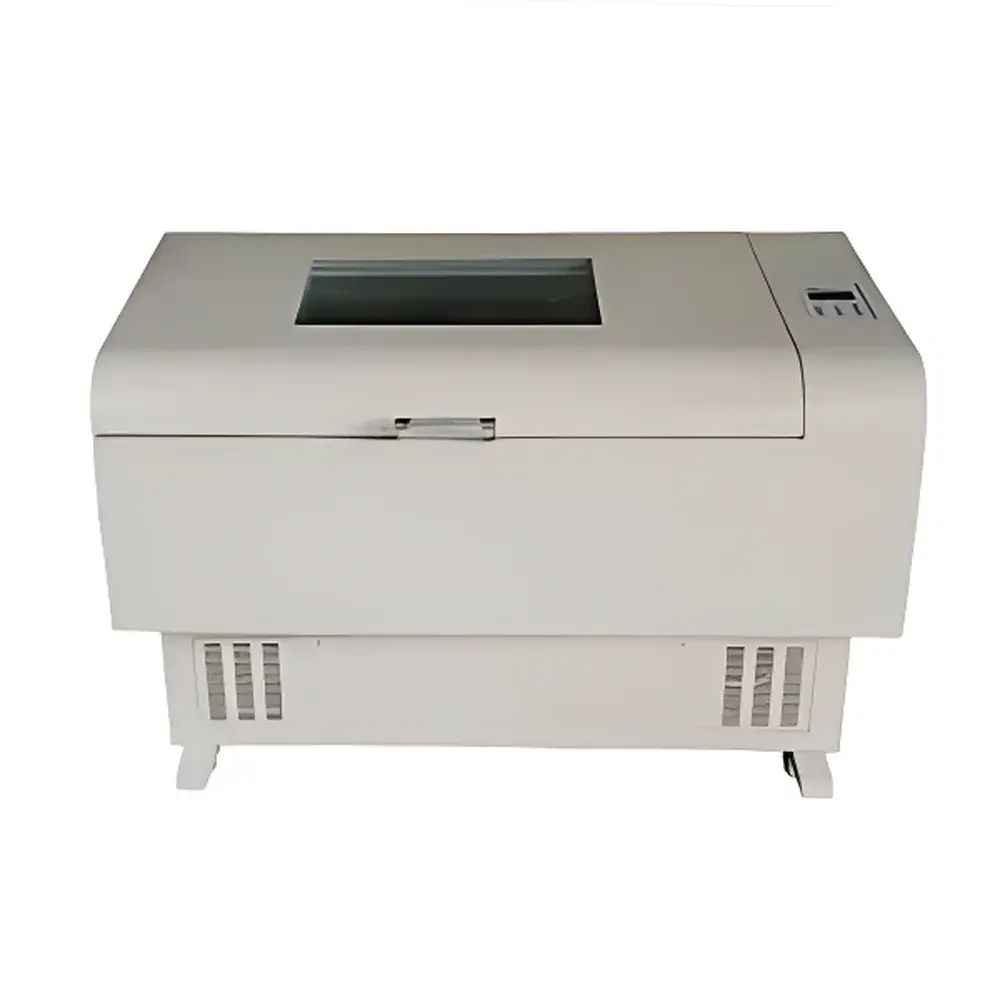
Boxun BSD-WX(F)2350 High-Capacity Horizontal Incubator Shaker
| Brand | Boxun |
|---|---|
| Origin | Shanghai, China |
| Manufacturer Type | Direct Manufacturer |
| Product Category | Domestic |
| Model | BSD-WX(F)2350 |
| Instrument Type | Temperature-Controlled Orbital/Reciprocating Shaker |
| Timer Range | 0–999 h |
| Orbital Speed | 30–300 rpm |
| Reciprocating Speed | 30–250 rpm |
| Orbital Amplitude | Φ26 mm |
| Reciprocating Amplitude | 0–50 mm |
| Temperature Range | 4–60 °C |
| Shelf Quantity | 1 |
Overview
The Boxun BSD-WX(F)2350 is a high-capacity horizontal incubator shaker engineered for precision-controlled cell culture, microbial fermentation, enzymatic assays, and biochemical reaction kinetics under tightly regulated thermal and mechanical conditions. Designed with dual-mode oscillation—orbital (circular) and reciprocating (linear)—this instrument supports reproducible suspension-based biological processes across life science laboratories, pharmaceutical R&D facilities, and bioprocess development centers. Its robust stainless-steel chamber, forced-air convection system, and PID-driven temperature regulation ensure uniform thermal distribution (±1 °C at 25 °C, unloaded) and exceptional stability (±0.2 °C at 37 °C), meeting the environmental consistency requirements of ISO 13485-compliant QC workflows and GLP-aligned experimental protocols.
Key Features
- Intelligent microprocessor controller with audible/visual alarm system for real-time monitoring of temperature deviation, motor overload, and power interruption events.
- Backlit LCD display showing setpoints and real-time values for temperature, speed, amplitude, and remaining time—enabling immediate operational verification without external software.
- Programmable multi-segment curve control (up to 10 segments) for complex incubation-shaking profiles, supporting time-dependent induction or gradient-based assay development.
- Brushless DC motor drive delivering consistent torque across the full speed range (30–300 rpm orbital / 30–250 rpm reciprocating), eliminating carbon brush wear and ensuring long-term rotational stability—even at low-speed agitation critical for fragile cell lines.
- Patented defrost algorithm minimizing temperature fluctuation during defrost cycles, preserving sample integrity in extended-duration experiments.
- Enhanced safety architecture including independent over-temperature cutoff, door interlock switch, and dedicated current-limiting circuitry for motor protection.
- Electrostatically coated steel exterior and electropolished 316 stainless-steel interior chamber with rounded corners and seamless welds for ease of decontamination and compliance with biosafety level 2 (BSL-2) cleaning standards.
- Modular shelf design with tool-free bottle clamp interchange—compatible with standard Erlenmeyer flasks (50–5000 mL) and custom vessel configurations—reducing setup time between experimental runs.
Sample Compatibility & Compliance
The BSD-WX(F)2350 accommodates heterogeneous sample formats, including shake flasks (2000 mL × 8 standard loading), culture bags, multi-well plates (with optional adapter), and custom bioreactor vessels. Its 970 × 605 mm (orbital) or 950 × 635 mm (reciprocating) platform supports both aerobic and anaerobic applications; an integrated inert gas inlet enables nitrogen or argon purging for oxygen-sensitive cultures. The unit complies with IEC 61010-1:2010 for laboratory equipment safety and meets electromagnetic compatibility (EMC) requirements per EN 61326-1. While not certified for medical device manufacturing per FDA 21 CFR Part 820, its data logging capability (when paired with optional printer or PC interface) supports audit-ready documentation for internal SOPs and regulatory submissions under ISO/IEC 17025.
Software & Data Management
The embedded controller records timestamped temperature and speed data internally. Optional accessories—including a thermal printer (supporting real-time curve output) and GPRS-enabled remote alert module—extend traceability and enable proactive intervention during unattended operation. When connected via RS-232 or USB to a host computer running Boxun’s proprietary LabLink software (Windows-compatible), users can export CSV-formatted datasets for integration into LIMS environments or statistical analysis platforms such as JMP or GraphPad Prism. All parameter changes are logged with user ID and timestamp, satisfying basic ALCOA+ principles for data integrity in non-GxP research settings.
Applications
- Mammalian and insect cell suspension culture under controlled dissolved oxygen mimicry (via orbital shaking optimization).
- High-yield recombinant protein expression in E. coli and yeast systems requiring precise temperature ramping and agitation synchronization.
- Enzyme kinetic studies involving immobilized or soluble catalysts where shear stress must remain within defined hydrodynamic limits.
- Environmental microbiology assays assessing pollutant biodegradation rates under simulated natural mixing conditions.
- Preclinical formulation stability testing of biologics under accelerated thermal-mechanical stress.
- Vaccine adjuvant development requiring consistent antigen dispersion in aqueous suspensions.
FAQ
What is the maximum flask capacity supported on the platform?
The platform accommodates up to eight 2000 mL Erlenmeyer flasks as standard configuration; alternative loadings include fifty 50 mL tubes or seven 5000 mL carboys—subject to center-of-gravity constraints and recommended fill ratios.
Does the unit support validation protocols for regulated environments?
While not pre-validated for GMP production, the BSD-WX(F)2350 provides configurable calibration points, digital audit trails (with optional PC link), and hardware-level redundancy (dual temperature sensors, independent limit thermostat) suitable for IQ/OQ execution by qualified personnel.
Can the shaker operate continuously for 999 hours without manual intervention?
Yes—the timer function supports uninterrupted operation up to 999 hours, after which the system halts motion, activates visual/audible alarms, and maintains set temperature until manually reset.
Is the reciprocating mode suitable for tissue dissociation protocols?
The linear oscillation mode (0–50 mm amplitude, 30–250 rpm) delivers controlled mechanical shear appropriate for gentle primary tissue disaggregation when combined with enzymatic digestion buffers.
What maintenance is required for long-term reliability?
No routine lubrication is needed due to sealed imported bearings and brushless motor design; annual verification of temperature uniformity and speed accuracy using NIST-traceable calibrators is recommended.




