AudioBox by NewBehavior – Sound Conditioning Chamber for Socially Housed Rodents
| Brand | TSE Systems |
|---|---|
| Origin | Germany |
| Model | AudioBox by NewBehavior |
| Application | Automated Auditory Operant Conditioning in Group-Housed Mice/Rats |
| Integration | Compatible with IntelliCage platform |
Overview
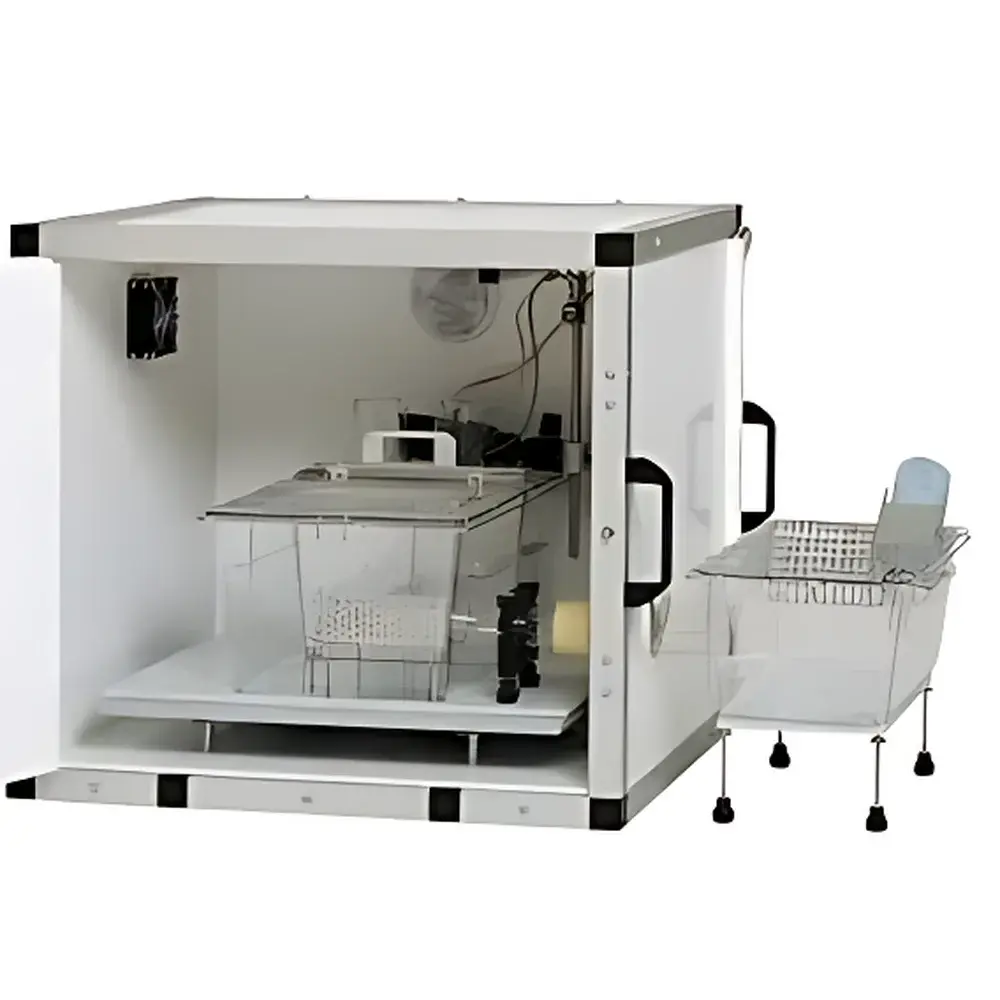
The AudioBox by NewBehavior is a purpose-built, acoustically isolated conditioning chamber designed for ethologically relevant auditory operant behavioral testing in group-housed rodents. Engineered as an add-on module to the IntelliCage system, it enables precise, automated sound-based learning paradigms without disrupting social housing—a critical advancement for translational neuroscience and behavioral pharmacology studies. The device operates on the principle of spatially confined auditory stimulus delivery combined with real-time, RFID-based individual animal identification and response tracking. Each AudioBox unit interfaces directly with the IntelliCage control unit via standardized digital I/O, allowing synchronized presentation of tonal or broadband acoustic stimuli (e.g., pure tones, frequency-modulated sweeps, gap-detection sequences) alongside contingent reinforcement (air puff, sucrose reward) or punishment protocols. Its construction features 40 dB(A) acoustic attenuation across 125 Hz–8 kHz, verified per ISO 717-1, ensuring minimal cross-chamber interference and high-fidelity stimulus fidelity essential for psychophysical threshold determination.
Key Features
- Acoustically shielded chamber (40 dB(A) insertion loss) with calibrated wideband speaker (20 Hz–20 kHz ±1.5 dB) and calibrated condenser microphone for stimulus verification
- Integrated RFID antenna array enabling continuous, non-invasive identification of individually tagged mice/rats entering or occupying the conditioned zone
- Full hardware synchronization with IntelliCage: leverages existing corner logic, door actuation, reward dispensing, and air-puff modules
- Programmable stimulus parameters: frequency, intensity (20–90 dB SPL), duration, inter-stimulus interval, and adaptive staircase protocols
- Modular design—mounts directly onto standard IntelliCage corners without structural modification; supports up to four AudioBoxes per cage
- Robust aluminum chassis with ESD-safe interior coating and IP54-rated external connectors for long-term vivarium deployment
Sample Compatibility & Compliance
The AudioBox is validated for use with C57BL/6, BALB/c, DBA/2, and CD-1 mice, as well as Sprague-Dawley and Wistar rats (body weight range: 18–50 g). It maintains full compatibility with standard polycarbonate home cages (e.g., Tecniplast Sealsafe Plus, Allentown A-Bio) when integrated into IntelliCage configurations. All electronic components comply with IEC 61000-6-3 (EMC emission limits) and IEC 61000-6-2 (immunity to electrostatic discharge and RF fields). The system supports GLP-compliant data acquisition: raw stimulus timestamps, animal ID, door state, reward delivery, and microphone-triggered response latency are logged with microsecond resolution and stored in HDF5 format with embedded metadata (ISO/IEC 17025 traceability framework). Audit trails and user access logs meet FDA 21 CFR Part 11 requirements when deployed with TSE’s LabMaster software suite.
Software & Data Management
Control and protocol definition occur through TSE’s LabMaster v5.x software, which provides a graphical workflow editor for auditory discrimination tasks (e.g., go/no-go, two-alternative forced choice, gap detection). Stimulus waveforms are generated in real time using DDS (Direct Digital Synthesis) architecture, eliminating file-based playback artifacts. All behavioral events—including entry into the conditioned zone, nose-poke initiation, stimulus onset, and reinforcement delivery—are time-stamped against a common NTP-synchronized clock across distributed IntelliCage nodes. Export options include CSV (for MATLAB/Python analysis), JSON-LD (for FAIR-aligned data repositories), and direct integration with EthoVision XT via API. Raw audio recordings (24-bit/96 kHz) and event-locked spectrograms can be archived with configurable compression to minimize storage footprint without compromising spectral resolution.
Applications
- Frequency discrimination and pitch perception thresholds in genetic mouse models of hearing loss (e.g., Cdh23ahl, Tmc1Bth)
- Gap detection assays for pre-pulse inhibition (PPI) and sensorimotor gating deficits in schizophrenia-relevant models
- Temporal processing deficits in aging rodent cohorts or neurodegenerative models (e.g., APP/PS1, tau P301L)
- Pharmacological modulation of auditory cortex plasticity (e.g., effects of D-cycloserine, memantine, or HDAC inhibitors)
- Longitudinal assessment of tinnitus-like behavior using conditioned suppression paradigms
- Validation of auditory brainstem response (ABR) findings with ethologically grounded behavioral readouts
FAQ
Can the AudioBox be used independently of IntelliCage?
No—the AudioBox requires the IntelliCage control unit for power, timing synchronization, RFID interrogation, and peripheral actuation. It is not a standalone system.
What is the minimum recommended group size for reliable data collection?
Studies demonstrate robust statistical power with n = 8–12 socially housed mice per cage; smaller groups (<6) may require extended training durations due to reduced spontaneous interaction rates.
Is calibration documentation provided for acoustic output?
Yes—each unit ships with a factory calibration certificate (traceable to PTB, Germany) including SPL vs. frequency response curves, harmonic distortion measurements (<0.8% THD at 80 dB SPL), and microphone sensitivity verification.
How is sound leakage between adjacent AudioBoxes mitigated?
Chambers are physically decoupled via vibration-damping mounts, and acoustic baffles are installed between units in multi-box configurations. Empirical crosstalk testing confirms <−60 dB signal coupling at 4 kHz under operational conditions.
Does the system support closed-loop adaptive testing?
Yes—LabMaster supports real-time performance-based parameter adjustment (e.g., dynamic stimulus intensity staircasing, variable inter-trial intervals based on recent accuracy), implemented via embedded Lua scripting engine.