
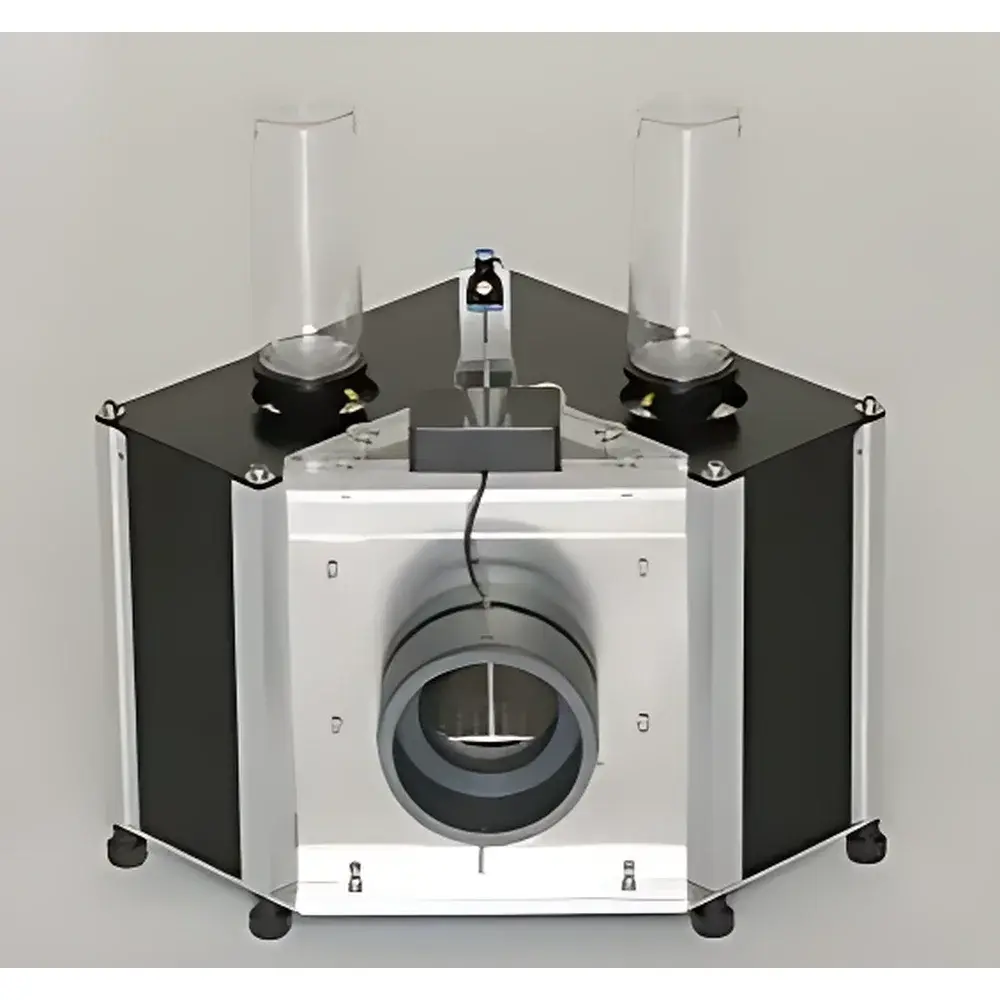
TSE Systems IntelliCage for Rats (NewBehavior Platform)
| Brand | TSE Systems |
|---|---|
| Origin | Germany |
| Manufacturer Type | Authorized Distributor |
| Origin Category | Imported |
| Model | IntelliCage for Rats by NewBehavior |
| Pricing | Available Upon Request |
Overview
The TSE Systems IntelliCage for Rats is a fully automated, home-cage-based behavioral phenotyping platform engineered for longitudinal, experimenter-independent assessment of cognitive and adaptive behaviors in group-housed rats. Built upon the validated NewBehavior architecture—originally developed for mice—the system extends high-resolution operant testing into the rat model using radio-frequency identification (RFID) via implantable or transponder-based transponders operating in the 134.2 kHz ISM band. Each IntelliCage unit implements a quadrilateral arena with four identical, independently programmable learning corners, enabling simultaneous, parallel behavioral monitoring of up to 16 rats under Swiss Animal Welfare Ordinance-compliant housing densities (≤16 rats per 1,200 × 1,200 mm floor area). The system operates on the principle of operant conditioning within ethologically relevant spatial contexts: animals initiate trials via nose-poke–activated access doors, receive real-time feedback (rewarded water access or aversive air-puff), and are tracked continuously across time–space domains without human intervention. This architecture supports both spontaneous exploration and structured learning paradigms—including spatial memory, reversal learning, temporal discrimination, and response inhibition—while preserving natural social dynamics and minimizing handling-induced stress.
Key Features
- Four autonomous, sensor-integrated learning corners per cage, each equipped with dual nose-poke–actuated access doors, dual independent water bottles, multi-color status LEDs, and pneumatic air-puff delivery for negative reinforcement
- Integrated 134.2 kHz RFID transponder reader per corner for unambiguous, continuous animal identification—even during overlapping occupancy or rapid transitions
- Onboard environmental monitoring: corner-level temperature and ambient light intensity sensors log microenvironmental conditions synchronized with behavioral events
- Real-time trial logging and online data streaming via Ethernet-connected control unit; no manual observation or scoring required
- Modular physical configuration: units support horizontal benchtop placement or vertical stacking on standard laboratory shelving systems (compatible with ISO 9001-certified rack infrastructure)
- Pre-validated behavioral protocols including place preference, spatial alternation, active avoidance, DRL (differential reinforcement of low rates), and fixed-ratio schedules—fully customizable via graphical user interface
Sample Compatibility & Compliance
The IntelliCage for Rats accommodates Sprague-Dawley, Wistar, Long-Evans, and transgenic rat strains (e.g., APP/PS1, TauP301L) aged 8–24 weeks, with body weights ≤500 g. All hardware components comply with EU Directive 2010/63/EU on the protection of animals used for scientific purposes and meet Swiss Ordinance on Animal Protection (TSchV) Annex 3 requirements for group housing density, enrichment, and behavioral freedom. Software operation adheres to GLP-aligned data integrity standards: audit trails record all protocol modifications, user logins, and data export actions. System validation documentation supports compliance with ISO/IEC 17025 for accredited testing laboratories and facilitates alignment with FDA 21 CFR Part 11 when deployed in preclinical safety pharmacology studies.
Software & Data Management
The IntelliCage Rat Software Suite (v5.2+) provides an intuitive, workflow-driven interface for protocol design, real-time monitoring, and hierarchical data analysis. Core modules include Protocol Designer (drag-and-drop logic builder), Live Monitor (live heatmaps and event timelines), and BehaviorAnalyzer (automated extraction of latency, accuracy, perseveration, and session-specific learning curves). Optional add-ons include Quality Phenotyping Module (QPM) for standardized strain characterization and ChronoAnalyzer for circadian rhythm decomposition of activity and reward-seeking patterns. All raw data are stored in vendor-neutral HDF5 format with embedded metadata (animal ID, timestamp, corner address, sensor readings); exports support CSV, MATLAB (.mat), and Python-compatible NumPy arrays. Data backups follow NIST SP 800-88 Rev. 1 guidelines for media sanitization and retention.
Applications
- Longitudinal modeling of neurodegenerative progression in Alzheimer’s and Parkinson’s disease rat models, including early deficits in spatial working memory and behavioral flexibility
- Pharmacological screening of cognition-enhancing compounds under chronic dosing regimens, with automated detection of dose-dependent shifts in learning asymptotes
- Neurodevelopmental disorder research: assessment of social learning biases, attentional set-shifting, and response inhibition in prenatal valproate or MAM-exposed rats
- Environmental enrichment studies evaluating structural plasticity correlates of voluntary cognitive engagement in aging cohorts
- Translational validation of optogenetic or chemogenetic interventions targeting hippocampal–prefrontal circuits during active learning
FAQ
What RFID transponder types are compatible with the IntelliCage for Rats?
The system supports ISO 11784/11785-compliant FDX-B transponders (134.2 kHz), including TSE’s own TST-100 series and commercially available alternatives meeting EN13849-1 PL e safety certification.
Can the system distinguish between two rats occupying the same corner simultaneously?
Yes—each corner’s antenna employs time-division multiplexing and signal-strength thresholding to resolve sequential entries within 100 ms; simultaneous occupancy triggers distinct event flags and initiates collision-handling logic.
Is remote monitoring supported across institutional networks?
Yes—via secure HTTPS-enabled web interface and optional VPN integration; live data streams require minimum 10 Mbps upstream bandwidth per cage unit.
How is calibration maintained across long-term deployments?
Automated daily self-tests verify door actuation timing (±2 ms tolerance), LED spectral output (CIE 1931 xy coordinates), and air-puff pressure consistency (0.5–1.2 bar, calibrated against NIST-traceable manometer).
Does the software support integration with third-party electrophysiology or imaging platforms?
Yes—through TCP/IP API and TTL pulse synchronization ports; documented interfaces exist for integration with Spike2, NeuroExplorer, and Bruker ParaVision systems.





