
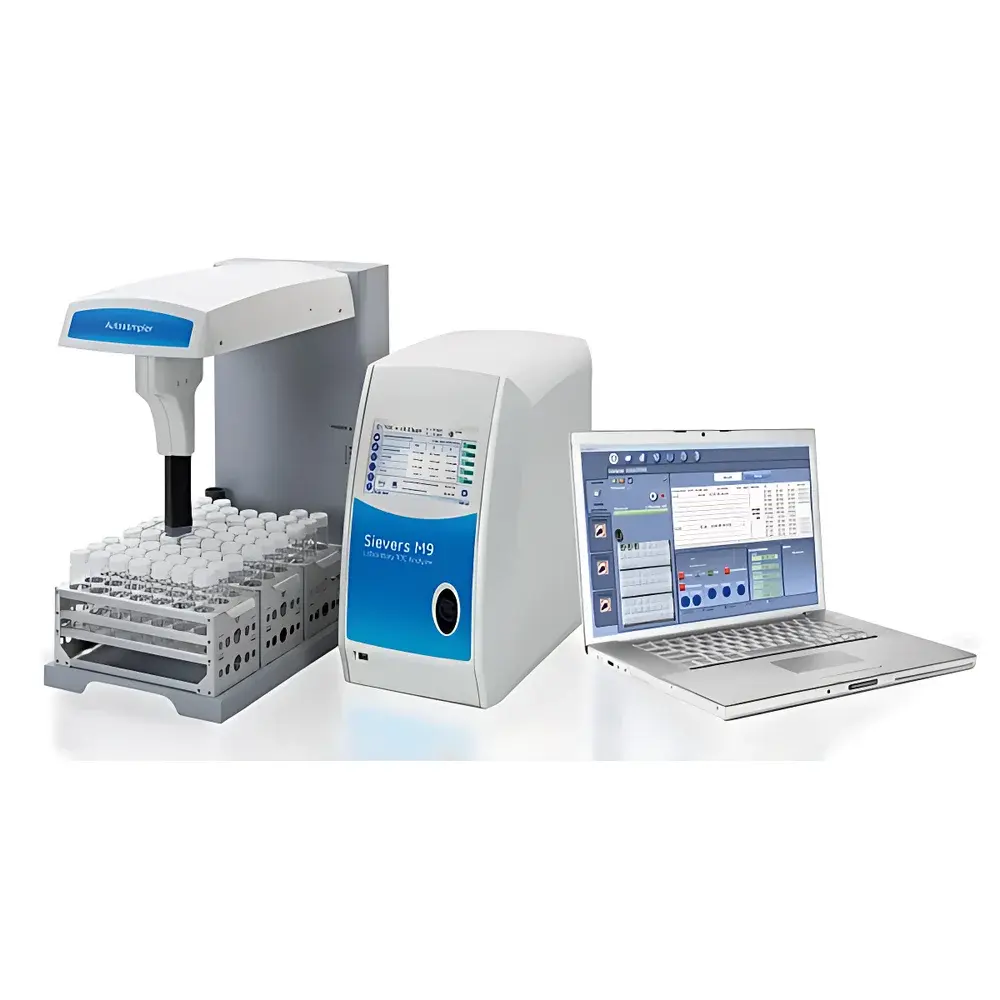
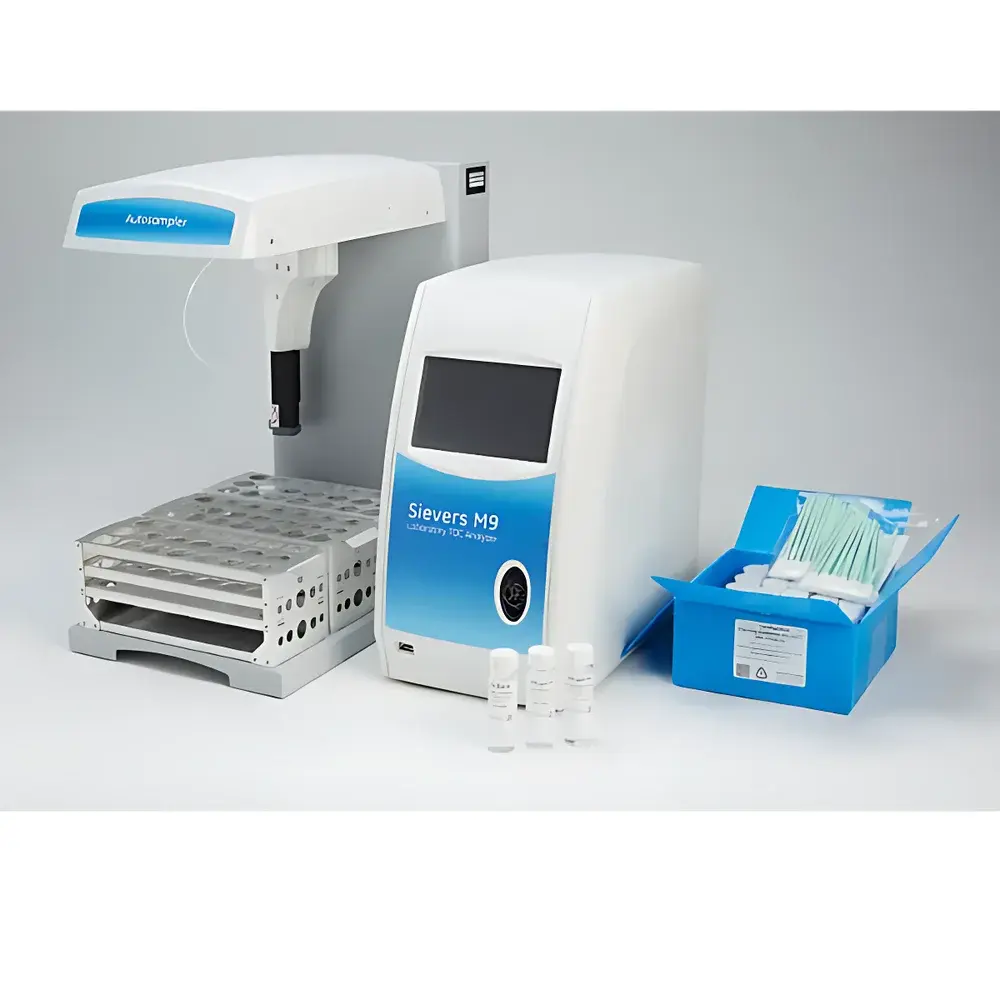
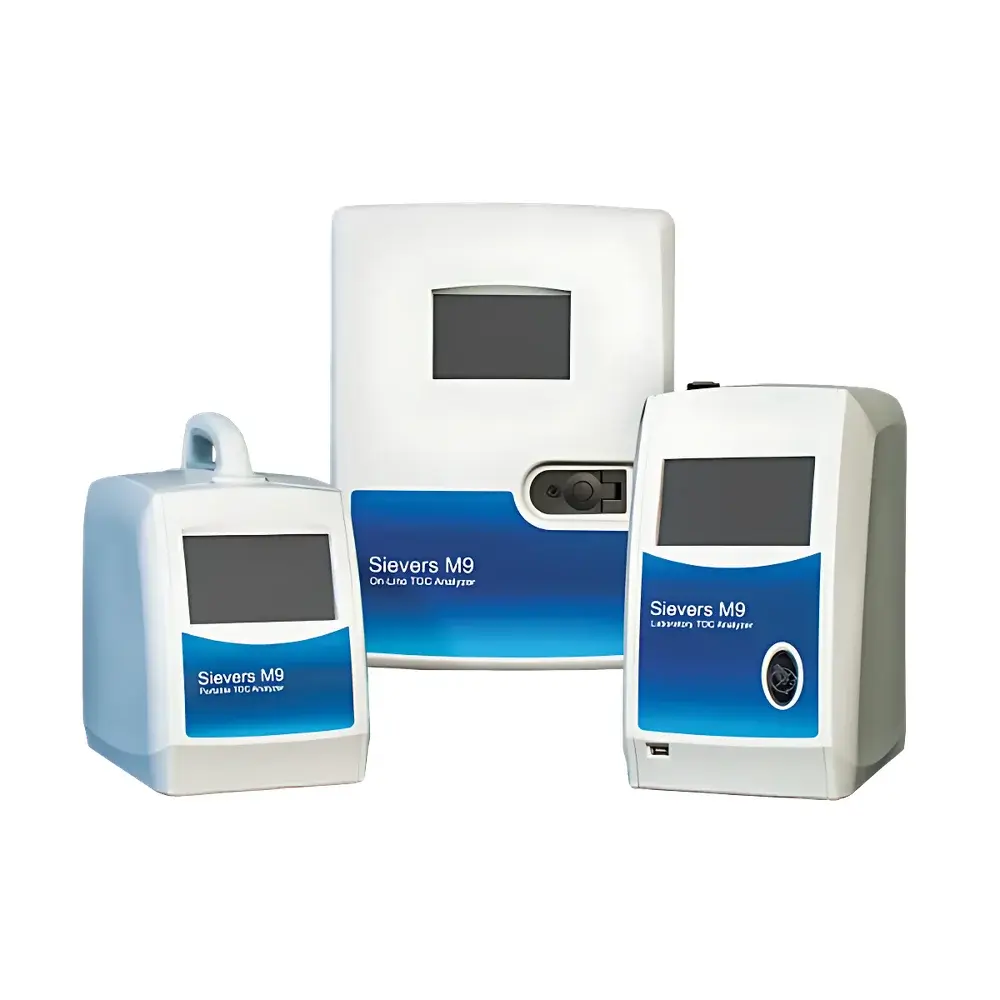
Sievers M9 Laboratory Total Organic Carbon (TOC) Analyzer
| Brand | Sievers (Veolia) |
|---|---|
| Origin | USA |
| Manufacturer Type | Original Equipment Manufacturer (OEM) |
| Product Category | Imported Instrument |
| Model | M9 Laboratory |
| Instrument Type | Laboratory TOC Analyzer |
| Detection Principle | Membrane Conductivity Detection |
| Oxidation Method | UV/Persulfate Oxidation |
| Measurement Range | 0.03 ppb – 50 ppm |
| Accuracy | ±2% or ±0.5 ppb (whichever is greater) |
| Resolution | 0.01 ppb |
| Detection Limit | 0.03 ppb |
| Repeatability | <1% RSD |
Overview
The Sievers M9 Laboratory Total Organic Carbon (TOC) Analyzer is a high-precision, regulatory-compliant analytical instrument engineered for pharmaceutical, biotechnology, and high-purity water quality laboratories. It employs a robust UV/persulfate oxidation method coupled with proprietary membrane conductivity detection to quantify non-purgeable organic carbon in aqueous samples. This dual-stage electrochemical measurement principle eliminates interferences from inorganic ions—such as chloride, sulfate, and nitrate—that commonly compromise traditional conductivity-based TOC systems. The M9 delivers trace-level quantification across an exceptionally wide dynamic range (0.03 ppb to 50 ppm), enabling accurate analysis of ultrapure water (UPW), purified water (PW), water for injection (WFI), cleaning validation rinse waters, and process streams without dilution or method switching.
Key Features
- Ultra-rapid analysis: Standard TOC measurement completed in ≤2 minutes; Turbo mode achieves full quantification in just 4 seconds—doubling throughput versus prior-generation instruments.
- Integrated conductivity measurement: Simultaneous TOC and initial conductivity analysis performed on the same sample aliquot in a single vial, eliminating cross-contamination risk and reducing manual handling errors.
- Regulatory-ready architecture: Firmware and software natively support JP (TOC), JP (conductivity), USP , EP 2.2.44, CP 0861, and IP 7320—including automated system suitability testing (SST), calibration verification, and audit-trail-compliant data management per FDA 21 CFR Part 11 and Annex 11 requirements.
- Self-optimizing fluidics: Intelligent reagent flow control dynamically adjusts oxidant and acid delivery per sample matrix, ensuring consistent oxidation efficiency across variable sample types and concentrations.
- Minimal maintenance footprint: 12-month calibration stability; annual preventive maintenance requires only ~3–4 hours; no external carrier gas or auxiliary reagent lines required.
- Intuitive human-machine interface: 7-inch WVGA color touchscreen with context-sensitive diagnostics, graphical fault navigation, and one-tap access to method templates, calibration logs, and real-time system status.
Sample Compatibility & Compliance
The M9 accepts discrete syringe-injected samples or integrates seamlessly with Sievers automated sampling systems supporting up to 120 positions. It accommodates sample temperatures from 5 °C to 95 °C and pressures up to 100 psi (with optional stainless-steel iOS module). Its validated performance meets stringent pharmacopeial acceptance criteria for PW and WFI under JP16, USP, EP, CP, and IP. All calibration standards, system suitability compounds (e.g., potassium hydrogen phthalate, sucrose), and calculation algorithms align precisely with JP specifications—distinct from USP/EP approaches—and are embedded directly in firmware. The instrument’s design conforms to IEC 61010-1 (safety) and IEC 61326-1 (EMC), and carries ETL and CE markings for global deployment in GLP/GMP environments.
Software & Data Management
Sievers M9 operates with embedded firmware and optional PC-based Sievers Insight™ Software, which provides role-based user access control, electronic signatures, full audit trail (including parameter changes, calibration events, and result modifications), and secure data export in CSV, PDF, and XML formats. Database architecture supports hierarchical sample grouping, customizable reporting templates, and keyword-driven search across years of archived results. All raw sensor outputs—including conductivity transients, oxidation current profiles, and baseline drift corrections—are retained with timestamps and metadata, satisfying ALCOA+ principles for data integrity. Modbus TCP/IP and USB host/device ports enable integration into LIMS and MES platforms without middleware.
Applications
- Pharmaceutical water system validation and routine monitoring (PW, WFI, clean steam condensate)
- Cleaning validation studies—quantifying residual organics in rinse waters from equipment and vessels
- Bioprocess monitoring of cell culture media, buffers, and final fill solutions
- Environmental compliance testing of low-TOC effluents and reclaimed water
- Research applications requiring ultra-trace carbon detection in semiconductor-grade UPW or nanoparticle suspensions
- Simultaneous TOC and conductivity trending for root cause analysis of water system excursions
FAQ
Does the M9 require carrier gas or external reagent reservoirs?
No—the M9 is fully self-contained. It uses integrated reagent cartridges and generates its own oxidizing environment via UV/persulfate chemistry, eliminating dependency on compressed air, nitrogen, or off-board acid/oxidant pumps.
How does the M9 handle high-chloride or high-salinity samples?
The membrane conductivity detector physically separates the oxidation chamber from the measurement cell, rejecting ionic interference while retaining CO₂-derived carbonate ions for selective detection—enabling reliable TOC quantification in saline matrices up to 10,000 ppm Cl⁻ without pretreatment.
Is the M9 compliant with FDA 21 CFR Part 11 for electronic records?
Yes. When used with Insight Software and configured with appropriate administrative controls (e.g., password policies, electronic signatures, and audit trail review protocols), the system satisfies all technical and procedural requirements for Part 11 compliance in regulated GxP environments.
What is the expected lifetime of the UV lamp and reagent cartridges?
UV lamps are rated for 6 months of continuous operation; acid and oxidant cartridges typically last 3–6 months depending on sample load and concentration. Cartridge replacement is tool-free and guided by on-screen prompts with automatic recalibration sequencing.
Can the M9 perform both TOC and conductivity measurements on the same sample without manual intervention?
Yes—its dual-channel electrochemical architecture acquires conductivity immediately upon sample introduction, followed automatically by UV/persulfate oxidation and TOC quantification—all within a single 2-minute cycle and using only one sample vial.







