
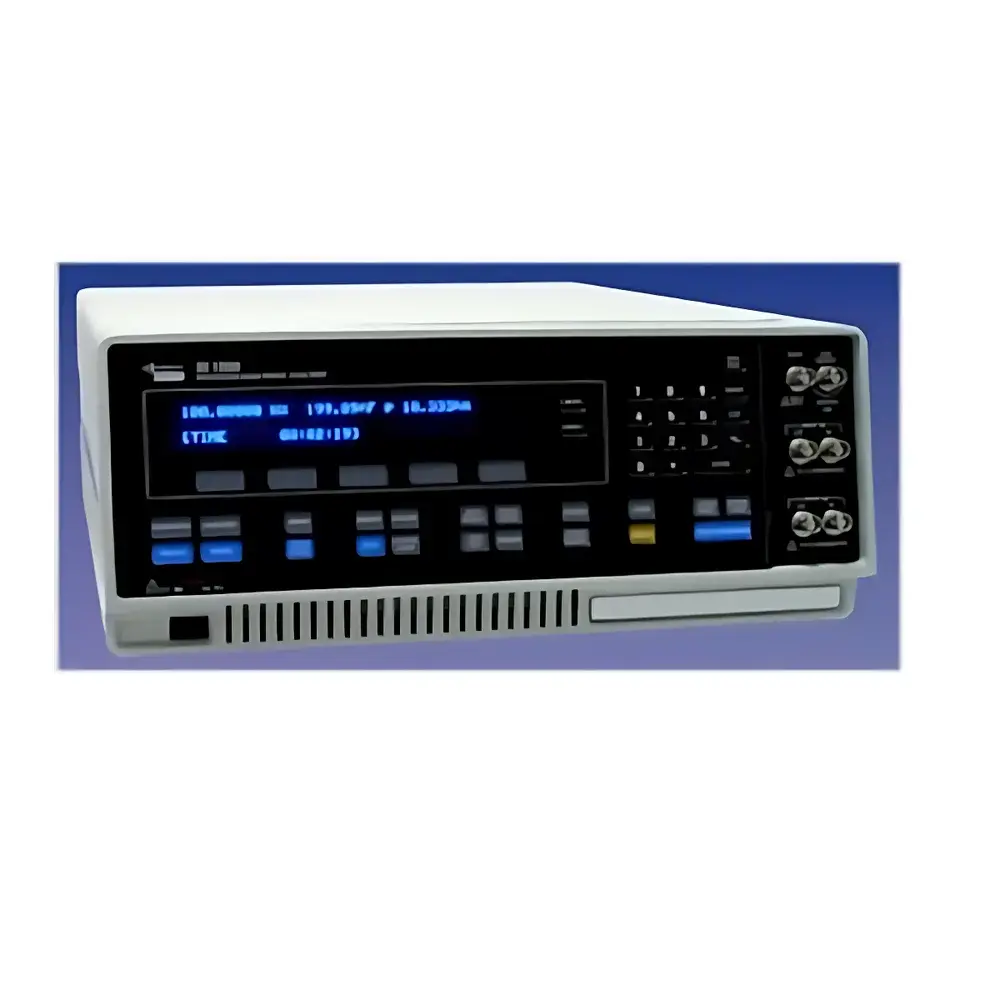
Solartron Analytical 1260A Solid-State Electrolyte Ionic Conductivity Measurement System
| Brand | Solartron Analytical |
|---|---|
| Origin | United Kingdom |
| Model | 1260A |
| Instrument Type | Multi-Channel Electrochemical Workstation |
| Current Range | ±60 mA |
| Current Accuracy | ±0.2% of reading |
| Potential Accuracy | ±0.2% of reading |
| Potentiostatic Range | ±40.95 V |
| AC Impedance Frequency Range | 10 µHz – 32 MHz |
| Phase Accuracy | ±0.1° |
| Magnitude Accuracy | ±0.1% |
| Frequency Resolution | 0.015 ppm |
| Core Technology | Single-Sine Correlation Method |
Overview
The Solartron Analytical 1260A Solid-State Electrolyte Ionic Conductivity Measurement System is a high-performance, multi-channel electrochemical workstation engineered for precision impedance spectroscopy and dynamic electrochemical characterization of solid-state ionic conductors. Operating on the principle of single-sine correlation frequency-domain analysis, the 1260A delivers exceptional signal-to-noise ratio and harmonic rejection—critical for resolving subtle dielectric relaxations, grain boundary contributions, and interfacial charge-transfer processes in ceramic electrolytes, polymer-in-salt membranes, and composite solid electrolytes. Its ultra-broad impedance bandwidth—from 10 µHz to 32 MHz—enables comprehensive mechanistic deconvolution across time constants spanning six orders of magnitude, supporting both low-frequency diffusion-limited kinetics and high-frequency dielectric response. Designed for materials R&D labs and battery development centers, the system meets the stringent requirements of solid-state battery qualification protocols, including those aligned with ASTM F3048 and ISO 18563 standards for impedance-based conductivity assessment.
Key Features
- Single-sine correlation architecture eliminates harmonic distortion and external electromagnetic interference—ensuring robust data acquisition even in unshielded laboratory environments.
- Multi-channel capability supports parallel testing of multiple solid electrolyte samples or electrode-electrolyte configurations under identical environmental conditions.
- High-resolution frequency stepping (0.015 ppm) enables precise identification of overlapping relaxation peaks in complex impedance spectra.
- ±40.95 V potentiostatic compliance range accommodates high-resistance solid electrolytes without voltage clipping or measurement saturation.
- ±60 mA current range with ±0.2% accuracy and ±0.1° phase resolution ensures quantitative differentiation between bulk ionic conduction and interfacial polarization effects.
- Integrated analog front-end with galvanostatic and potentiostatic control modes supports DC polarization, chronoamperometry, and step-scan EIS protocols.
Sample Compatibility & Compliance
The 1260A is routinely deployed for characterization of sintered oxide ceramics (e.g., LLZO, LATP), sulfide-based glasses (e.g., Li₆PS₅Cl), and polymer-ceramic composites (e.g., PEO-LiTFSI-Al₂O₃). It interfaces seamlessly with temperature-controlled probe stations (–40 °C to 200 °C), hermetic sample cells, and inert-atmosphere gloveboxes. Data integrity complies with GLP and GMP documentation requirements: audit trails, user-access controls, and electronic signature support are available via optional software modules aligned with FDA 21 CFR Part 11. All impedance measurements adhere to ISO 13320 (particle size by laser diffraction) and ASTM D7849 (impedance spectroscopy of energy storage materials) procedural frameworks.
Software & Data Management
Controlled via the modular SMaRT (Solartron Modular Real-Time) software suite, the 1260A provides real-time spectrum visualization, automated equivalent circuit fitting (using ZView or custom MATLAB-based models), and batch processing of multi-temperature impedance datasets. Raw data is exported in ASCII-compatible .smp format, compatible with third-party modeling tools including EC-Lab, Thales, and Python-based impedance.py libraries. The system supports time-stamped metadata logging—including ambient humidity, cell pressure, and thermal ramp rates—for full traceability in regulatory submissions and peer-reviewed publications.
Applications
- Quantification of bulk vs. grain-boundary ionic conductivity in polycrystalline solid electrolytes using complex non-linear least-squares (CNLS) fitting.
- Accelerated aging studies of interfacial stability at Li-metal/solid-electrolyte interfaces via in-situ EIS monitoring during galvanostatic cycling.
- Dielectric spectroscopy of polymer electrolytes to determine segmental mobility (α-relaxation) and ion-pair dissociation (β-relaxation) temperatures.
- Correlation of microstructural evolution (via SEM/TEM) with impedance arc separation during thermal annealing or mechanical densification.
- Validation of computational models (e.g., continuum transport simulations, DFT-derived migration barriers) against experimental Arrhenius and Vogel–Tammann–Fulcher (VTF) fits.
FAQ
What distinguishes the 1260A from conventional lock-in amplifier-based impedance analyzers?
The 1260A employs proprietary single-sine correlation—not dual-phase lock-in detection—resulting in superior harmonic rejection and immunity to ground-loop noise, especially critical for high-impedance (>10⁹ Ω) solid electrolyte measurements.
Can the 1260A perform simultaneous multi-frequency EIS sweeps?
No—it operates in sequential single-frequency mode to maintain phase fidelity and dynamic range; however, its 32 MHz upper limit and sub-microhertz resolution enable rapid spectral acquisition with minimal interpolation artifacts.
Is firmware upgradability supported for future electrochemical protocols?
Yes—Solartron provides field-upgradable firmware releases through authorized service partners, including enhancements for pulsed EIS, transient impedance mapping, and integration with in-situ XRD/XAS synchrotron beamlines.
Does the system include calibration certificates traceable to NPL or NIST?
Factory calibration is performed against UK National Physical Laboratory (NPL)-traceable standards; certificate of calibration (including uncertainty budgets per ISO/IEC 17025) is supplied with each instrument shipment.




