
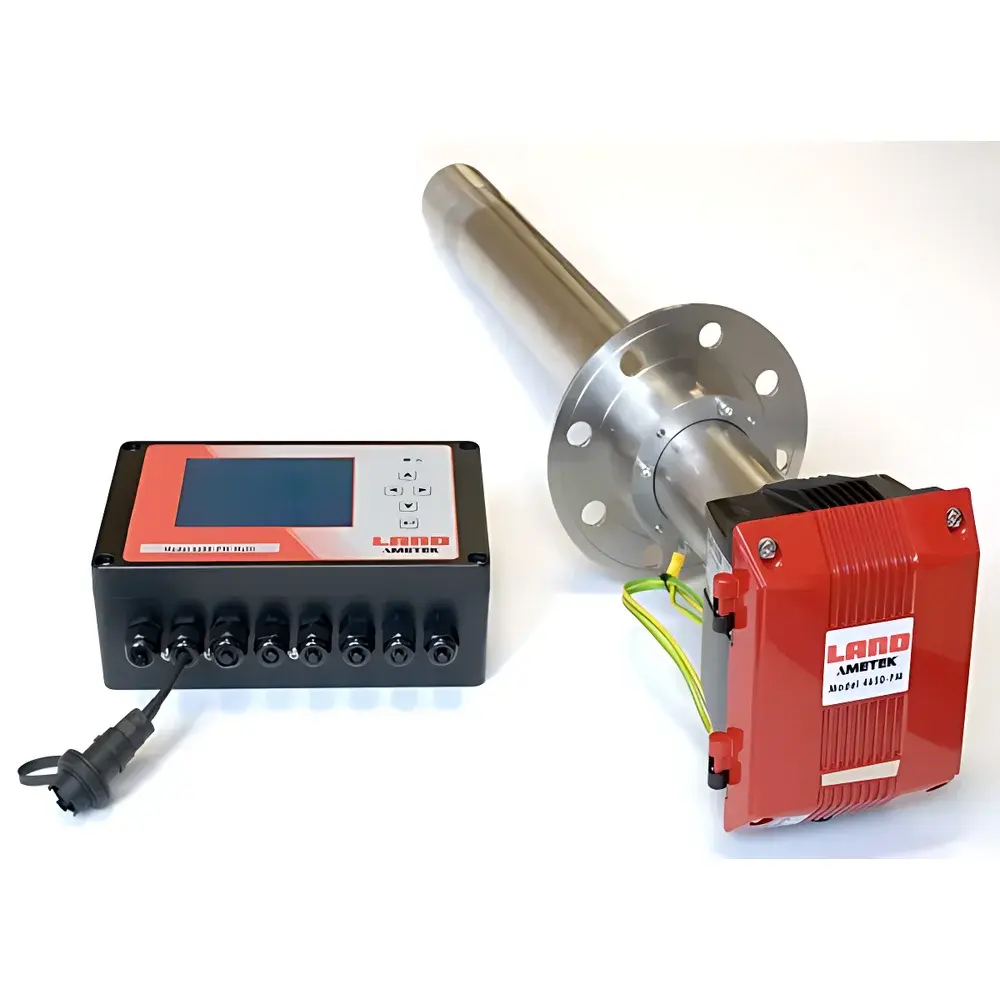
LAND 4650-PM Forward-Scatter Laser Dust Monitor
| Brand | LAND |
|---|---|
| Origin | UK |
| Model | 4650-PM |
| Measurement Principle | Forward-Scatter Laser Light Scattering |
| Safety Rating | Non-Explosive |
| Measurement Range | 0–15 to 0–200 mg/m³ |
| Resolution | 0.01 mg/m³ |
| Accuracy | ±1% of reading |
| Relative Error | ≤1% |
| Operating Temperature | up to 500 °C (930 °F) |
| Compliance | U.S. EPA Performance Specification 11 (PS-11), applicable to MATS and Boiler MACT requirements |
Overview
The LAND 4650-PM is a high-stability, forward-scatter laser-based dust monitor engineered for continuous particulate matter (PM) concentration measurement in hot, dry flue gas streams. It operates on the principle of low-angle forward light scattering—where a collimated laser beam interacts with suspended particles in the sampled gas stream, and the intensity of scattered light at shallow angles (typically <15°) is linearly correlated with mass concentration under controlled optical and flow conditions. Unlike nephelometric or backscatter systems, this geometry minimizes sensitivity to particle size distribution variability while maintaining high signal-to-noise ratio at low concentrations (down to 0.01 mg/m³). The probe assembly is designed for direct insertion into ducts or stacks, with optical components rigidly mounted to eliminate alignment drift—a critical factor for long-term field stability in industrial emission monitoring applications.
Key Features
- Robust optical architecture featuring fixed-focus, temperature-stabilized laser diode and photodetector array, eliminating manual calibration drift over time
- Low-incidence-angle forward-scatter geometry optimized for reduced particle-size dependence and enhanced detection limit performance
- High-temperature probe rated for continuous operation up to 500 °C (930 °F), suitable for post-ESP or post-baghouse installation without external cooling or dilution
- Integrated control unit with dual-channel analog outputs (4–20 mA), digital I/O (alarm relays, 24 VDC trigger inputs), RS232/RS485 serial interface, and Modbus RTU support
- Optional multi-monitor controller supporting synchronized operation and data aggregation from up to four 4650-PM units on a single bus
- Compliance-ready firmware with audit-trail logging, configurable alarm thresholds, and timestamped event records aligned with EPA PS-11 data integrity requirements
Sample Compatibility & Compliance
The 4650-PM is validated for use in dry, non-condensing flue gas environments—specifically where liquid droplets are absent (e.g., downstream of efficient wet scrubbers or after thermal drying stages). It is not intended for saturated or aerosol-laden streams without prior conditioning. The system meets U.S. Environmental Protection Agency Performance Specification 11 (PS-11) for continuous opacity and PM monitors used in compliance with the Mercury and Air Toxics Standards (MATS) and the Boiler Maximum Achievable Control Technology (Boiler MACT) rulemaking. Its design supports GLP-aligned operational protocols, including documented calibration verification procedures, zero/span checks, and maintenance logs compatible with 21 CFR Part 11–compliant data management platforms when integrated via secure serial or industrial Ethernet gateways.
Software & Data Management
The embedded control firmware provides local configuration via front-panel keypad and LCD display, enabling real-time status monitoring, span adjustment, and diagnostic self-tests. All operational parameters—including measured concentration, internal temperature, laser output power, and detector response—are logged at user-defined intervals (1-second to 1-hour resolution) and stored in non-volatile memory for retrieval via serial interface. Optional PC-based configuration and trending software supports CSV export, trend charting, and automated report generation per EPA Method 9 or ISO 12141 frameworks. When deployed in regulated facilities, the system’s event logging structure—including operator-initiated calibrations, alarm activations, and power-cycle timestamps—supports traceability requirements under GMP and environmental quality assurance programs.
Applications
The 4650-PM is widely deployed in combustion-intensive industries requiring reliable, low-maintenance PM monitoring where regulatory compliance and process optimization intersect. Primary application domains include:
- Coal-, biomass-, and oil-fired power generation units—especially downstream of electrostatic precipitators (ESPs) or fabric filters
- Industrial boiler systems in chemical, pulp & paper, and food processing plants subject to NSPS Subpart Db or state-level PM limits
- Specialty metal production (e.g., ferroalloy, copper smelting) where high-temperature stack conditions preclude conventional filter-based samplers
- Glass melting furnaces operating above 400 °C, where traditional beta attenuation or TEOM methods suffer thermal degradation
- Waste-to-energy incineration lines requiring continuous compliance demonstration under EU BREF or U.S. Clean Air Act Title V permit conditions
FAQ
Does the 4650-PM require periodic optical cleaning or alignment?
No—the optical path is sealed and mechanically fixed; no user-accessible alignment screws or consumable lenses are present. Routine maintenance is limited to periodic inspection of the probe window for deposition buildup and scheduled zero-checks.
Can it be used in wet or humid flue gas streams?
Not without upstream conditioning. Condensation or liquid droplets will cause erroneous scattering signals; the instrument is specified for dry-gas applications only, typically downstream of desiccant dryers or high-efficiency mist eliminators.
Is factory calibration traceable to NIST standards?
Yes—each unit ships with a certificate of calibration traceable to NIST-traceable PM reference aerosols (e.g., Arizona Test Dust, ISO 12103-1 A2) and certified gas-phase opacity standards per ASTM D6216.
What communication protocols does the control unit support?
Standard interfaces include RS232 (point-to-point), RS485 (multi-drop Modbus RTU), and isolated 4–20 mA analog outputs. Optional Ethernet/IP or PROFIBUS-DP modules are available upon request for integration into DCS or SCADA architectures.
How is compliance with EPA PS-11 verified during site acceptance?
Verification follows PS-11 Section 5 procedures: 7-day stability test, linearity assessment using calibrated reference aerosols, and comparison against co-located reference method samplers (e.g., EPA Method 5 or ISO 9096) across three concentration levels spanning the full 0.01–200 mg/m³ range.
Related Products







