
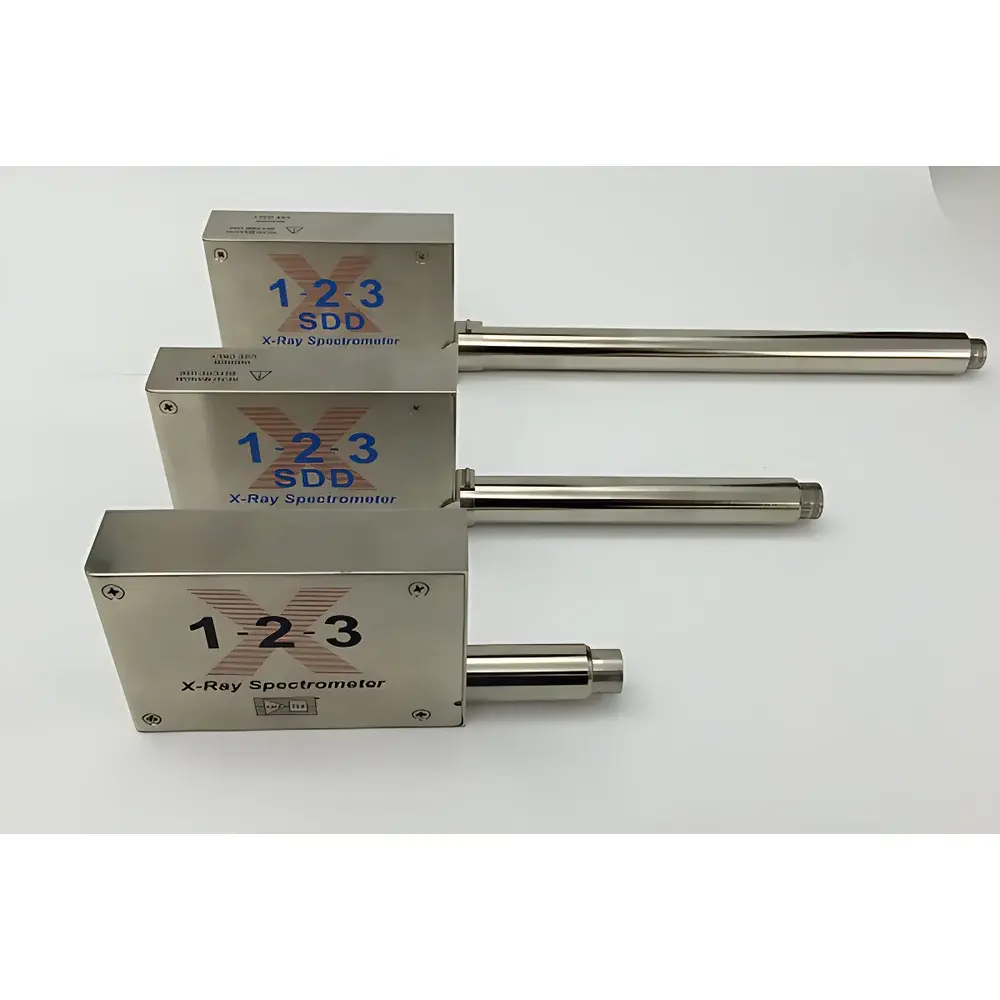
AMPTEK X-123FAST SDD (70 mm²) Large-Area Fast Silicon Drift Detector
| Brand | AMPTEK |
|---|---|
| Origin | USA |
| Model | X-123FAST SDD (70 mm²) |
| Resolution | 123 eV FWHM @ 5.9 keV |
| Max Count Rate | >1,000,000 cps |
| Peak-to-Background Ratio | 26,000:1 |
| Window Options | 0.5-mil Be or Si₃N₄ (C2) |
| Cooling ΔT | >85 K |
| Preamplifier Output Pulse Width | <60 ns |
| Active Si Thickness | 500 µm |
| Collimated Effective Area | 50 mm² |
| Total Sensitive Area | 70 mm² |
Overview
The AMPTEK X-123FAST SDD (70 mm²) is a high-performance, large-area silicon drift detector engineered for demanding X-ray spectroscopy applications requiring both speed and spectral fidelity. Based on the proven SDD architecture, it operates via charge collection in a high-purity silicon drift region under controlled reverse bias and cryogenic cooling—enabling low electronic noise, fast charge extraction, and high count-rate capability without significant resolution degradation. Its 70 mm² total active area—of which 50 mm² remains effective after collimation—delivers enhanced solid-angle coverage for weak-source detection and rapid elemental mapping. The detector integrates a thermoelectric cooler achieving ΔT > 85 K below ambient, eliminating the need for liquid nitrogen while maintaining stable operation across extended acquisition periods. Designed for integration into benchtop analyzers, handheld XRF platforms, SEM-EDS systems, and industrial OEM instrumentation, the X-123FAST SDD conforms to fundamental requirements of quantitative X-ray fluorescence (XRF), energy-dispersive X-ray spectroscopy (EDS), and process monitoring where throughput, repeatability, and low-background performance are critical.
Key Features
- 123 eV FWHM energy resolution at 5.9 keV (Mn-Kα), measured with standard 0.5-mil beryllium window under typical operating conditions
- Sustained count rate capability exceeding 1,000,000 counts per second (cps) with minimal pulse pile-up and resolution broadening
- Peak-to-background ratio of 26,000:1, achieved through optimized detector geometry, low-noise preamplifier design, and intrinsic Si purity
- Integrated multilayer collimator ensuring spatial definition and minimizing stray radiation contribution to spectral background
- Ultrafast preamplifier output with pulse width <60 ns, supporting high-speed digital pulse processing and real-time dead-time correction
- Vacuum-compatible hermetic packaging (XR100FAST-compatible footprint), suitable for UHV environments down to 10⁻⁷ Torr
- Flexible window options: standard 0.5-mil Be for general-purpose use or ultra-thin Si₃N₄ (C2) membrane for enhanced light-element transmission (B–F)
Sample Compatibility & Compliance
The X-123FAST SDD supports direct mounting onto vacuum chambers, SEM columns, and portable XRF housings without modification. Its 500 µm thick high-resistivity silicon substrate ensures efficient absorption of X-rays from 1 keV to 20 keV, with optimal quantum efficiency for transition metals (e.g., Fe, Cu, Zn) and heavier elements (Pb, U). For light-element analysis (C, N, O), the optional C2 (Si₃N₄) window enables transmission down to ~100 eV, compatible with ASTM E1508-18 and ISO 21043-2 guidelines for low-energy EDS quantification. The detector’s mechanical and electrical interfaces align with AMPTEK’s PX5 and XR100 series, facilitating drop-in replacement and OEM system scalability. All units undergo factory calibration traceable to NIST-standard radioactive sources and comply with RoHS directives and CE marking requirements for electromagnetic compatibility (EN 61326-1).
Software & Data Management
The detector operates seamlessly with AMPTEK’s DPPM (Digital Pulse Processor Module) firmware and is fully supported by the PC-based WinQXAS and PyMCA open-source software ecosystems. Real-time spectrum acquisition, live background subtraction, and peak deconvolution leverage adaptive Gaussian fitting and iterative least-squares algorithms compliant with ISO 11843-5 for detection limit estimation. Raw pulse data streams support external timestamping and synchronized multi-detector acquisition—essential for GLP/GMP-aligned QA/QC workflows. Audit-trail functionality, user-access controls, and exportable .csv/.edx formats meet FDA 21 CFR Part 11 readiness when deployed with validated host software. Firmware updates preserve backward compatibility and include configurable shaping times, gain stabilization modes, and automatic temperature compensation.
Applications
- Rapid elemental identification and quantification in handheld and benchtop XRF analyzers for alloy verification, mining exploration, and environmental soil screening
- High-resolution, high-speed EDS mapping in scanning electron microscopy (SEM), enabling sub-µm compositional imaging at scan rates up to 100 fps
- In-line material sorting and grade verification in recycling facilities and metal production lines, interfaced with PLC-controlled conveyor systems
- OEM integration into synchrotron beamline end-stations, portable LIBS–XRF hybrid platforms, and nuclear safeguards instrumentation
- Research-grade micro-XRF for cultural heritage analysis, geological thin-section mapping, and battery electrode heterogeneity studies
FAQ
What is the minimum detectable energy with the C2 (Si₃N₄) window option?
With the 100 nm Si₃N₄ window, the detector achieves usable response down to approximately 100 eV, enabling detection of boron (Kα = 183 eV) and carbon (Kα = 277 eV) under optimized vacuum and geometry conditions.
Is the detector compatible with existing AMPTEK digital signal processors?
Yes—it is fully compatible with the DP5, DPP-MCA, and newer DPP-PHA modules, supporting both analog and digital trigger outputs with configurable gate widths and polarity.
Can this SDD be operated continuously in high-vacuum environments?
Yes—the XR100FAST mechanical housing and hermetic ceramic package are rated for continuous operation in vacuum down to 10⁻⁷ Torr; bake-out up to 80 °C is permitted with appropriate thermal management.
Does the >1,000,000 cps specification apply to all X-ray energies?
The maximum sustainable count rate is energy-dependent; it exceeds 1 Mcps for Mn-Kα (5.9 keV) and remains above 700,000 cps for Fe-Kα (6.4 keV), as verified per IEC 62220-1-2 pulse-processing linearity testing protocols.
How is energy calibration stability maintained over time?
The integrated temperature sensor feeds real-time compensation to the DPP firmware, while periodic auto-calibration routines reference internal Mn-Kα and Co-Kα peaks from embedded check sources—ensuring long-term energy scale drift <0.01% per 24 h.




