
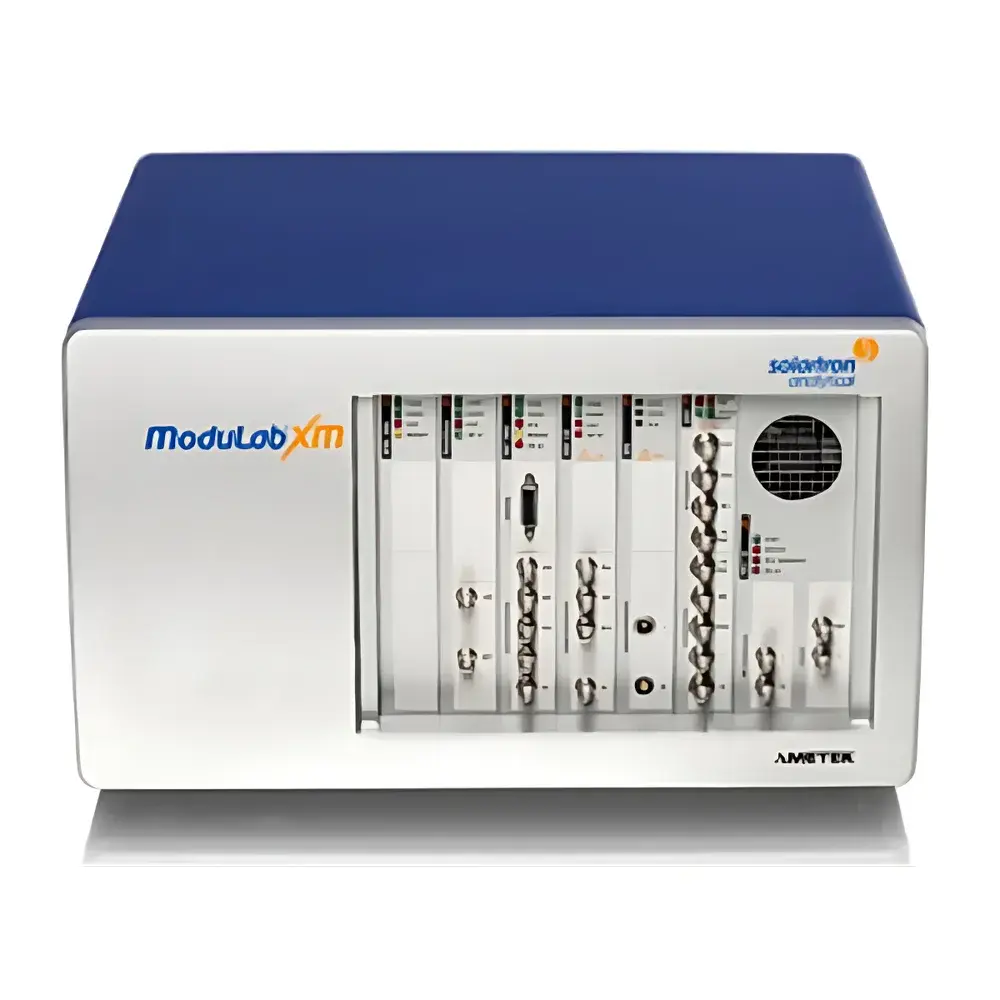
English Product Name
| Brand | Solartron Analytical |
|---|---|
| Origin | United Kingdom |
| Manufacturer Type | Authorized Distributor |
| Import Status | Imported |
| Model | ModuLab XM ECS |
| Instrument Type | Electrochemical Workstation |
| Channel Configuration | Multi-Channel Expandable Architecture |
| Current Range | ±2 A to ±100 A |
| Current Accuracy | ±0.2% of reading |
| Potential Accuracy | ±0.2% of reading |
| Potentiostatic Range | ±100 V |
| AC Impedance Frequency Range | 10 µHz to 1 MHz |
Overview
The Solartron Analytical ModuLab XM ECS is a high-performance, modular electrochemical workstation engineered for precision control and measurement across diverse electrochemical research and industrial development domains. At its core lies a high-speed, low-noise potentiostat/galvanostat with real-time digital signal processing (DSP) architecture, enabling stable, artifact-free operation under demanding dynamic conditions—including linear sweep voltammetry (LSV), cyclic voltammetry (CV), pulse techniques, and electrochemical impedance spectroscopy (EIS). The system employs oversampling-based waveform generation and acquisition, delivering smooth, step-free potential sweeps at scan rates exceeding 10 kV/s—critical for eliminating transient artifacts and ensuring fidelity in fast kinetic studies. Its modular design allows seamless integration of functional units—such as high-current amplifiers, ultra-low-current preamplifiers, or EIS-specific excitation modules—without recalibration or hardware reconfiguration. This architecture supports both single-channel deployment and scalable multi-channel configurations, from one potentiostat per chassis to distributed systems spanning multiple chassis, all synchronized and controlled via a unified software environment compliant with GLP/GMP data integrity requirements.
Key Features
- Modular “plug-and-play” expansion: Add or replace functional modules—including high-current (±100 A), ultra-low-current (100 aA resolution), and high-voltage (±100 V) units—without system downtime or manual calibration.
- High-fidelity waveform generation: 64 MS/s oversampled scanning for LSV, CV, and LSP ensures distortion-free potential ramps, even at extreme scan rates (>10 kV/s).
- Ultra-high-speed data acquisition: Up to 1 MS/s sampling rate enables precise capture of transient current/voltage responses in pulse voltammetry, chronoamperometry, and fast EIS.
- Broad dynamic range: Supports impedance measurements from 10 µΩ (low-impedance fuel cell electrodes) to >100 TΩ (insulating coatings, dielectric films).
- Multi-channel synchronization: Independent channel control with sub-microsecond timing alignment for parallel experiments or spatially resolved electrochemical mapping.
- Robust hardware architecture: Industrial-grade chassis with EMI-shielded signal paths, isolated analog front-ends, and thermally stabilized reference circuitry for long-term stability.
Sample Compatibility & Compliance
The ModuLab XM ECS accommodates a wide range of electrochemical cells—from standard three-electrode aqueous electrolytes to high-temperature molten salt systems, solid-state batteries, PEM fuel cells, and conductive polymer films. Its ±100 V compliance voltage supports high-potential oxidation studies (e.g., water splitting, metal oxide formation), while the ±100 A current capability enables full-stack battery cycler emulation and corrosion testing under accelerated polarization. The system meets key international standards for electrochemical instrumentation, including ASTM G5, G59, G102, ISO 17475 (corrosion testing), and IEC 62660-1 (Li-ion battery performance). All hardware and firmware comply with CE, UKCA, and RoHS directives. Software audit trails, electronic signatures, and configurable user access levels support adherence to FDA 21 CFR Part 11 and EU Annex 11 requirements for regulated environments.
Software & Data Management
ModuLab XM software provides an integrated, scriptable platform for experiment design, real-time visualization, and post-acquisition analysis. Users define protocols using intuitive graphical sequencing—selecting from over 50 built-in techniques (OCP, CV, CA, CP, EIS, Mott-Schottky, galvanostatic intermittent titration, etc.)—with full parameter validation and live preview of applied waveforms and connection schematics. During acquisition, dual-channel oscilloscope-style displays show simultaneous voltage/current transients, while impedance spectra update in real time with Kramers-Kronig validation. Raw data are stored in vendor-neutral HDF5 format with embedded metadata (instrument ID, calibration timestamps, environmental logs). Batch analysis tools support automated equivalent circuit fitting (ZView-compatible), derivative peak detection, and statistical comparison across datasets. Export options include CSV, MATLAB .mat, and ASCII for third-party modeling (COMSOL, Python SciPy). Audit trail logging records all user actions, parameter changes, and instrument events with timestamped, non-erasable entries.
Applications
- Fuel cell and electrolyzer R&D: MEA degradation profiling, catalyst activity mapping, and high-current impedance analysis under realistic operating conditions.
- Battery materials science: Solid-electrolyte interphase (SEI) formation kinetics, Li-metal dendrite suppression studies, and multi-step GITT/PITT for diffusion coefficient quantification.
- Corrosion and coating evaluation: Electrochemical noise monitoring (ENM), localized electrochemical impedance spectroscopy (LEIS), and scanning vibrating electrode technique (SVET) integration.
- Nanomaterial electrochemistry: Single-nanoparticle collision detection, graphene oxide redox switching, and enzyme-modified electrode characterization.
- Industrial QC/QA: Passivation layer verification on stainless steel, anodized aluminum thickness validation, and printed electronics conductivity screening.
FAQ
Can the ModuLab XM ECS operate in true multi-channel mode with independent control of each channel?
Yes. Each installed potentiostat module functions as an autonomous channel with dedicated analog front-end, DAC/ADC, and timing engine—enabling simultaneous, asynchronous experiments with independent parameter sets and sampling rates.
Is the system compatible with third-party electrochemical cells and accessories?
Absolutely. Standard BNC and banana-jack interfaces support universal connection to commercial cells, rotating disk electrodes (RDE), flow cells, and custom-designed fixtures. Optional adapters are available for Gamry, BioLogic, and Pine-compatible connectors.
How does the system ensure measurement traceability and regulatory compliance?
Every hardware module carries NIST-traceable calibration certificates. Software enforces role-based access control, electronic signatures, and immutable audit trails—fully aligned with 21 CFR Part 11, ISO/IEC 17025, and GLP documentation requirements.
What level of technical support and application assistance is provided?
Solartron Analytical offers global engineering support, including remote diagnostics, on-site installation, method development workshops, and application-specific protocol optimization—backed by a 3-year comprehensive warranty.





