
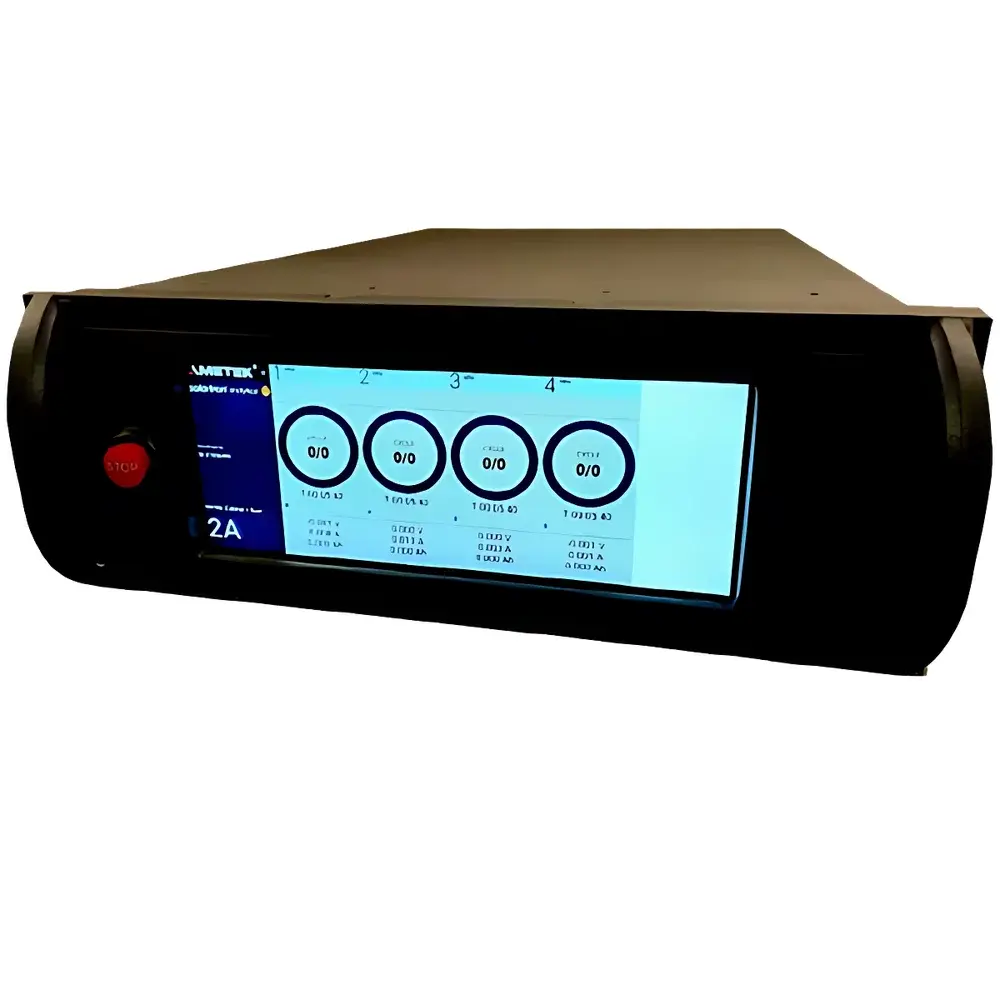
Solartron Analytical 9300R SA High-Power AC/DC Integrated Electrochemical Workstation
| Brand | Solartron Analytical |
|---|---|
| Origin | United Kingdom |
| Model | 9300R SA |
| Channel Count | 1–4 configurable channels |
| DC Current Range | ±200 A (±300 A pulse), up to ±800 A with 4-channel parallel operation |
| DC Current Accuracy | ±0.03% of reading |
| DC Potential Accuracy | ±0.03% of reading |
| Potentiostatic Range | ±10 V |
| EIS Frequency Range | 1 mHz – 10 kHz |
| Voltage Resolution | 20 µV (24-bit ADC) |
| Current Resolution | 2 µA (24-bit ADC) |
| DC Sampling Rate | 1 kS/s per channel |
| Auxiliary Inputs | 2 differential voltage dividers (for DC/EIS), optional synchronized temperature acquisition |
| Power Supply | 3-phase 380 V AC, 5.5–11 kW |
Overview
The Solartron Analytical 9300R SA is a high-power, multi-channel electrochemical workstation engineered for rigorous testing of next-generation energy devices operating under realistic dynamic and transient conditions. Unlike conventional potentiostats limited to mA–A scale currents, the 9300R SA employs precision current-source architecture with integrated magnetic flux sensing and high-bandwidth analog front-ends to deliver stable, low-noise control and measurement at up to ±800 A—enabling direct characterization of large-format traction batteries, grid-scale flow cells, electrolyzers, and fuel cell stacks. Its core design adheres to fundamental electrochemical measurement principles: galvanostatic and potentiostatic control via real-time digital feedback loops; four-quadrant operation supporting charge/discharge, polarization, and impedance excitation in both directions; and simultaneous dual-electrode EIS capability for independent anode/cathode analysis under load. The system meets the stringent requirements of industrial R&D labs conducting accelerated life testing, safety-critical thermal-electrochemical coupling studies, and validation against ISO 12405, IEC 62620, and SAE J2929 standards.
Key Features
- Scalable multi-channel architecture: Configurable from 1 to 4 fully isolated channels—each capable of ±200 A continuous (±300 A pulse), with hardware-synchronized parallel operation delivering up to ±800 A total output.
- Sub-millisecond response fidelity: Fast current range switching (<1 ms), step transition times <500 µs, and 1 kS/s real-time DC sampling per channel ensure accurate capture of fast transients during fast-charging protocols or fault-event simulation.
- Dual-electrode EIS: Each channel integrates a dedicated frequency response analyzer (FRA) supporting 1 mHz–10 kHz impedance sweeps with phase-resolved harmonic analysis, enabling concurrent anode and cathode impedance mapping under operational bias.
- Open-loop waveform synthesis: User-defined arbitrary current/voltage waveforms—including staircase, pulsed, and hybrid profiles—with programmable parameter-triggered conditional jumps (e.g., terminate sweep on voltage drift >50 mV).
- Hardware-synchronized auxiliary acquisition: Simultaneous 16-channel voltage and temperature logging (via optional external DAQ) time-aligned to electrochemical data at microsecond-level jitter, critical for correlating thermal runaway onset with impedance evolution.
- Industrial-grade power delivery: 3-phase 380 V input with active power factor correction, rated 5.5–11 kW depending on configuration, compliant with IEC 61000-3-12 harmonic emission limits.
Sample Compatibility & Compliance
The 9300R SA supports electrochemical testing across diverse physical formats: prismatic and pouch lithium-ion cells (up to 100 Ah), PEM electrolyzer MEAs, solid-oxide fuel cell stacks, and redox flow battery modules. It accommodates integration with environmental test chambers (e.g., thermal cycling from −40 °C to +85 °C) via standardized analog/digital I/O interfaces. All firmware and software comply with GLP/GMP data integrity requirements: audit-trail enabled, electronic signature support per FDA 21 CFR Part 11, and immutable raw-data archiving directly to NAS storage with SHA-256 checksum verification. System calibration traceability follows UKAS-accredited procedures aligned with ISO/IEC 17025.
Software & Data Management
Control and analysis are executed through ModuLab XM—Solartron’s modular, scriptable platform built on LabVIEW Real-Time and .NET architecture. The software provides native support for ASTM G106, ISO 17025-compliant test sequence definition, automated report generation (PDF/Excel), and API access for Python/Matlab integration. Raw datasets are stored in HDF5 format with embedded metadata (timestamp, channel ID, calibration coefficients, environmental conditions). Data encryption at rest (AES-256) and role-based access control ensure secure collaboration across distributed R&D teams. Optional cloud synchronization enables remote monitoring without compromising local data sovereignty.
Applications
- Fast-charge protocol development for EV batteries, including CC-CV termination optimization and lithium plating detection via in-situ dV/dQ and EIS fingerprinting.
- Operando degradation analysis of PEM water electrolyzers: quantifying catalyst dissolution rates, membrane resistance growth, and gas crossover under 1–2 A/cm² current densities.
- Thermal-electrochemical coupling studies: correlating localized temperature rise (measured via thermocouple arrays) with interfacial impedance shifts during overcurrent events.
- Multi-parameter lifetime modeling: combining capacity fade, resistance increase, and gas evolution data to train physics-informed machine learning models for SoH estimation.
- MEA durability screening for fuel cells: accelerated stress testing (AST) per DOE protocols, including OCV hold, load cycling, and humidity ramping with real-time EIS monitoring.
FAQ
Can the 9300R SA perform true four-quadrant operation across all channels simultaneously?
Yes—each channel operates independently in all four quadrants (charge/discharge, anodic/cathodic), with no shared ground constraints or cross-channel coupling.
Is EIS measurement possible while applying DC load?
Yes—the integrated FRA supports superimposed sinusoidal perturbation (up to 100 mV RMS) during galvanostatic or potentiostatic DC bias, enabling impedance tracking under realistic operating conditions.
What third-party instruments can be synchronized with the 9300R SA?
Standard TTL triggers and analog sync signals enable hardware-level coordination with thermal cameras, gas chromatographs, and acoustic emission sensors—fully documented in the ModuLab XM External Device Integration Guide.
How is current accuracy maintained at 800 A aggregate current?
Each channel uses calibrated Hall-effect sensors with individual offset/gain compensation; parallel operation includes automatic current-balancing feedback via shared bus voltage monitoring to ensure ≤0.5% inter-channel current deviation.
Does the system support automated safety interlocks?
Yes—programmable hardware watchdog timers, overtemperature cutoffs (via external thermistor inputs), and emergency stop integration comply with IEC 61508 SIL2 requirements for functional safety.





