
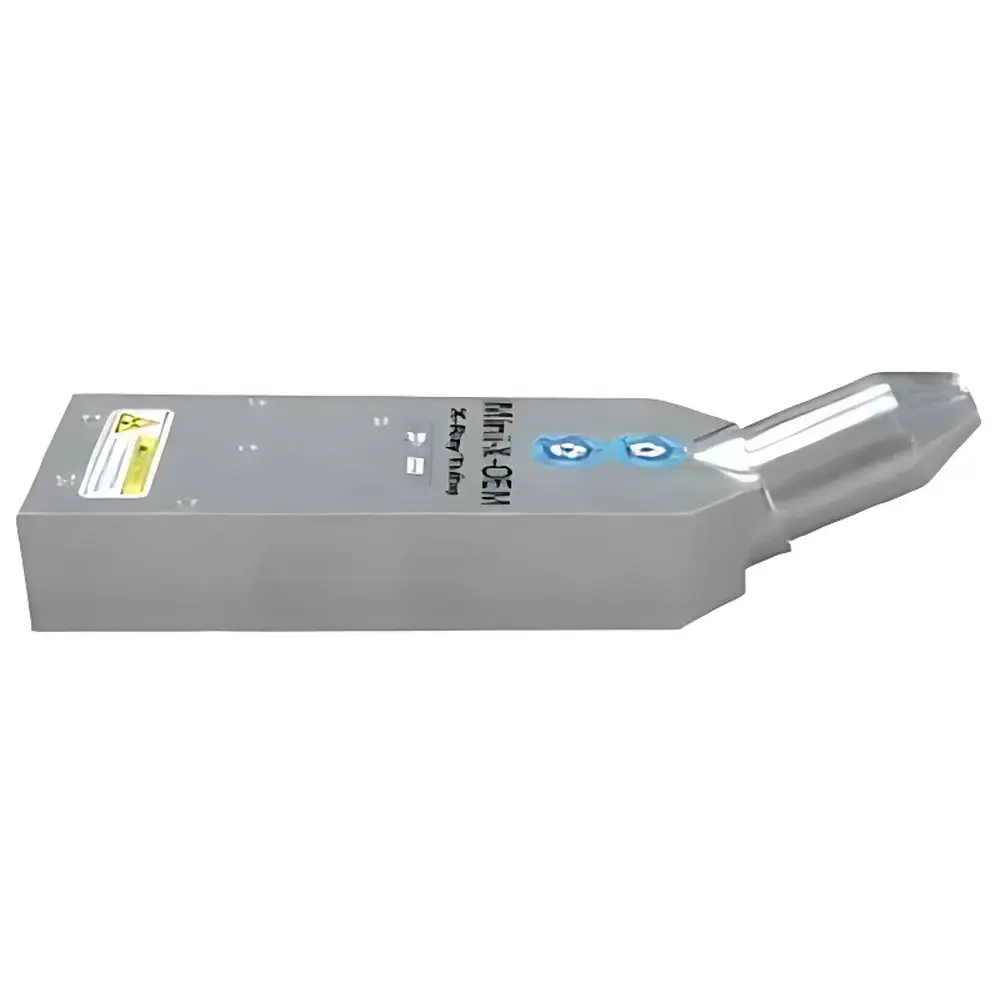
Amptek Mini-X-OEM X-ray Source Module
| Brand | Amptek |
|---|---|
| Origin | USA |
| Model | Mini-X-OEM |
| X-ray Tube Type | Metal-Ceramic |
| Operating Voltage Range | 5–50 kV |
| Tube Current Range | 0–200 µA |
| Max Power | 4 W |
| Anode Material (Standard) | Au, Ag, or Rh |
| Anode Material (Optional) | W |
| Window Material | Be (125 µm) |
| Beam Spot Size | ~2 mm |
| Output Divergence Angle | 120° (5° with 2 mm collimator) |
| Input Voltage | 6–12 VDC |
| Input Current | 1.35 A (typ. @6 V), 0.70 A (typ. @12 V) |
| HV Stability | <0.1% |
| Cooling | Conductive (user-supplied heatsink required) |
| Operating Temperature | −10 °C to +60 °C (housing) |
| Humidity | 30–90% RH (non-condensing) |
| Weight | 340 g |
| Radiation Shielding | Integrated self-shielding (except output window) |
| Control Interface | Analog voltage inputs (0–4 V for kV/µA) and TTL logic outputs |
Overview
The Amptek Mini-X-OEM is a compact, high-performance X-ray source module engineered specifically for original equipment manufacturers (OEMs) integrating X-ray fluorescence (XRF) spectroscopy into portable, handheld, or benchtop analytical instruments. Unlike general-purpose X-ray tubes, the Mini-X-OEM employs a metal-ceramic sealed tube architecture with a beryllium transmission window (125 µm thickness), enabling efficient low-energy X-ray emission essential for detecting light elements (e.g., Mg, Al, Si, P, S) in elemental analysis applications. Its operation is based on thermionic emission from a tungsten filament cathode, accelerated across a vacuum gap to strike a selectable anode target (Au, Ag, Rh standard; W optional), generating characteristic X-rays and bremsstrahlung radiation. The module integrates both the X-ray tube and its high-voltage power supply within a single radiation-shielded housing—excluding the output aperture—minimizing electromagnetic interference and simplifying system-level integration. Designed for embedded control, it accepts analog voltage signals (0–4 V) to independently regulate tube voltage (0–50 kV) and current (0–200 µA), supporting precise, real-time optimization of excitation conditions without external USB dependencies.
Key Features
- Ultra-compact form factor: 340 g total mass, enabling integration into space-constrained platforms including handheld analyzers and miniaturized lab-grade spectrometers.
- Low-power operation: Maximum 4 W dissipation, compatible with battery-powered systems and thermally sensitive enclosures.
- Wide excitation range: Adjustable tube voltage (5–50 kV) and current (0–200 µA) allow optimization for diverse sample matrices—from low-Z polymers to high-Z alloys—without hardware modification.
- High voltage stability: <0.1% short-term drift ensures reproducible spectral intensity and peak-to-background ratios critical for quantitative XRF calibration.
- OEM-ready analog interface: Dedicated pins for kV/µA control, readiness status, enable/disable signaling, and real-time kV/µA monitoring simplify synchronization with host microcontrollers or FPGA-based instrument controllers.
- Thermally robust design: Conductive cooling architecture requires only user-provided heatsinking—no forced air or liquid cooling—reducing system complexity and noise.
- Compliant mechanical integration: Mounting orientation is unrestricted; pinout follows industry-standard layout (see Amptek datasheet Rev. F) for rapid PCB-level integration.
Sample Compatibility & Compliance
The Mini-X-OEM is intended exclusively as a subsystem component—not a standalone analytical instrument—and therefore does not carry CE, UKCA, or FDA 510(k) certification. Final instrument compliance rests entirely with the OEM integrator. When incorporated into complete XRF systems, the module supports measurement of solid, powdered, and thin-film samples across industrial QA/QC, mining geochemistry, environmental soil screening, and academic materials science. Its 120° native beam divergence (reducible to ~5° via user-installed 2 mm collimators) permits flexible optical path design, including multi-target excitation or grazing-incidence configurations. All end-user systems must conform to local radiation safety regulations—including IEC 61010-1 (electrical safety), IEC 62495 (X-ray equipment), and national requirements such as 21 CFR 1020.40 (USA) or EURATOM Directive 2013/59 (EU). Amptek explicitly disclaims liability for misuse, improper shielding, or failure to implement interlocks and dose monitoring per ALARA principles.
Software & Data Management
The Mini-X-OEM operates without embedded firmware or onboard software. Control and telemetry are implemented entirely through analog and digital I/O lines, making it agnostic to operating systems and compatible with real-time embedded environments (e.g., ARM Cortex-M, TI C2000, or Xilinx Zynq SoCs). OEMs retain full authority over timing sequences, safety protocols, and closed-loop feedback—for example, dynamically adjusting tube current in response to detector dead-time or ambient temperature drift. While Amptek provides reference schematics and characterization data (including kV/µA linearity curves and angular intensity profiles), no proprietary drivers or SDKs are supplied. Integration into GLP/GMP-regulated workflows requires the OEM to implement audit trails, electronic signatures, and configuration change logs per 21 CFR Part 11—functions managed at the host instrument level, not by the Mini-X-OEM itself.
Applications
- Handheld XRF analyzers for field-deployable alloy verification, RoHS screening, and scrap metal sorting.
- Benchtop micro-XRF mapping systems requiring spatially resolved elemental distribution analysis.
- Embedded XRF sensors in automated production lines for real-time coating thickness and composition verification.
- Academic research platforms studying phase transformations, catalyst degradation, or corrosion mechanisms under controlled atmospheres.
- Custom-designed portable EDXRF spectrometers for planetary surface exploration or nuclear safeguards verification.
FAQ
Is the Mini-X-OEM certified for direct use in medical or diagnostic devices?
No. It is not designed, tested, or approved for clinical or diagnostic applications under ISO 13485, IEC 62304, or FDA QSR requirements.
Does Amptek provide radiation shielding for the output window?
No. The module includes self-shielding for all surfaces except the Be window. Customers must design and validate collimation, shuttering, and local shielding per applicable radiation safety codes.
What is the expected lifetime under continuous operation?
Rated for 2,000 hours or one year (whichever occurs first) under nominal 4 W loading and proper thermal management.
Can the anode material be customized beyond Au/Ag/Rh/W options?
No. Only the four standard anode materials are available; custom targets are not offered due to vacuum integrity and thermal expansion constraints.
Is firmware update capability supported?
Not applicable—the device contains no programmable logic or flash memory; all functionality is hardware-defined and analog-controlled.
Related Products






