GRABNER MINIFLASH FPA VISION 12-Position Automated Flash Point Tester
| Brand | GRABNER |
|---|---|
| Origin | Austria |
| Model | MINIFLASH FPA VISION |
| Detection Method | Closed-Cup (ASTM D93, ISO 2719, IP 34, EN ISO 3679) |
| Compatibility | Fully compatible with MINIFLASH FP VISION and FPH VISION analyzers |
| Sample Capacity | 12 positions |
| Footprint | 0.18 m² |
| Operating Temperature Range | −25 °C to 400 °C |
| Cooling Option | External liquid cooling interface for autosampler chamber |
| Software Platform | VISION Cockpit™ (FDA 21 CFR Part 11 compliant, audit trail enabled) |
Overview
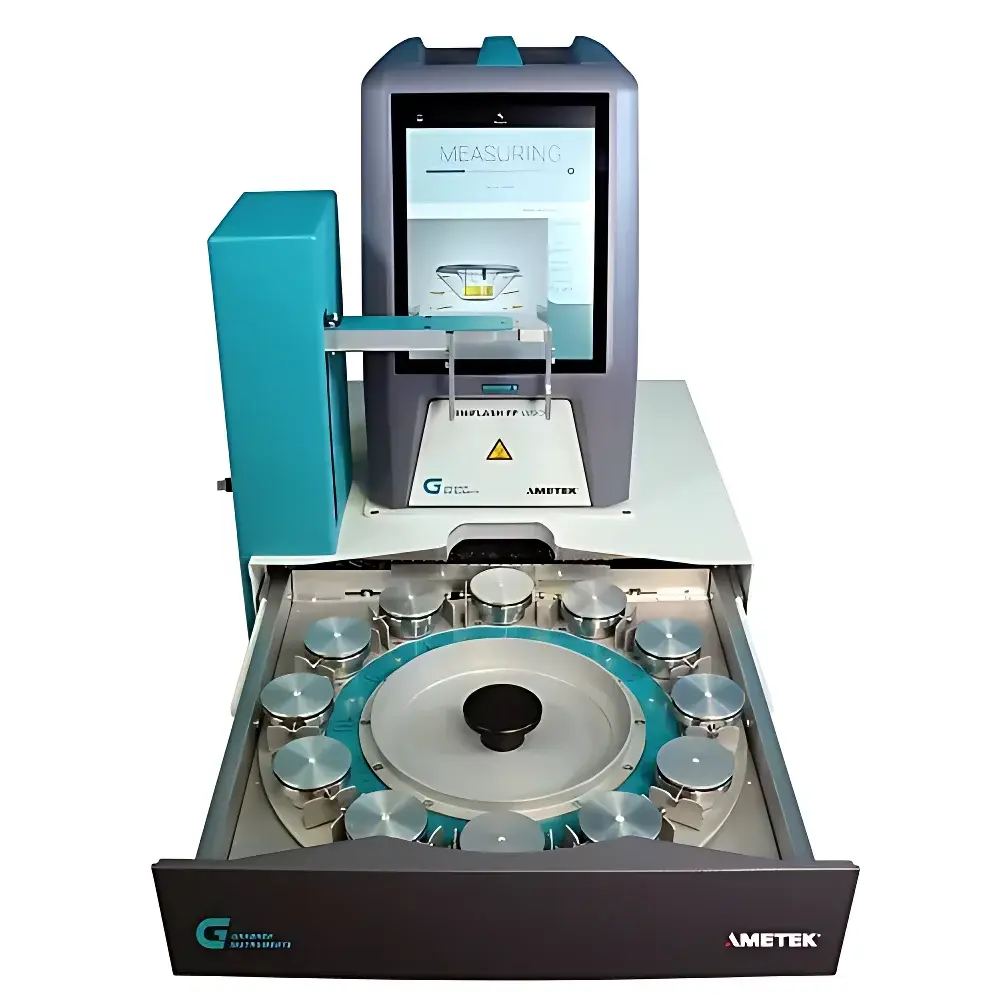
The GRABNER MINIFLASH FPA VISION is a modular, 12-position automated sample handler engineered exclusively for integration with the MINIFLASH FP VISION and FPH VISION closed-cup flash point analyzers. Designed and manufactured in Austria, this instrument implements the Pensky-Martens closed-cup principle per ASTM D93, ISO 2719, IP 34, and EN ISO 3679—ensuring full regulatory alignment for petroleum, chemical, and lubricant testing laboratories operating under GLP or GMP frameworks. Unlike legacy batch-style flash point systems, the FPA VISION operates as a true plug-and-play extension module: it requires no mechanical retrofitting or firmware reconfiguration. Within seconds, users can convert a single-position FP(H) VISION unit into a high-throughput, unattended 12-sample flash point testing platform—enabling continuous operation across wide thermal ranges (−25 °C to 400 °C) without manual intervention.
Key Features
- Modular architecture: Physically and electronically decoupled from the base analyzer—enables independent transport, service, or replacement of either unit without system downtime.
- Expanded throughput: 12-sample carousel increases sample handling capacity by 50% versus predecessor MINIFLASH FLA, reducing operator interaction frequency and supporting overnight or weekend runs.
- Compact footprint: Occupies only 0.18 m² of bench space—optimized for constrained laboratory environments where floor area is at a premium.
- Industrial-grade construction: Housing coated with corrosion-resistant industrial polymer; electronics conform to IEC 61000-4 EMC standards; electromechanical components rated for >500,000 cycle longevity.
- Active chamber cooling interface: Optional external liquid coolant connection maintains autosampler chamber temperature stability during extended high-temperature sequences—preventing premature volatilization or thermal degradation of low-flash samples.
- Switch-mode power supply: Delivers clean, regulated DC power to all motion control and sensor subsystems—minimizing electrical noise and improving measurement repeatability.
Sample Compatibility & Compliance
The FPA VISION supports standard 30–50 mL test cups (ASTM D93-compliant aluminum or stainless steel) and accommodates viscous, volatile, and thermally sensitive petroleum derivatives—including gasoline, diesel, jet fuel, biodiesel blends, lubricating oils, solvents, and transformer fluids. All hardware and software components comply with international safety and performance standards: CE marking per Machinery Directive 2006/42/EC and Low Voltage Directive 2014/35/EU; electromagnetic compatibility certified to EN 61326-1; and fully traceable calibration documentation available upon request. When operated with VISION Cockpit™ software, the system satisfies FDA 21 CFR Part 11 requirements for electronic records and signatures—including role-based access control, immutable audit trails, and user activity logging.
Software & Data Management
Integrated exclusively with GRABNER’s VISION Cockpit™ software platform, the FPA VISION enables centralized method management, remote monitoring, and enterprise-level data synchronization. Test protocols—including ramp rates, ignition delay times, equilibrium dwell periods, and pass/fail criteria—are defined once and deployed across multiple FP(H) VISION instruments linked to FPA modules. Results are stored in an encrypted SQLite database with optional export to LIMS via ASTM E1384-compliant XML or CSV. The Cockpit™ interface supports real-time status dashboards, predictive maintenance alerts (e.g., cup wear estimation, motor torque deviation), and scheduled calibration reminders—all accessible via secure HTTPS from any authorized workstation within a corporate intranet or cloud-managed infrastructure.
Applications
This system serves quality control laboratories in refineries, petrochemical plants, aviation fuel certification centers, and third-party testing facilities requiring high-volume, auditable flash point determinations. Typical use cases include: incoming crude assay verification; finished product release testing per ASTM D93 or ISO 2719; stability assessment of biofuel blends under accelerated aging; flash point trending for transformer oil condition monitoring (IEC 60156); and regulatory submission support for REACH, CLP, and DOT hazard classification dossiers. Its −25 °C capability makes it suitable for cold-climate fuel formulations, while its 400 °C upper limit supports heavy-end residue analysis in vacuum gas oil or bitumen streams.
FAQ
Is the FPA VISION compatible with older MINIFLASH FP models?
No—it is designed exclusively for the VISION-series analyzers (FP VISION and FPH VISION) and requires firmware version ≥5.2.0.
Can the autosampler operate independently without a connected FP(H) VISION unit?
No—the FPA VISION has no standalone measurement capability; it functions solely as a robotic sample delivery module.
Does the system support unattended overnight operation?
Yes—when configured with appropriate cooling and environmental controls, it supports continuous 24-hour sequencing with automatic cup ejection and cleaning cycles.
What maintenance intervals are recommended for the 12-position carousel mechanism?
GRABNER recommends visual inspection every 2,000 cycles and full lubrication service every 10,000 cycles—documented in the included service log template.
Is raw sensor data (e.g., thermocouple readings, ignition voltage traces) accessible for advanced troubleshooting?
Yes—VISION Cockpit™ provides optional diagnostic mode enabling export of time-stamped analog waveforms and internal PID controller logs.