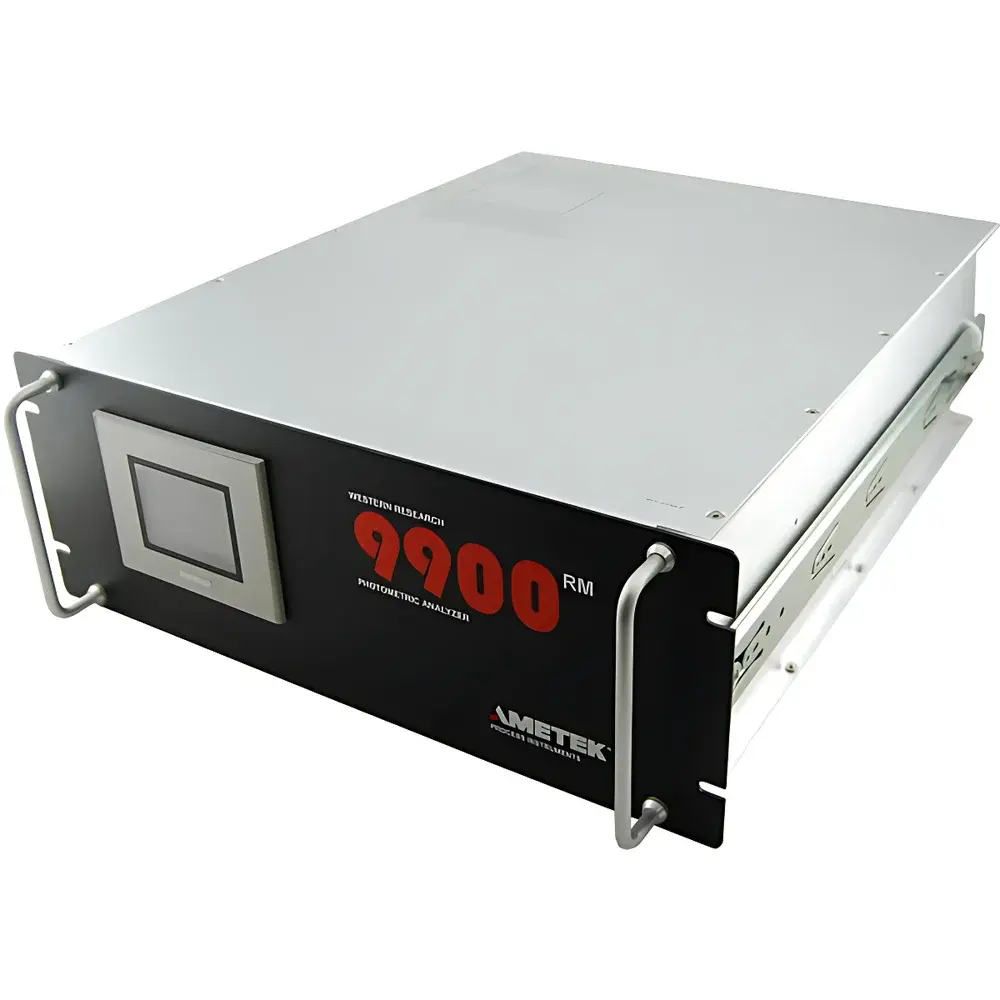
Western Research CEMS 9900 Continuous Emission Monitoring System
| Brand | PROCESS INSTRUMENTS |
|---|---|
| Origin | Canada |
| Model | 9900 |
| Measured Gases | SO₂, NOₓ (NO + NO₂), CS₂, H₂S, O₂ |
| Compliance Category | Imported Industrial CEMS |
| Distribution Type | Authorized Distributor |
Overview
The Western Research CEMS 9900 is a fully integrated, extractive-type Continuous Emission Monitoring System engineered for real-time, regulatory-grade quantification of key gaseous pollutants in industrial flue gas streams. Based on proven multi-gas optical absorption spectroscopy—primarily UV-Vis and IR spectral analysis—the system delivers stable, interference-resistant measurements of sulfur dioxide (SO₂), nitrogen oxides (NOₓ as the sum of NO and NO₂), carbon disulfide (CS₂), hydrogen sulfide (H₂S), and oxygen (O₂) concentration. Designed to meet the functional and reporting requirements of environmental compliance frameworks—including EPA Methods 6C, 7E, 10, and EN 15267-certified performance criteria—the CEMS 9900 operates continuously under harsh stack conditions with automated calibration validation, zero/span drift correction, and integrated sample conditioning to ensure data integrity across extended deployment cycles.
Key Features
- Multi-gas simultaneous detection using dual-beam UV-Vis and mid-infrared absorption cells, enabling independent quantification of SO₂ (280–320 nm), NO/NO₂ (190–230 nm & 350–450 nm), CS₂ (7–12 µm), H₂S (7.7 µm), and O₂ (paramagnetic or zirconia-based sensor option)
- Heated, corrosion-resistant extractive sampling train with Teflon-lined probe, heated filter (180 °C), and chiller-based moisture removal (<5 °C dew point) to prevent condensation and analyte loss
- Onboard NIST-traceable calibration gas management with automatic zero (N₂) and span (certified gas mixtures) verification at user-defined intervals (e.g., every 24 h)
- Redundant data acquisition architecture supporting dual analog outputs (4–20 mA), Modbus TCP/IP, and optional Profibus DP for seamless integration into DCS/SCADA systems
- Embedded Linux controller with secure web interface (HTTPS), local data logging (≥30 days at 1-min resolution), and remote diagnostics via VPN-authenticated access
- Compliance-ready firmware compliant with EPA 40 CFR Part 60 Appendix B PS-11 and PS-15 specifications for relative accuracy testing (RAT) and quality assurance procedures
Sample Compatibility & Compliance
The CEMS 9900 accommodates flue gas matrices from coal-fired boilers, cement kilns, petrochemical crackers, sulfur recovery units, and municipal waste incinerators. It handles particulate loadings up to 10 g/Nm³ (with optional ceramic filter upgrade), gas temperatures up to 200 °C (probe inlet), and acid gas concentrations exceeding 5,000 ppmv SO₂ without signal saturation. All measurement modules are certified to EN 14181 (QAL1, QAL2, AST) and support full QA/QC documentation required for EU IED permitting. The system meets U.S. EPA Performance Specification 11 (PS-11) for SO₂/NOₓ and PS-15 for O₂, and includes audit trails, electronic signatures, and 21 CFR Part 11–compliant data handling when configured with validated software modules.
Software & Data Management
The integrated CEMS Manager software provides configuration, real-time visualization, alarm management (configurable thresholds, email/SMS alerts), and automated report generation per regulatory templates (e.g., EPA Form 7500-1, EU ETS MRV). Raw spectral data, calibration logs, maintenance records, and diagnostic flags are stored in a relational SQLite database with SHA-256 hashing for data immutability. Export options include CSV, PDF, and XML formats compatible with national emission registries (e.g., US EPA CDX, UK EA EPR, German IHR). Audit trail functionality captures all operator actions—including method changes, calibration overrides, and data edits—with timestamp, user ID, and reason code, satisfying GLP/GMP traceability requirements.
Applications
- Regulatory compliance monitoring for Title V permits and NSPS subparts Da, Db, and Dc in power generation and industrial manufacturing
- Process optimization in Claus sulfur recovery units via real-time H₂S/SO₂ ratio control
- Emissions verification during startup, shutdown, and malfunction (SSM) events per EPA 40 CFR Part 63
- Stack testing support and reference method correlation studies (e.g., ASTM D6784 for elemental mercury co-monitoring readiness)
- Carbon accounting integration through stoichiometric O₂-based flow correction and mass balance calculations
FAQ
Does the CEMS 9900 require periodic certification by an accredited third-party body?
Yes—per EN 14181, QAL1 certification must be performed prior to initial commissioning, and QAL2 re-validation is required annually; the system includes built-in test modes to facilitate this process.
Can the analyzer measure NO and NO₂ separately, or only as total NOₓ?
The standard configuration reports total NOₓ; however, optional dual-channel UV spectrometry enables speciated NO and NO₂ quantification with <±2% FS cross-sensitivity.
Is the system compatible with existing plant cybersecurity policies?
Yes—the embedded controller supports TLS 1.2 encryption, role-based access control (RBAC), and integration with enterprise Active Directory; network hardening guides and STIG-compliant configurations are available upon request.
What is the typical installation lead time and site commissioning duration?
Standard delivery is 12–16 weeks from order; on-site mechanical installation requires 3–5 days, followed by 5–7 days of QAL1/QAL2 certification, calibration, and regulatory acceptance testing.
How does the system handle high-moisture or corrosive gas streams common in biomass combustion?
The heated sampling line (maintained at >150 °C), Hastelloy C-276 probe tip, and dual-stage condensate management (thermoelectric chiller + membrane dryer) ensure long-term stability in wet, acidic environments without frequent maintenance.