
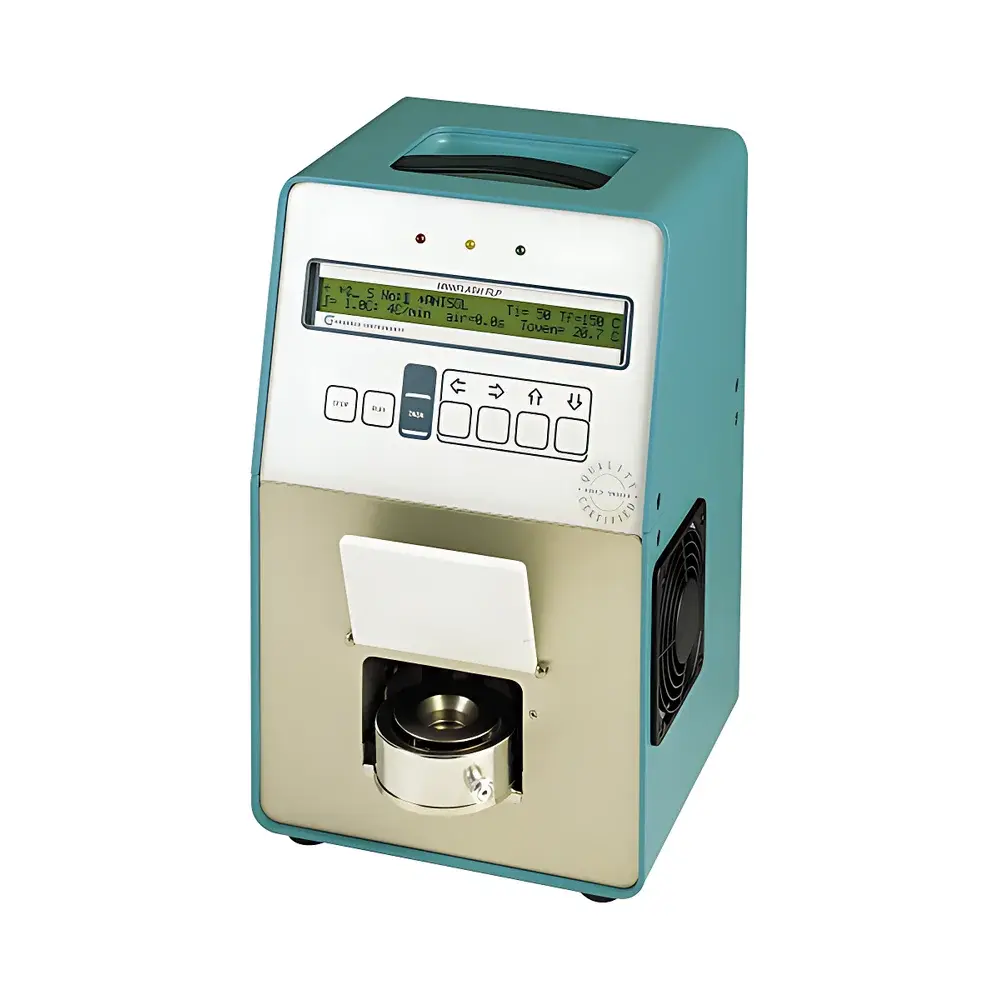
GRABNER MiniFlash Automatic Closed-Cup Flash Point Tester
| Brand | GRABNER |
|---|---|
| Origin | Austria |
| Model | MiniFlash |
| Test Method | Closed-Cup (CCCFP) |
| Temperature Range | −25 °C to 400 °C |
| Temperature Accuracy | ±0.1 °C |
| Test Duration | 3–5 min per sample |
| Sample Volume | 1 mL or 2 mL |
| Cooling | Integrated Peltier cooling system |
| Data Storage | Internal memory for multiple test records |
| Interfaces | RS-232, LIMS-ready, printer & PC connectivity |
| Power Supply | 100–230 V AC, 50 Hz, 65 W |
| DC Option | 12 V / 8 A (vehicle battery) |
| Dimensions | 196 × 315 × 175 mm |
| Weight | 8 kg |
Overview
The GRABNER MiniFlash Automatic Closed-Cup Flash Point Tester is an engineered solution for precise, safe, and standards-compliant flash point determination across petroleum, chemical, fragrance, coatings, and defense sectors. It operates on the Continuously Closed Cup Flash Point (CCCFP) principle—a thermodynamically controlled, fully sealed measurement methodology that maintains true equilibrium conditions throughout the heating and ignition phases. Unlike conventional Pensky-Martens or Tag closed-cup instruments, the MiniFlash eliminates open cup exposure, external flame sources, and manual intervention during testing. This architecture ensures compliance with regulatory definitions of “closed-cup” as stipulated in ASTM D93, ISO 2719, and EN ISO 3679—while delivering superior repeatability (R ≤ 1.5 °C) and reproducibility (Rr ≤ 2.5 °C) under routine laboratory conditions. Designed and manufactured in Austria, the instrument meets stringent European CE directives and supports global harmonized hazard communication frameworks including GHS, REACH, and UN TDG classification requirements.
Key Features
- True CCCFP technology: Continuous cup sealing during heating, vapor accumulation, and electronic spark ignition—enabling measurement under thermodynamic equilibrium without venting or pressure release.
- Minimal sample consumption: Requires only 1–2 mL per test, reducing cost and hazardous waste generation—critical for high-value or restricted substances (e.g., fragrances, specialty solvents).
- Integrated Peltier cooling: Enables rapid thermal cycling between tests; no external chiller or coolant required—ideal for sequential analysis of samples spanning wide volatility ranges.
- Automated cleaning cycle: Ceramic sample cup is thermally purged and cooled post-test, eliminating cross-contamination and operator handling of hot components.
- Single-button operation: Fully guided workflow with pre-programmed methods for SH/T 0768–2005, ASTM D6450/D7094, ISO 2719, and US DoT 49 CFR §173.120 protocols.
- Compact and mobile-ready: 8 kg mass and integrated 12 V DC input support field deployment—including marine, refinery perimeter, and military logistics environments.
- Passive safety architecture: No open flame, no gas supply, no UV ignition source—compliant with IEC 61010-1:2010 Class II, Category II overvoltage rating.
Sample Compatibility & Compliance
The MiniFlash accommodates a broad spectrum of liquid matrices: low-viscosity hydrocarbons (gasoline, naphtha), viscous feedstocks (bitumen cutbacks, heavy fuel oils), oxygenated blends (bioethanol, biodiesel), volatile organic compounds (VOCs), and complex mixtures (perfume concentrates, polymer emulsions). Its adaptive temperature ramping and dynamic vapor-phase detection enable reliable flash point assignment even for non-Newtonian or compositionally unstable samples. Regulatory alignment includes ASTM D6450 (low-flash liquids), ASTM D7094 (high-boiling materials), ISO 2719:2016, EN ISO 3679, SH/T 0768–2005, and NATO AEP-66 (STANAG 6630–25–145–3256 & 6630–25–146–0895). It is formally designated by the U.S. Department of Transportation for hazard classification under 49 CFR Part 173 and accepted for GLP-compliant studies requiring full audit trails.
Software & Data Management
Instrument control and data acquisition are managed via GRABNER’s FlashPoint Software v5.x, supporting method validation, user-level access control, and electronic signature workflows compliant with FDA 21 CFR Part 11 Annex 11 requirements. All measurements include timestamped metadata: ambient pressure, humidity compensation, cup temperature history, ignition event waveform, and pass/fail status against defined criteria. Raw data export is supported in CSV, XML, and PDF formats. The RS-232 interface enables direct integration into LIMS platforms (e.g., LabWare, Thermo Fisher SampleManager) with configurable trigger logic for automated result ingestion and QC flagging.
Applications
- Petroleum refining: Crude assay screening, distillate blending verification, and specification conformance per ASTM D93 and IP 34.
- Chemical manufacturing: SDS authoring for UN Class 3 flammable liquids, batch release testing per ISO 8217, and R&D formulation stability assessment.
- Fragrance & flavor industry: Compliance with IFRA guidelines and EU Cosmetics Regulation (EC No. 1223/2009) for raw material classification.
- Coatings & inks: VOC content estimation, solvent blend safety profiling, and regulatory submission packages for EPA TSCA and ECHA registration.
- Defense & aerospace: Fuel certification per MIL-STD-1881B and NATO AEP-66, including JP-8, F-34, and hydraulic fluid qualification.
FAQ
What distinguishes CCCFP from traditional closed-cup methods?
CCCFP maintains continuous cup closure and real-time vapor-phase monitoring throughout the entire test sequence—eliminating the intermittent opening inherent in Pensky-Martens and Tag instruments, thereby improving thermodynamic fidelity and statistical robustness.
Is the MiniFlash suitable for high-viscosity samples like bitumen or lubricants?
Yes—when configured with the optional high-temperature module (up to 400 °C) and programmed using ASTM D7094 methodology, it reliably determines flash points for viscous or thermally sensitive materials without pre-dilution.
How does the instrument ensure data integrity for regulated environments?
It provides full ALCOA+ traceability: attributable, legible, contemporaneous, original, accurate, complete, consistent, enduring, and available—via encrypted local storage, time-stamped audit logs, and electronic signature support aligned with 21 CFR Part 11.
Can the MiniFlash be used outside the laboratory?
Yes—the integrated 12 V DC power input, ruggedized housing, and self-contained cooling allow operation in mobile labs, offshore platforms, and forward-deployed military units without auxiliary infrastructure.
Does it support method customization for proprietary test protocols?
Yes—FlashPoint Software allows creation and validation of user-defined methods, including custom ramp rates, dwell times, ignition thresholds, and pass/fail logic, subject to internal calibration verification.





