
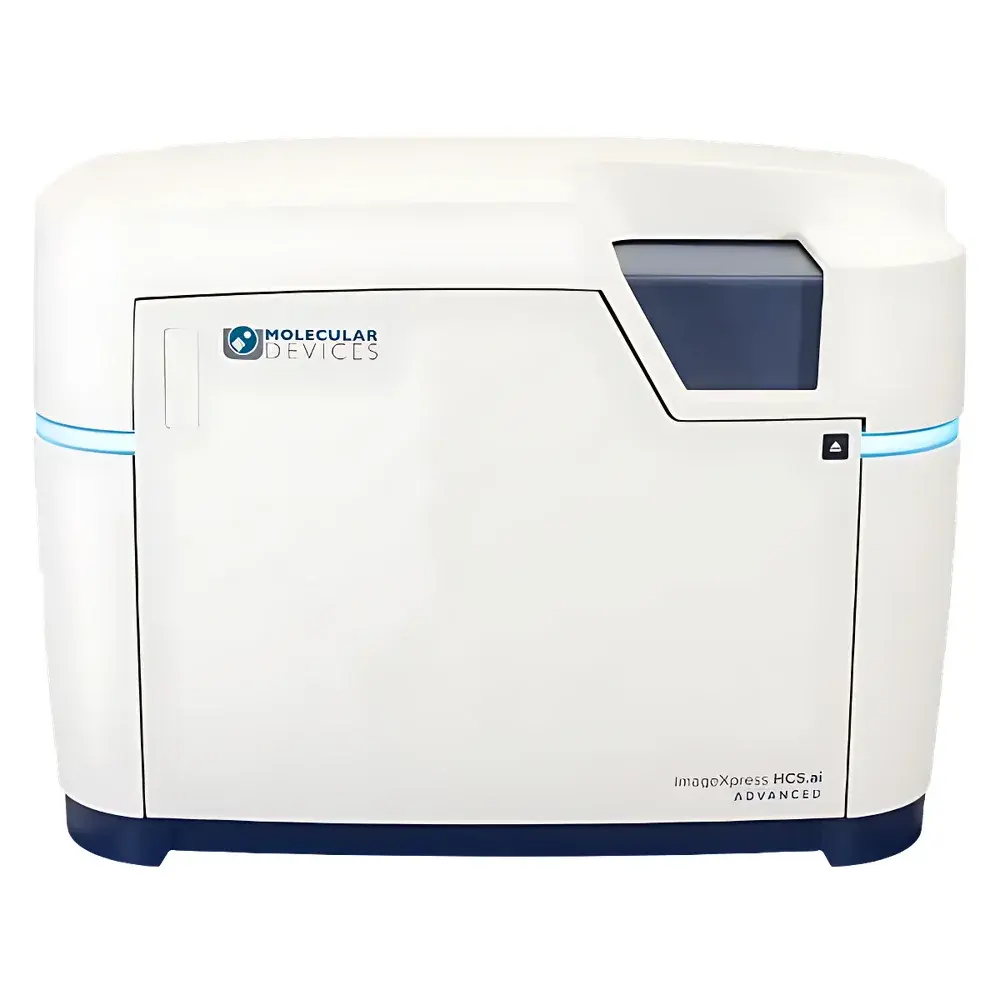
Molecular Devices ImageXpress HCS.ai High-Content Screening and Analysis System
| Brand | Molecular Devices |
|---|---|
| Origin | Shanghai, China |
| Manufacturer Type | Original Equipment Manufacturer (OEM) |
| Country of Origin | China |
| Model | ImageXpress HCS.ai |
| Pricing | Available upon Request |
Overview
The Molecular Devices ImageXpress HCS.ai High-Content Screening and Analysis System is a next-generation automated fluorescence microscopy platform engineered for quantitative, multi-parametric cellular phenotyping at scale. Built upon a robust widefield optical architecture with optional confocal module integration, the system employs high-sensitivity sCMOS imaging, precision motorized Z-stacking, and adaptive focus control to deliver reproducible, high-fidelity image acquisition across 2D monolayers and complex 3D tissue models—including organoids, spheroids, and ex vivo explants. Its core measurement principle relies on spatially resolved fluorescence intensity quantification, subcellular object segmentation, and morphometric feature extraction—enabling unbiased, hypothesis-free profiling of cellular responses to pharmacological, genetic, or environmental perturbations. Designed for compliance-driven environments, the system supports audit-ready workflows aligned with GLP, GCP, and FDA 21 CFR Part 11 requirements when deployed with validated software configurations.
Key Features
- Optimized optical path with >2.6× signal-to-noise ratio improvement over prior-generation platforms—achieved through low-autofluorescence optics, cooled sCMOS sensor (6.5 µm pixel size), and dynamic background subtraction algorithms.
- High-throughput 3D imaging capability: motorized Z-drive with 10 nm step resolution, combined with hardware-accelerated autofocus (LED-based contrast detection + optional infrared reflection sensing) for consistent focus across heterogeneous sample heights.
- AI-powered analysis via Carta AI Software: integrates deep learning–based segmentation models (U-Net architecture trained on >10⁶ annotated cellular structures), unsupervised feature clustering, and interpretable model outputs compliant with ISO/IEC 23894:2023 guidelines for AI transparency in life sciences.
- 40% faster image acquisition cycle time versus ImageXpress Micro XLS—enabled by parallel LED excitation control, optimized filter wheel sequencing, and on-the-fly metadata tagging without frame buffering latency.
- Modular hardware design supporting field-upgradable components: optional spinning-disk confocal unit (Yokogawa CSU-W1), environmental chamber (37°C ±0.3°C, 5% CO₂ ±0.2%), and robotic arm interface (standardized ANSI/ISA-88 compliant I/O).
- MetaXpress Acquire v7.5 software: touch-optimized UI with protocol templating, real-time QC dashboards, and integrated instrument diagnostics—reducing operator training time by ≥35% in multi-user core facility deployments.
Sample Compatibility & Compliance
The ImageXpress HCS.ai accommodates standard microplate formats (6–1536-well), glass-bottom dishes, chamber slides, and custom substrates up to 25 mm diameter. It supports live-cell assays requiring temperature/humidity/gas control, fixed immunofluorescence staining (including multiplexed IF with spectral unmixing), and label-free modalities (phase contrast, DIC, and brightfield cytometry). All firmware and software modules undergo annual verification per ASTM E2500-13 (Standard Guide for Specification, Design, and Verification of Pharmaceutical and Biopharmaceutical Manufacturing Systems) and are qualified for use in regulated environments under ISO 13485:2016 and ICH M10 guidance for bioanalytical method validation.
Software & Data Management
Carta AI Software provides end-to-end analysis pipelines—from raw TIFF ingestion to publication-ready statistical reporting—with built-in support for HDF5-based data storage, FAIR (Findable, Accessible, Interoperable, Reusable) metadata schemas, and RESTful API integration with LIMS (e.g., LabVantage, Thermo Fisher SampleManager). Audit trails record all user actions, parameter modifications, and model retraining events with cryptographic timestamping. Export formats include CSV, FCS (for flow-like cytometric visualization), and OME-TIFF with embedded OMERO annotations—ensuring compatibility with open-source analysis frameworks such as CellProfiler, QuPath, and napari.
Applications
- Phenotypic screening in oncology, neurodegeneration, and metabolic disease models using 3D co-cultures and patient-derived organoids.
- CRISPR/Cas9 functional genomics validation via multi-parameter readouts (nuclear translocation, mitochondrial fragmentation, lysosomal pH, cell cycle phase).
- Toxicity assessment per ICH S7B/S7A guidelines: cardiomyocyte beating analysis, hepatocyte steatosis quantification, and neuronal network activity mapping.
- Immunooncology assay development: T-cell synapse formation kinetics, macrophage phagocytosis efficiency, and checkpoint inhibitor response profiling.
- Regulatory submission support: analytical method transfer documentation, precision/reproducibility studies (intra-/inter-day CV ≤8.2%), and IQ/OQ/PQ protocols available upon request.
FAQ
Does the ImageXpress HCS.ai support FDA 21 CFR Part 11-compliant electronic signatures?
Yes—when configured with Carta AI Enterprise Edition and validated MetaXpress Acquire, the system provides role-based access control, biometric or token-based e-signature capture, and immutable audit logs meeting Part 11 Subpart B requirements.
Can existing ImageXpress users upgrade legacy systems to HCS.ai hardware or software?
Hardware upgrades are not supported due to fundamental architectural differences; however, MetaXpress Acquire v7.5 and Carta AI are backward-compatible with ImageXpress Micro Confocal and Pico systems for software-only migration paths.
Is the AI model training process transparent and auditable?
All Carta AI models include documented training datasets, hyperparameter configurations, and SHAP (SHapley Additive exPlanations) values for individual prediction interpretability—fully traceable within the system’s validation package.
What environmental controls are certified for live-cell imaging?
The integrated environmental chamber is validated per ISO 15197:2013 Annex C for thermal stability and gas mixing accuracy, with calibration certificates traceable to NIST standards.
How does the system handle large-scale multi-site screening campaigns?
Through centralized deployment of Carta AI Server clusters with load-balanced job queues, distributed storage (S3-compatible object storage), and cross-site synchronization of analysis templates and reference models.




