
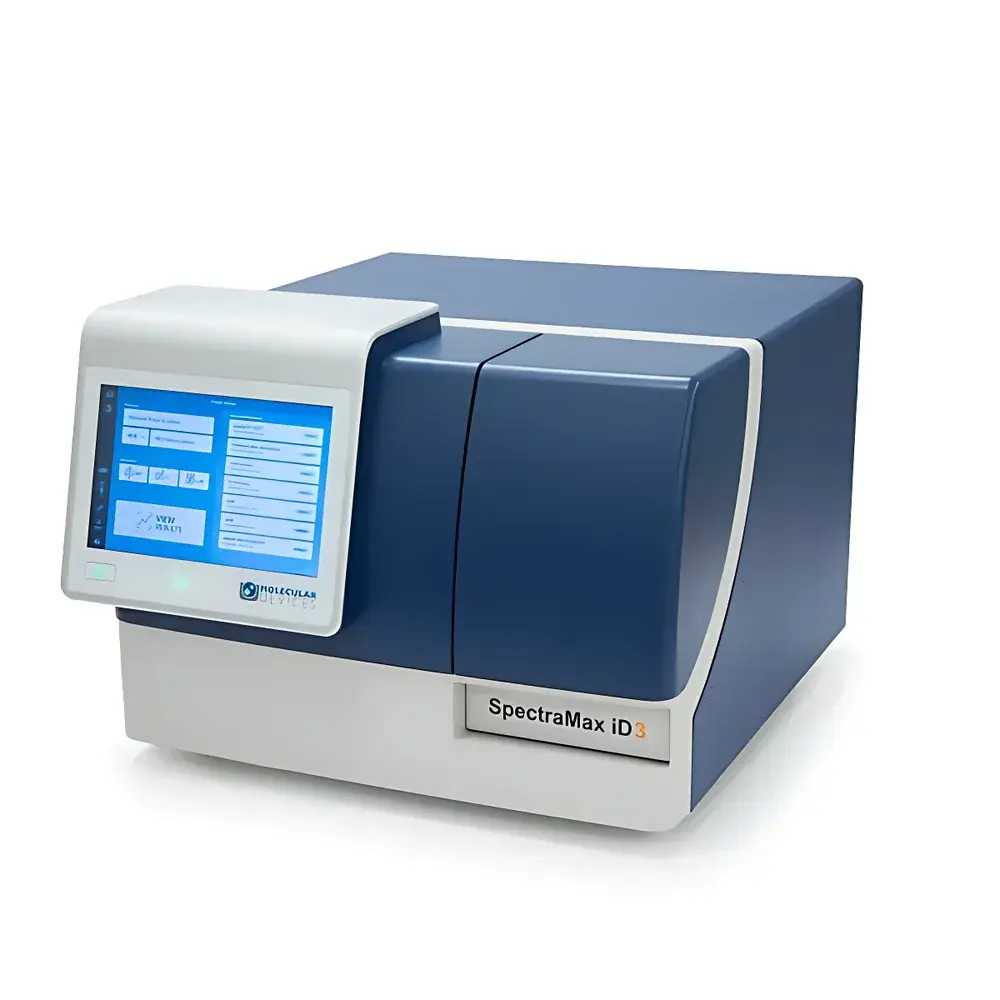
Molecular Devices SpectraMax iD3 Multimode Microplate Reader
| Brand | Molecular Devices |
|---|---|
| Origin | USA |
| Manufacturer Type | Original Equipment Manufacturer (OEM) |
| Product Origin | Imported |
| Model | SpectraMax iD3 |
| Detection Methods | Absorbance, Fluorescence, Luminescence |
| Functionality | Multimode |
| Automation Level | Fully Automated |
| Assay Modes | Endpoint, Kinetic, Scanning |
| Curve Fitting | SoftMax Pro Software-Based |
| Detector Types | Photomultiplier Tube (PMT), Photodiode |
| Wavelength Ranges | Absorbance 230–1000 nm |
| Absorbance Range | 230–1000 nm |
| Absorbance Linearity | 0–2.0 OD |
| Absorbance Speed | 96-well plate in 25 sec |
| Accuracy | < ±0.010 OD |
Overview
The Molecular Devices SpectraMax iD3 Multimode Microplate Reader is a rigorously engineered platform designed for quantitative and kinetic analysis across life science research, drug discovery, and quality control laboratories. It operates on three core optical detection principles: UV-Vis absorbance (based on Beer-Lambert law), fluorescence intensity (including excitation/emission scanning), and bioluminescent/chemiluminescent photon counting. Its modular optical architecture integrates a high-intensity xenon flash lamp, dual-grating monochromators, and a thermoelectrically cooled (–5 °C) photomultiplier tube—enabling low-noise, high-dynamic-range measurements essential for low-abundance analytes such as ATP (detection down to 10−11 M) or nucleic acids (2 ng/μL sensitivity in 4-μL volumes). Designed for reproducibility and regulatory readiness, the iD3 meets foundational performance criteria aligned with ISO/IEC 17025 calibration traceability and supports method validation under GLP/GMP frameworks.
Key Features
- Integrated 7-inch high-resolution capacitive touchscreen interface enabling standalone operation—no external PC required for protocol setup, real-time data visualization, or video-guided troubleshooting.
- NFC-enabled workflow personalization: Tap an NFC tag to instantly load user-specific assay templates, instrument configurations, or SOPs—reducing method setup time and inter-operator variability.
- Dual syringe injection system with SmartInject™ technology for precise, programmable reagent dispensing across all detection modes; includes anti-drip and overflow prevention mechanisms to conserve precious samples and reagents.
- Thermostatic control from ambient to 65 °C with ±0.5 °C uniformity, supporting temperature-dependent assays such as enzyme kinetics, protein thermal shift, and cell-based functional assays.
- Orbital and double-orbital shaking with adjustable speed and duration; compatible with 6-, 12-, 24-, 48-, 96-, 384-, and 1536-well microplates—including SpectraDrop™ ultra-low-volume plates for 2–10 μL samples.
- Spectral scanning capability (absorbance and fluorescence) with up to 20 × 20 spatial resolution per well, enabling intra-well heterogeneity mapping and Z-axis profiling.
Sample Compatibility & Compliance
The SpectraMax iD3 accommodates standard ANSI/SLAS-compliant microplates and specialized formats including black/clear-bottom plates for fluorescence/luminescence, white opaque plates for luminescence, and UV-transparent plates for nucleic acid quantification. Its hardware and firmware comply with electromagnetic compatibility (EMC) standards IEC 61326-1 and safety standard IEC 61010-1. For regulated environments, the system supports 21 CFR Part 11 compliance when used with SoftMax Pro GxP software—featuring role-based access control, electronic signatures, immutable audit trails, and secure local/remote user management. IQ/OQ documentation packages and pre-validated test protocols (including linearity, precision, and wavelength accuracy verification) are provided to streamline installation and operational qualification per FDA, EMA, and PMDA expectations.
Software & Data Management
SoftMax Pro 7 serves as the native acquisition and analysis engine, offering over 200 pre-optimized assay templates for common kits (e.g., Promega Dual-Glo®, PerkinElmer ATPlite™, Thermo Fisher Pierce BCA). It supports advanced curve-fitting algorithms—including 4-parameter logistic (4PL), 5-parameter logistic (5PL), log-log, and spline interpolation—with built-in residual diagnostics and goodness-of-fit metrics. Data export is compliant with ASTM E1384 and ANSI X12 standards, supporting CSV, XML, and SDMX formats. Network deployment enables centralized monitoring of multiple iD3 units via Ethernet/Wi-Fi; raw data and metadata are automatically pushed to designated network shares or LIMS endpoints without manual retrieval. Optional SoftMax Pro GxP edition provides full ALCOA+ (Attributable, Legible, Contemporaneous, Original, Accurate, Complete, Consistent, Enduring, Available) electronic record integrity.
Applications
The iD3 supports diverse applications across academic, pharmaceutical, and clinical research domains: DNA/RNA quantification (A260/A280 ratio analysis), ELISA and immunoassay development, cell viability (MTT, resazurin), cytotoxicity (LDH release), reporter gene assays (luciferase, GFP), calcium flux (Fluo-4, Fura-2), mitochondrial membrane potential (JC-1), oxidative stress (DCFDA), and high-throughput screening (HTS) of compound libraries. Its kinetic sampling rate (up to 100 readings/second per well) and low-coefficient-of-variation (<2% CV at 1 OD) ensure robust data generation for time-resolved enzymology and live-cell imaging integration.
FAQ
Does the SpectraMax iD3 support spectral scanning in both absorbance and fluorescence modes?
Yes—it performs continuous wavelength scans from 230–1000 nm (absorbance) and 250–850 nm (fluorescence emission), with 1-nm resolution and auto-scan optimization.
Can the instrument be validated for GMP use?
Yes—when paired with SoftMax Pro GxP software and the included IQ/OQ documentation suite, it fulfills requirements for analytical instrument qualification under USP , Annex 11, and ISO 13485.
Is temperature control available during kinetic reads?
Yes—precise on-the-fly temperature regulation is maintained throughout kinetic acquisitions, with ramp rates configurable between 0.1–2.0 °C/min.
What microplate formats does the iD3 accept?
All standard ANSI/SLAS formats: 6–1536-well plates, plus SpectraDrop™ ultra-low-volume plates and custom-designed assay strips.
How is data security ensured during remote network transfer?
Data transmission uses TLS 1.2 encryption; user authentication is enforced via LDAP/Active Directory integration or local certificate-based login.




