
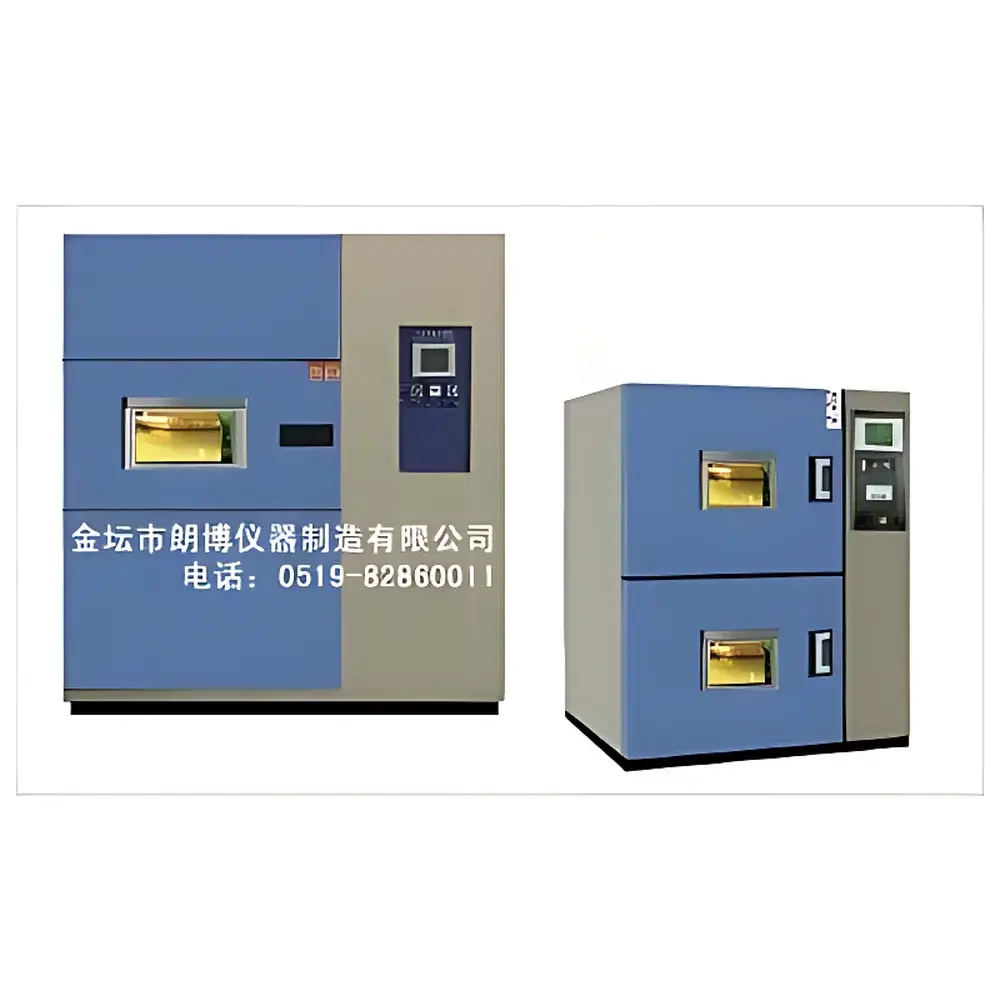
Langbo GDCJ-3-100 Thermal Shock Test Chamber
| Brand | Langbo |
|---|---|
| Origin | Jiangsu, China |
| Model | GDCJ-3-100 |
| Temperature Range | −70 °C to +150 °C |
| Test Zone Dimensions | 450 × 450 × 450 mm (W × D × H) |
| Temperature Transition Time (Door Switch) | ≤5 s |
| Temperature Recovery Time in Test Zone | ≤5 min |
| Temperature Uniformity | ±2 °C |
| Heating Rate (Typical) | 40 min (−70 °C → +150 °C) |
| Cooling Rate (Typical) | 45 min (+150 °C → −70 °C) |
| Refrigeration System | Twin-compressor cascade configuration with imported Copeland/Tecumseh or Bitzer semi-hermetic units |
| Control System | PLC-based with 7-inch color TFT-LCD HMI (English/Chinese switchable) |
| Communication Interface | RS-232 standard |
| Compliance | Designed per IEC 60068-2-14, MIL-STD-810G Method 503.5, GB/T 2423.22 |
Overview
The Langbo GDCJ-3-100 Thermal Shock Test Chamber is an engineered environmental stress screening (ESS) system designed for rapid, repeatable evaluation of material and component reliability under extreme thermal cycling conditions. It operates on the three-zone thermal shock principle—comprising independent high-temperature, low-temperature, and test zones—enabling precise, non-contact temperature transitions via pneumatically actuated cold/hot air damper valves. Unlike single-chamber ramp-and-soak systems, this architecture eliminates thermal inertia from the test specimen zone during transition, ensuring true step-change thermal exposure compliant with IEC 60068-2-14 (Test N: Change of Temperature) and MIL-STD-810G Method 503.5 (Temperature Shock). The chamber’s stainless steel (SUS304) interior and galvanized steel exterior with epoxy-polyester powder coating provide long-term corrosion resistance and structural integrity across repeated thermal expansion/contraction cycles.
Key Features
- Three-zone segregated architecture with independent temperature control for high-temperature (+150 °C), low-temperature (−70 °C), and ambient test zones
- High-speed pneumatic damper switching mechanism (<5 s door transition time) minimizing dwell time between thermal extremes
- PLC-controlled cascade refrigeration system with dual-stage compressors (imported Copeland, Tecumseh, or Bitzer units) for stable sub-zero performance and extended service life
- 7-inch color TFT-LCD human-machine interface with real-time trend graphing, multi-segment programmability, and English/Chinese language toggle
- Integrated safety architecture including over-temperature cut-off, phase sequence monitoring, high/low pressure shutdown, motor overload protection, and audible/visual fault alerts
- RS-232 serial interface supporting remote program upload/download, data logging, and integration into centralized lab management systems
Sample Compatibility & Compliance
The GDCJ-3-100 accommodates samples up to 450 mm × 450 mm × 450 mm without obstructing airflow uniformity or compromising thermal recovery performance. Its design supports testing of printed circuit boards (PCBs), automotive ECUs, aerospace connectors, semiconductor packages, and polymer-based enclosures. All operational parameters—including temperature deviation, recovery time, and transition rate—are verified per ISO/IEC 17025-accredited calibration procedures. The system meets essential requirements for GLP-compliant environmental qualification, aligning with ASTM D5229/D5229M (low-temperature impact), IPC-9701A (thermal cycle reliability), and JEDEC JESD22-A104E (temperature cycling). Optional audit trails and electronic signature support are available to satisfy FDA 21 CFR Part 11 documentation requirements.
Software & Data Management
The embedded PLC controller records timestamped temperature profiles at user-defined intervals (1–60 s resolution) and stores up to 100 test programs with 99 segments each. Data export is supported via USB memory stick or RS-232 to Windows-based analysis software (e.g., LabVIEW-compatible .csv or .txt formats). The HMI provides real-time deviation monitoring against setpoints, automatic alarm logging with event codes (e.g., “E03: Low-pressure trip”), and password-protected parameter editing tiers (Operator / Engineer / Administrator). For enterprise deployment, optional Modbus RTU gateway integration enables SCADA-level supervision and automated report generation aligned with internal quality management systems (QMS).
Applications
- Qualification of solder joint integrity in surface-mount assemblies subjected to thermal fatigue
- Evaluation of coefficient of thermal expansion (CTE) mismatch in multi-material electronic modules
- Validation of sealant adhesion and gasket resilience in automotive powertrain components
- Accelerated aging studies of lithium-ion battery cell housings under cyclic thermal stress
- Reliability screening of optical sensor housings exposed to desert-to-alpine operational envelopes
- Pre-compliance verification prior to formal certification testing per AEC-Q200 or IATF 16949
FAQ
What standards does the GDCJ-3-100 comply with for thermal shock testing?
It is configured to meet IEC 60068-2-14, MIL-STD-810G Method 503.5, and GB/T 2423.22. Calibration reports reference ISO/IEC 17025 traceable to national metrology institutes.
Can the test zone temperature be held constant while transitioning between hot/cold zones?
No—the system is optimized for dynamic shock transitions; holding is not supported in shock mode. However, standalone high-temperature or low-temperature soak tests can be executed independently.
Is remote monitoring and control possible beyond RS-232?
Yes—optional Ethernet-to-RS232 converters enable TCP/IP connectivity, allowing integration with building management systems (BMS) or cloud-based condition monitoring platforms.
What maintenance intervals are recommended for the refrigeration system?
Compressor oil and filter driers require replacement every 24 months under continuous operation; annual validation of refrigerant charge and heat exchanger cleanliness is advised.
Does the chamber support custom test profiles with variable dwell times and ramp rates?
Yes—up to 99 programmable segments per test, each with independent dwell time (1–9999 min), target temperature, and zone selection (hot/low/test), all editable via HMI or PC software.



