
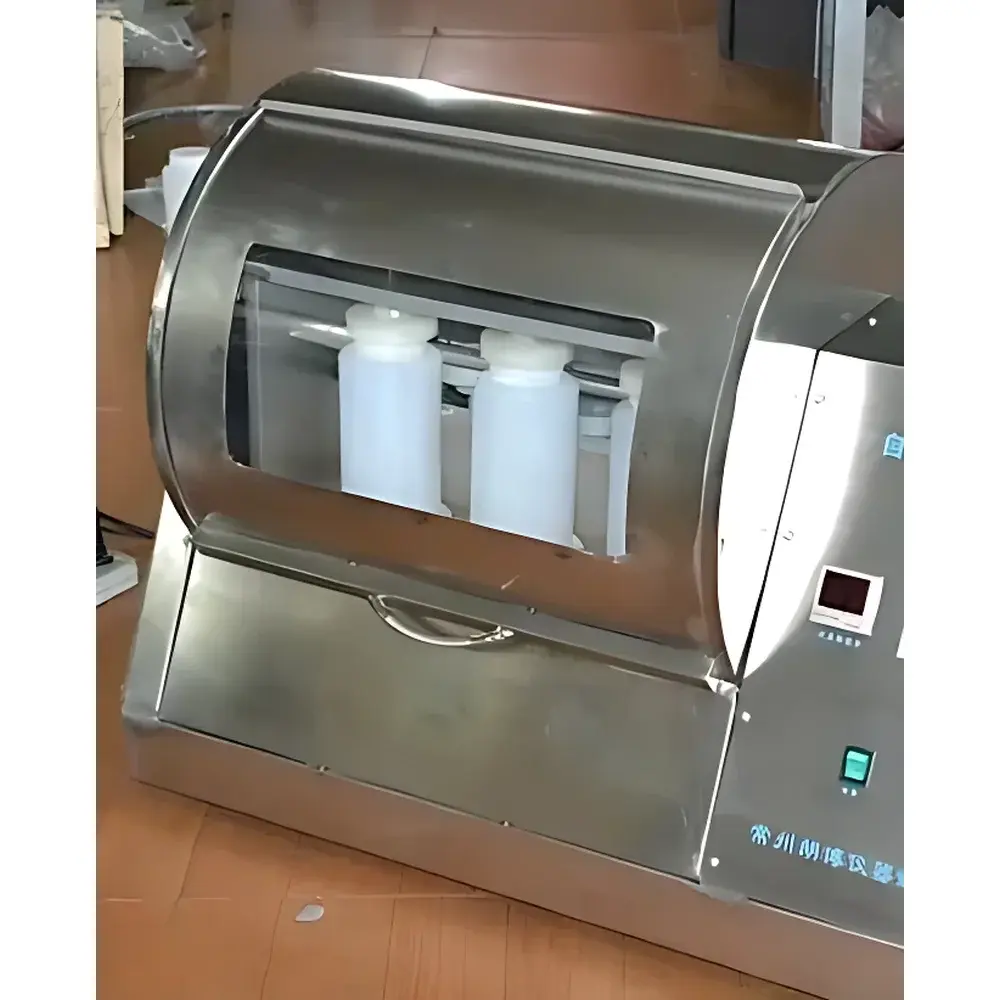
Langbo TCLB-20 Full-Temperature Inversion Shaker
| Brand | Langbo |
|---|---|
| Origin | Jiangsu, China |
| Model | TCLB-20 |
| Type | Inversion Shaker |
| Timer Range | 1–999 h |
| Oscillation Speed | 0–60 rpm |
| Oscillation Amplitude | 180° (inversion motion) |
| Temperature Range | Ambient +5°C to 50°C |
| Shelf Quantity | 1 stainless-steel platform |
| Sample Capacity | Up to six 2 L containers (glass, PE, PTFE, or HDPE) |
| Construction | Stainless steel outer chamber with electrostatic epoxy coating |
| Safety Features | Overload protection circuit |
| Control System | Digital PID temperature controller + microprocessor-based speed regulator |
Overview
The Langbo TCLB-20 Full-Temperature Inversion Shaker is an engineered laboratory instrument designed for controlled, low-shear mixing of large-volume samples under precisely regulated thermal conditions. Unlike orbital or reciprocating shakers, the TCLB-20 employs a true 180° inversion motion—rotating the entire platform end-over-end—to ensure uniform suspension of dense, viscous, or particulate-laden suspensions without introducing excessive shear stress or foaming. This principle is particularly critical in applications involving cell lysis buffer equilibration, solid-phase extraction (SPE) protocols, leaching studies per EPA Method 1311/1312, and long-term stability testing of biopharmaceutical formulations. The unit operates across a thermally stable range from ambient +5°C to 50°C, enabling consistent incubation-coupled agitation for microbiological enrichment, environmental sample digestion, and polymer dissolution kinetics.
Key Features
- Full-temperature operation with high-stability PID-controlled heating system and forced-air circulation for ±0.5°C uniformity across the platform surface
- Dual-mode digital timer supporting continuous operation or programmable intervals from 1 minute to 999 hours with auto-shutdown and alarm notification
- Stepless speed regulation from 0 to 60 rpm, calibrated to ±2 rpm accuracy at setpoint (verified under no-load and loaded conditions with six 2 L vessels)
- Single-tier, heavy-duty stainless steel platform (304 grade) with integrated aluminum-alloy universal clamping system—compatible with standard 2 L glass bottles, polyethylene (PE), fluorinated ethylene propylene (FEP), and high-density polyethylene (HDPE) containers
- Robust mechanical architecture featuring sealed AC induction motor, reinforced pivot shafts, and vibration-damped mounting to minimize transmission to adjacent instrumentation
- Integrated electronic overload protection that monitors current draw and initiates immediate shutdown upon abnormal load detection—ensuring motor longevity and operator safety
Sample Compatibility & Compliance
The TCLB-20 accommodates standardized container geometries used in regulatory-compliant workflows, including USP sterility test bottles, EPA-approved leaching vessels, and ISO 11737-1 compliant microbial recovery containers. Its non-contact inversion mechanism eliminates risk of cross-contamination between samples on the same platform and supports GLP-aligned documentation when paired with external data loggers. While not certified to IEC 61000-6-3 or UL 61010-1 out-of-the-box, the unit meets general electrical safety requirements for laboratory Class II equipment and may be validated per internal SOPs for use in ISO/IEC 17025-accredited laboratories conducting environmental or pharmaceutical testing.
Software & Data Management
The TCLB-20 operates via embedded firmware with local parameter control only—no proprietary software or USB/RS-232 interface is provided. All operational parameters (temperature setpoint, speed, timer duration) are stored in non-volatile memory and retained after power cycling. For audit-trail compliance in regulated environments, users may integrate third-party temperature and rotational speed data loggers (e.g., Omega OM-DAQPRO-5300 or Testo 176 T4) connected to the unit’s analog output terminals (0–5 V DC proportional to real-time RPM and °C). Such configurations support 21 CFR Part 11–compliant electronic records when deployed with validated acquisition software and user access controls.
Applications
- Environmental analysis: TCLP (Toxicity Characteristic Leaching Procedure) extractions per EPA SW-846 Method 1311 and SPLP (Synthetic Precipitation Leaching Procedure) protocols
- Pharmaceutical development: Extraction efficiency studies for residual solvents from solid dosage forms; dissolution profile comparison of extended-release matrix tablets
- Microbiology: Anaerobic culture media preparation and uniform resuspension of biofilm fragments prior to CFU enumeration
- Biotechnology: Gentle mixing of antibody-conjugated magnetic beads during immunoprecipitation wash steps; buffer exchange in dialysis-based protein purification workflows
- Materials science: Homogenization of nanoparticle dispersions in high-viscosity polymer precursors prior to rheological characterization
FAQ
What is the maximum load capacity per cycle?
The platform is rated for six 2 L containers filled to 85% capacity (i.e., ≤1.7 L each), totaling up to 10.2 kg distributed load. Exceeding this limit may compromise thermal uniformity and mechanical longevity.
Can the TCLB-20 operate unattended overnight?
Yes—the 999-hour timer and auto-shutdown function enable fully autonomous operation for multi-day experiments. However, periodic visual inspection is recommended for containment integrity and condensation management in humid environments.
Is calibration documentation available from the manufacturer?
Langbo provides factory calibration certificates for temperature and speed sensors upon request (traceable to national standards), though routine recalibration must be performed by accredited third-party service providers per ISO/IEC 17025 requirements.
Does the unit support external communication protocols such as Modbus or Ethernet?
No—the TCLB-20 lacks built-in digital communication interfaces. Integration with LIMS or SCADA systems requires analog signal conversion and external PLC-level interfacing.
What maintenance is required to ensure long-term performance?
Biannual inspection of pivot bearings, cleaning of air intake filters, and verification of door seal integrity are advised. Lubrication of moving parts is not required—the unit uses maintenance-free sealed bearings and self-lubricating polymer bushings.




