
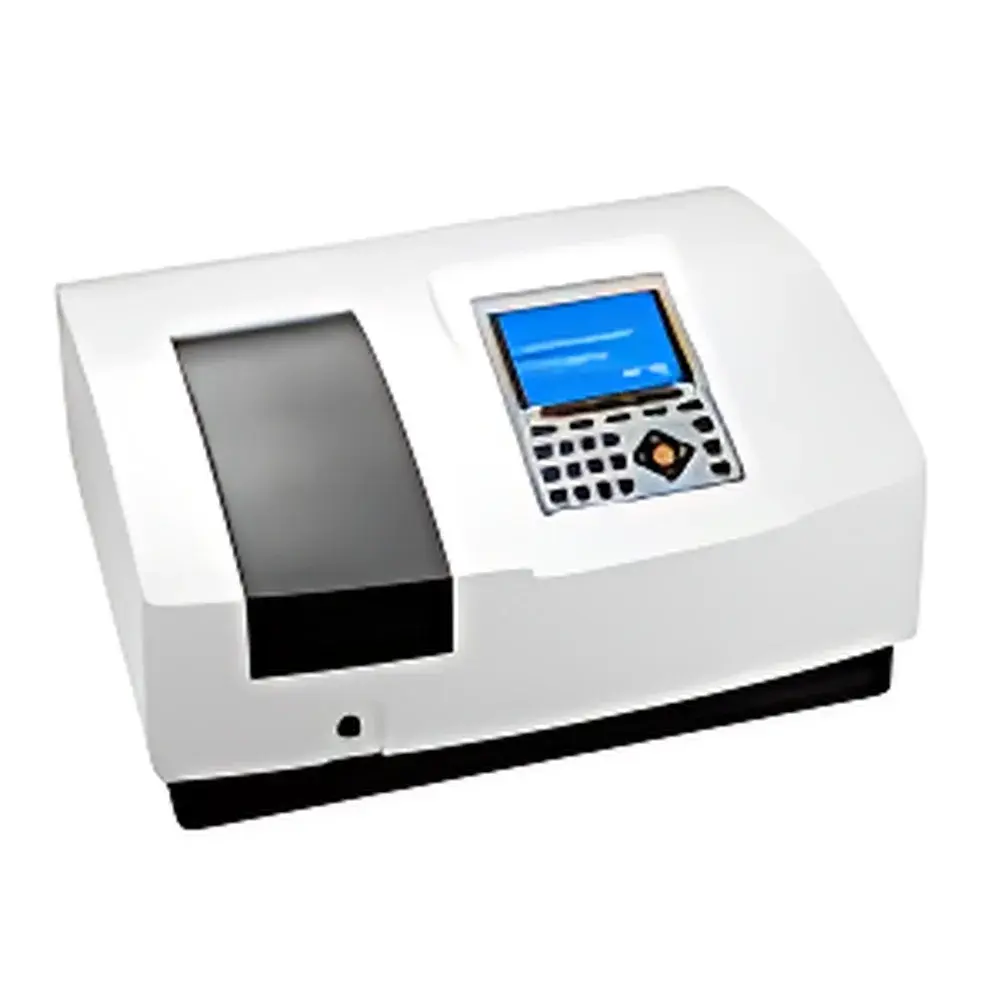
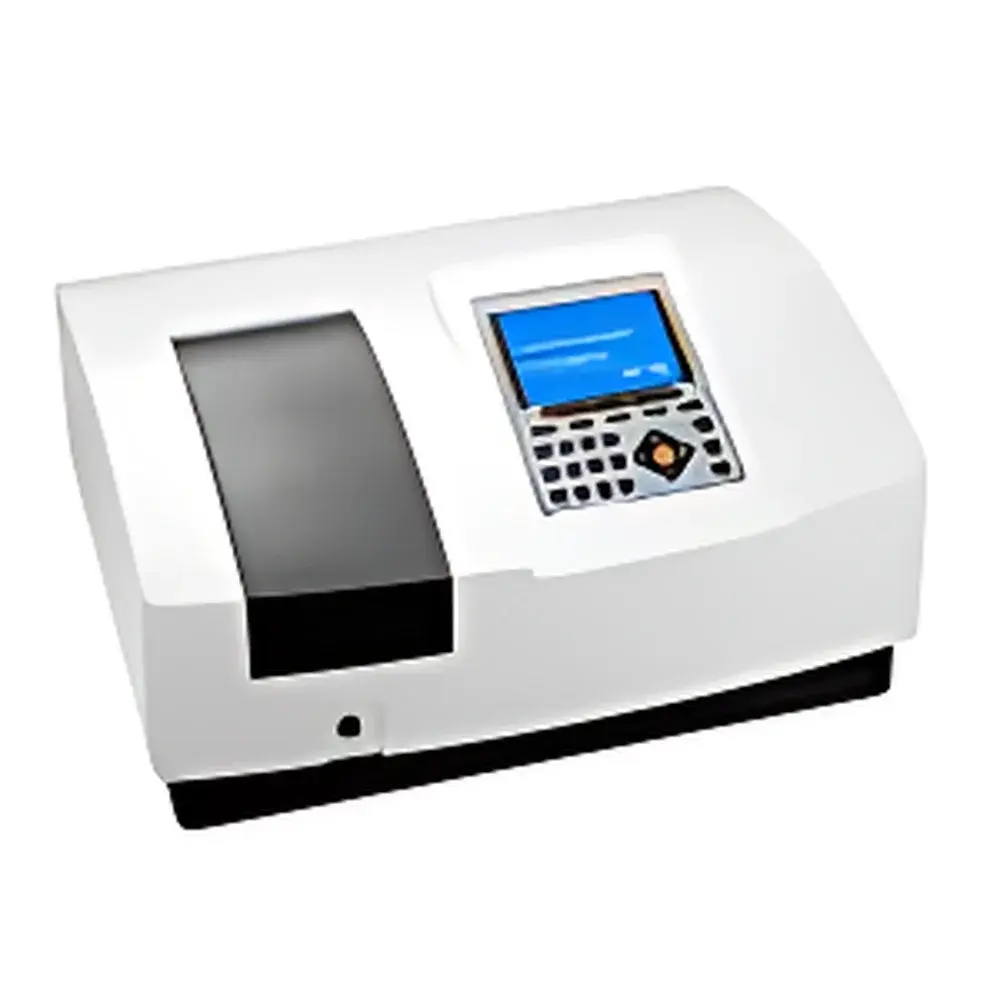
Yoke UV765 Scanning UV-Vis Spectrophotometer
| Brand | Yoke |
|---|---|
| Origin | Shanghai, China |
| Manufacturer Type | Direct Manufacturer |
| Instrument Architecture | Pseudo-Double-Beam |
| Detector Type | Photodiode Array (PDA) |
| Wavelength Range | 190–1100 nm |
| Wavelength Accuracy | ±0.1 nm at 656.1 nm (D₂ line), ±0.3 nm across full range |
| Spectral Bandwidth | 1.8 nm |
| Stray Light | ≤0.05% T |
| Wavelength Repeatability | ≤0.2 nm |
| Photometric Accuracy | ±0.002 A (0–0.5 A), ±0.004 A (0.5–1 A), ±0.3% T (0–100% T) |
| Photometric Repeatability | ±0.001 A (0–0.5 A), ±0.002 A (0.5–1 A), ±0.15% T (0–100% T) |
| Baseline Flatness | ±0.0015 A |
| Drift | ±0.0005 A/h at 500 nm |
| Display | 6-inch high-brightness LCD (320 × 240 pixels) |
| Data Interface | USB port |
| Print Interface | Parallel port |
| Lamp Type | Plug-in deuterium and tungsten lamps |
| Sample Compartment | Accommodates cuvettes from 5 mm to 100 mm pathlength |
| Weight | 15 kg |
Overview
The Yoke UV765 Scanning UV-Vis Spectrophotometer is a precision optical instrument engineered for routine and research-grade absorbance, transmittance, and reflectance measurements across the ultraviolet, visible, and near-infrared spectral regions (190–1100 nm). Based on a pseudo-double-beam optical architecture, it compensates for source intensity fluctuations and detector drift in real time—enhancing measurement stability without requiring mechanical beam switching. The system employs a high-efficiency 1200 lines/mm holographic grating and a thermally stabilized photodiode array detector to deliver high signal-to-noise ratio and excellent wavelength fidelity. Its embedded ARM-based microcontroller supports dual-language (English/Chinese) firmware, enabling seamless operation in international academic, quality control, and regulatory environments.
Key Features
- Pseudo-double-beam optical design with real-time reference correction for improved photometric stability and reduced baseline drift.
- High-resolution 6-inch LCD display (320 × 240 pixels) provides direct visualization of full-spectrum scans, kinetic traces, and multi-wavelength overlays—eliminating dependency on external PCs for basic operation.
- Plug-in deuterium and tungsten lamp assembly enables rapid lamp replacement without optical realignment or recalibration—minimizing instrument downtime.
- Optimized optical path with low-stray-light design (≤0.05% T at 220 nm) ensures accurate quantitation even for highly absorbing samples or low-transmittance standards.
- Integrated 4-channel, high-speed A/D converter (16-bit resolution) delivers photometric repeatability of ±0.001 A (0–0.5 A) and baseline flatness within ±0.0015 A—meeting ISO 10997 and ASTM E275 validation criteria for spectrophotometric performance.
- Universal sample compartment accommodates standard rectangular cuvettes (5 mm, 10 mm, 20 mm, 50 mm, and 100 mm pathlengths), as well as flow cells and solid-sample holders with optional accessories.
Sample Compatibility & Compliance
The UV765 is routinely deployed in pharmaceutical QC labs for USP and EP 2.2.25-compliant assay validation, including dissolution testing and excipient interference screening. Its photometric accuracy (±0.3% T, 0–100% T) and wavelength traceability (NIST-traceable D₂ and Hg emission lines) support GLP and GMP documentation requirements. The instrument meets IEC 61010-1 safety standards and complies with electromagnetic compatibility (EMC) directives per EN 61326-1. While not pre-certified for FDA 21 CFR Part 11, its USB data export functionality—paired with timestamped, non-editable .CSV and .TXT outputs—facilitates audit-ready record retention when integrated into validated laboratory information management systems (LIMS).
Software & Data Management
The UV765 operates autonomously via its onboard interface but also supports PC-based control through optional UVWin software (Windows 7–11 compatible). Data acquisition includes spectral scanning (full-range or user-defined windows), time-resolved kinetics (up to 60 points/sec), multi-wavelength quantitative analysis (up to 10 wavelengths simultaneously), and nucleic acid/protein concentration calculation using built-in extinction coefficients (e.g., A₂₆₀/A₂₈₀ ratios). All measurement logs—including date/time stamps, operator ID fields, method parameters, and raw absorbance arrays—are exportable via USB flash drive. No proprietary drivers are required; exported files conform to ANSI X3.4 ASCII format for interoperability with Excel, Origin, and MATLAB.
Applications
- Quantitative analysis of active pharmaceutical ingredients (APIs) and degradation products per ICH Q2(R2) guidelines.
- DNA/RNA purity assessment and concentration determination using A₂₆₀ normalization and A₂₆₀/A₂₈₀ ratios.
- Enzyme kinetics monitoring (e.g., NADH oxidation at 340 nm) under controlled temperature conditions with external cell holders.
- Colorimetric assays (e.g., Bradford, Lowry, BCA) in life science and food testing laboratories.
- Thin-film thickness estimation and semiconductor material characterization via interference fringe analysis in transmission mode.
- Educational use in undergraduate analytical chemistry curricula for Beer–Lambert law verification and spectral deconvolution exercises.
FAQ
Does the UV765 support compliance with pharmacopeial methods such as USP ?
Yes—the instrument’s wavelength accuracy (±0.1 nm at 656.1 nm), photometric linearity (0–1.5 A), and stray light performance (≤0.05% T) satisfy core instrumental qualification requirements outlined in USP and EP 2.2.25.
Can the UV765 be used for kinetic studies requiring high temporal resolution?
It supports up to 60 data points per second in fixed-wavelength kinetic mode, sufficient for monitoring moderate-rate enzymatic reactions and ligand-binding events when paired with thermostatted cuvette holders.
Is spectral data export compatible with LIMS integration?
All exported .CSV files include metadata headers (wavelength, absorbance, timestamp, method name), enabling automated ingestion into validated LIMS platforms without manual reformatting.
What maintenance is required for long-term wavelength calibration stability?
Annual verification using NIST-traceable holmium oxide and didymium filters is recommended; no user-accessible optical alignment is needed due to the fixed-grating, plug-in lamp design.
Does the instrument support GLP audit trails?
While native audit trail logging is not implemented, all measurement files contain immutable timestamps and operator identifiers—enabling retrospective traceability when combined with procedural controls and electronic lab notebooks (ELN).




