
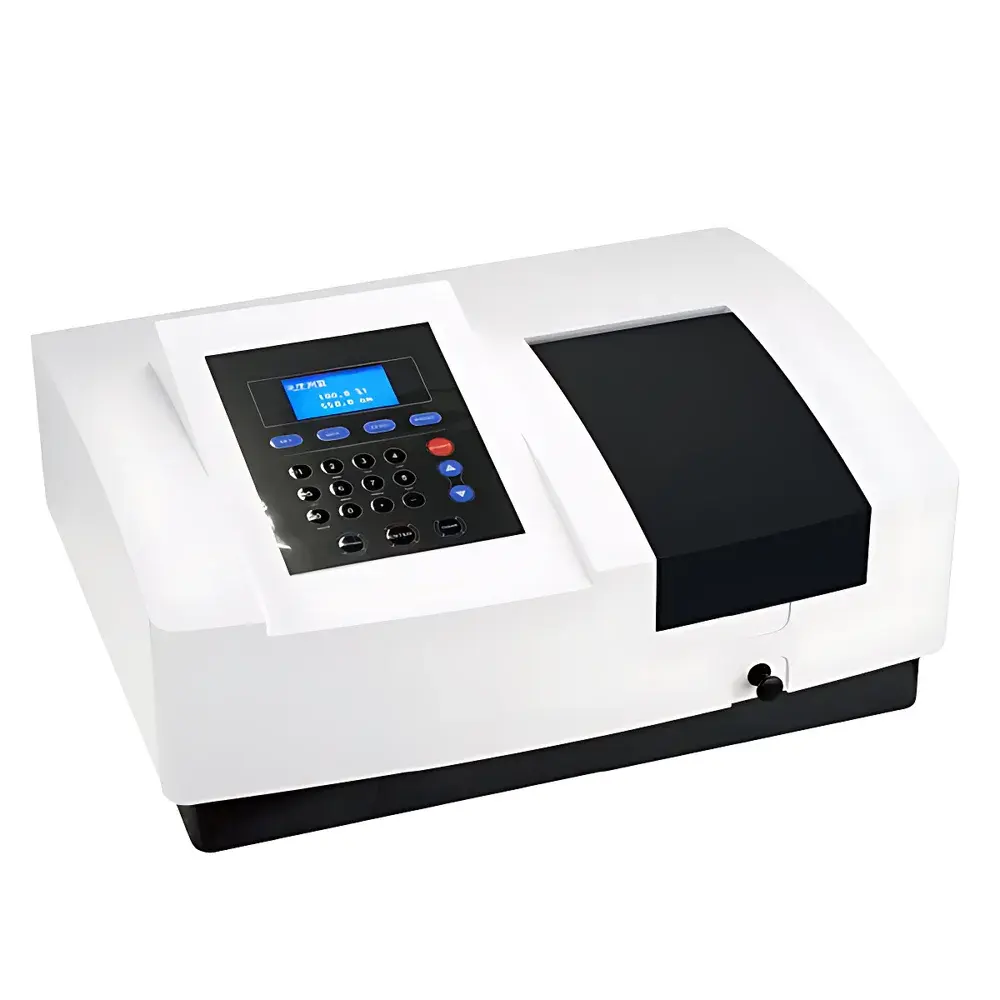
Yoke VIS-7230G Scanning Visible Spectrophotometer
| Brand | Yoke |
|---|---|
| Origin | Shanghai, China |
| Manufacturer Type | Direct Manufacturer |
| Instrument Architecture | Pseudo-Double-Beam |
| Detector Type | Photodiode Array |
| Wavelength Range | 320–1100 nm |
| Wavelength Automation | Motorized Auto-Scan |
| Spectral Bandwidth | 4 nm |
| Wavelength Accuracy | ±1 nm |
| Stray Light | ≤0.1%T at 360 nm |
| Wavelength Repeatability | ±0.5 nm |
| Photometric Accuracy | ±0.5%T |
| Photometric Repeatability | ±0.2%T |
| Photometric Range | 0–200%T, −0.301–3.000 A |
| Baseline Linearity | ±0.004 A |
| Drift Stability | ±0.002 A/h @ 500 nm |
| Display | 128×64 Dot-Matrix LCD |
| Light Source | Imported Tungsten Halogen Lamp |
| Sample Compartment Size | Accommodates Cuvettes from 5 mm to 100 mm Pathlength |
| Net Weight | 12 kg |
| Software Compatibility | YOKE 3.0 PC Control & Data Analysis Suite |
| Warranty | 12-month Limited Hardware Warranty with Lifetime Technical Support |
Overview
The Yoke VIS-7230G Scanning Visible Spectrophotometer is a precision-engineered pseudo-double-beam instrument designed for routine quantitative and qualitative analysis in the visible and near-UV spectral region (320–1100 nm). It operates on the principle of Beer–Lambert law-based absorbance measurement, utilizing a high-efficiency optical architecture that includes a 1200 lines/mm holographic grating and sealed SiO₂-coated optical components to ensure long-term photometric stability and resistance to environmental degradation. Unlike single-beam systems, its pseudo-double-beam design enables real-time reference beam compensation during scanning, significantly improving baseline fidelity and reducing drift-induced errors—particularly critical for kinetic assays, multi-point standard curve generation, and extended measurement sessions. The instrument employs a motorized wavelength drive mechanism for fully automated spectral scanning, eliminating manual calibration steps and ensuring reproducible positioning across repeated measurements.
Key Features
- Pseudo-double-beam optical configuration with real-time reference correction for enhanced photometric accuracy and reduced baseline drift.
- High-resolution 1200 lines/mm holographic grating coupled with a photodiode array detector, delivering consistent spectral resolution and signal-to-noise performance within the 4 nm spectral bandwidth specification.
- Fully sealed monochromator housing with SiO₂ anti-reflective and protective coatings on all optical surfaces, minimizing oxidation and contamination effects in laboratory environments.
- Embedded 32-bit ARM11 microcontroller (533 MHz) enabling rapid data acquisition, onboard storage of up to 200 sample datasets and 100 user-named calibration curves, and responsive local operation via intuitive membrane keypad interface.
- Large sample compartment accommodating standard cuvettes from 5 mm to 100 mm pathlength—compatible with both microvolume and macro-scale liquid cells, flow-through cells, and solid-sample holders with optional accessories.
- Integrated 128×64 dot-matrix LCD display supporting direct visualization of absorbance spectra, transmittance profiles, and linear/nonlinear calibration curves without external software.
- USB 2.0 interface compliant with USB CDC class protocols, enabling seamless bidirectional communication with Windows-based YOKE 3.0 analytical software for advanced data processing, method validation, and report generation.
Sample Compatibility & Compliance
The VIS-7230G supports aqueous, organic, and mixed-solvent samples in standard quartz, glass, or plastic cuvettes. Its broad 320–1100 nm range covers key absorption bands for dyes, transition metal complexes, biological macromolecules (e.g., NADH, cytochromes), and industrial pigments. While not certified for regulatory submissions under FDA 21 CFR Part 11, the instrument’s hardware architecture—including non-volatile memory logging, deterministic scan timing, and traceable wavelength calibration—supports GLP-compliant workflows when paired with YOKE 3.0 software configured with audit trail and electronic signature modules. It meets ISO 9001 manufacturing standards and complies with IEC 61010-1 for electrical safety in laboratory equipment.
Software & Data Management
YOKE 3.0 is a dedicated Windows application (Windows 10/11, 64-bit) providing full remote control, spectral acquisition, kinetic time-course analysis, multi-wavelength quantitation, and customizable report templates. Data export options include CSV, TXT, and XML formats compatible with LIMS integration. The software implements configurable data integrity safeguards: automatic timestamping, user login tracking, and version-controlled method storage. All calibration curves are stored with metadata including date/time, operator ID, wavelength settings, and photometric parameters—enabling retrospective verification per ISO/IEC 17025 requirements.
Applications
- Quantitative determination of analytes in environmental water testing (e.g., nitrate, phosphate, COD reagents).
- Quality control of pharmaceutical excipients and active ingredients in visible-absorbing formulations.
- Enzyme kinetics monitoring via NAD(P)H or DCIP absorbance changes at defined wavelengths.
- Colorimetric assay development for clinical chemistry (e.g., total protein, glucose, uric acid).
- Educational use in undergraduate spectroscopy laboratories for teaching spectral scanning, Beer’s law validation, and interference assessment.
- Industrial pigment and dye concentration profiling in textile, paint, and ink manufacturing QA/QC.
FAQ
Does the VIS-7230G support UV-range measurements below 320 nm?
No—the instrument is optimized for the visible and near-UV spectrum (320–1100 nm) and uses a tungsten halogen lamp as its sole light source; it does not incorporate a deuterium lamp required for deep-UV operation.
Can the instrument perform kinetic measurements over time?
Yes—YOKE 3.0 software enables time-scan mode with programmable interval acquisition (100 ms to 60 s per point) and real-time plotting of absorbance vs. time for enzymatic or reaction monitoring applications.
Is wavelength calibration traceable to NIST standards?
The factory calibration is performed using certified holmium oxide and didymium filters; users may perform verification scans but full recalibration requires authorized service personnel and reference standards traceable to national metrology institutes.
What is the maximum data storage capacity of the onboard memory?
The internal flash memory retains up to 200 individual test results and 100 named calibration curves, each with full parameter metadata and spectral snapshots.
Does the instrument meet electromagnetic compatibility (EMC) requirements for CE marking?
Yes—it conforms to EN 61326-1:2013 for laboratory equipment EMC and carries the CE mark for use within the European Economic Area under Directive 2014/30/EU.





