
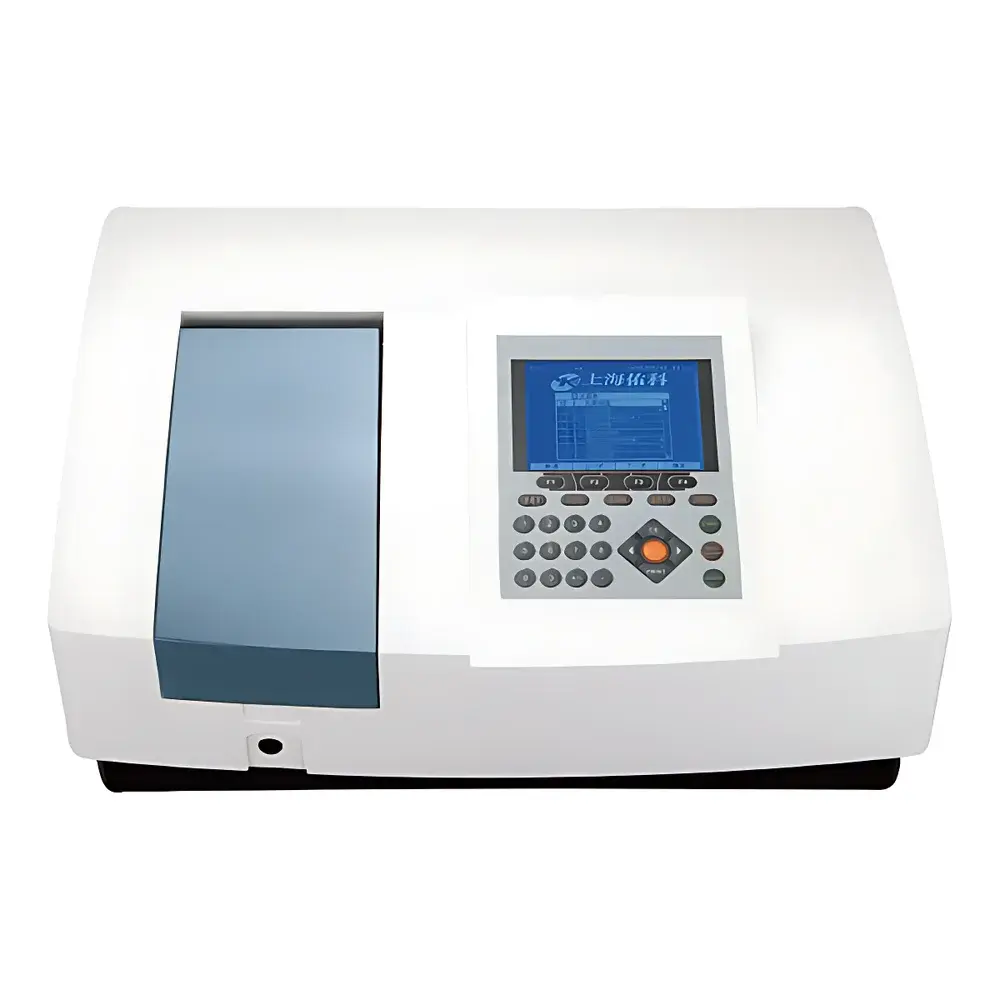
Yoke UV1900 Dual-Beam Ultraviolet-Visible Spectrophotometer
| Brand | Yoke |
|---|---|
| Origin | Shanghai, China |
| Manufacturer Type | Manufacturer |
| Model | UV1900 |
| Optical System | Dual-beam |
| Detector | Photodiode Array |
| Wavelength Range | 190–1100 nm |
| Wavelength Accuracy | ±0.1 nm (at D₂ 656.1 nm), ±0.3 nm (full range) |
| Spectral Bandwidth | 2 nm |
| Stray Light | ≤0.02 %T |
| Photometric Accuracy | ±0.002 A (0–0.5 A), ±0.004 A (0.5–1 A), ±0.2 %T (0–100 %T) |
| Photometric Repeatability | ±0.001 A (0–0.5 A), ±0.002 A (0.5–1 A), ±0.1 %T (0–100 %T) |
| Baseline Flatness | ≤±0.0005 A |
| Drift | ≤±0.0004 A/h |
| Noise | ≤0.0004 A/h |
| Wavelength Repeatability | ≤0.1 nm |
| Photometric Range | 0–200 %T, –4 to +4 A |
| Operating Modes | Transmittance (T), Absorbance (A), Concentration (C), Energy (E) |
| Display | 320 × 240 pixel, 6-inch high-brightness LCD |
| Data Interface | USB and parallel port |
| Power Supply | AC 220 V/50 Hz or AC 110 V/60 Hz |
| Net Weight | 25 kg |
Overview
The Yoke UV1900 Dual-Beam Ultraviolet-Visible Spectrophotometer is an engineered analytical instrument designed for high-fidelity quantitative and qualitative analysis across the ultraviolet and visible spectral regions (190–1100 nm). It operates on the fundamental principle of Beer–Lambert law-based absorption spectroscopy, utilizing a true dual-beam optical architecture to continuously compare sample and reference beam intensities in real time. This configuration inherently compensates for source intensity fluctuations, lamp aging, and electronic drift—significantly enhancing photometric stability and long-term measurement reproducibility. The system integrates a precision-matched deuterium lamp (UV) and tungsten-halogen lamp (VIS/NIR), both sourced from internationally certified suppliers, with fully automated lamp selection and optimal alignment positioning. Its 2 nm spectral bandwidth ensures sufficient resolution for routine pharmaceutical, environmental, and biochemical assays while maintaining robust signal-to-noise performance.
Key Features
- True dual-beam optical path design with real-time reference compensation, delivering superior baseline stability and photometric accuracy.
- High-performance photodiode array detector enabling rapid spectral acquisition and low-noise signal transduction (≤0.0004 A/h noise level at 500 nm).
- Automated dual-lamp system with intelligent positioning logic—eliminates manual alignment and minimizes downtime during lamp replacement or maintenance.
- Embedded ARM-based control architecture supporting dual-language (English/Chinese) firmware, local data storage, and deterministic response latency.
- 24-bit high-speed analog-to-digital conversion ensures fine-grained absorbance resolution and minimal quantization error across the full dynamic range (–4 to +4 A).
- 6-inch high-brightness LCD (320 × 240 pixels) with intuitive graphical interface—enables direct visualization of spectra, kinetic traces, and calibration curves without external PC dependency.
Sample Compatibility & Compliance
The UV1900 accommodates standard 10 mm pathlength quartz, glass, or plastic cuvettes (including matched pairs for dual-beam referencing), as well as micro-volume adapters and flow cells for specialized applications. Its optical design meets core performance criteria aligned with ISO 9001 manufacturing controls and conforms to essential metrological requirements outlined in ASTM E275 and ISO/IEC 17025 for spectrophotometric instrumentation validation. While not pre-certified for regulated GxP environments out-of-the-box, the instrument supports audit-ready operation when integrated with validated laboratory information management systems (LIMS) and configured with appropriate procedural controls—e.g., user access levels, electronic signature enforcement, and full audit trail logging via optional software modules compliant with FDA 21 CFR Part 11.
Software & Data Management
The UV1900 is supported by a Windows-native application offering comprehensive spectral acquisition and post-processing capabilities. Functions include automatic wavelength scanning, multi-wavelength quantitation (up to three wavelengths simultaneously), kinetic time-course monitoring, linear/nonlinear regression (1st–3rd order), derivative spectroscopy (1st–4th order), and spectral subtraction. All acquired data—including raw absorbance/transmittance values, processed curves, and metadata (date/time, operator ID, instrument serial number)—are stored in structured .csv and proprietary binary formats. USB mass storage mode enables seamless transfer of datasets to external drives or networked workstations. The software includes built-in report templates compatible with GLP documentation standards and supports direct export to Excel, PDF, and image formats (PNG, BMP) for regulatory submission or publication workflows.
Applications
This spectrophotometer serves as a foundational tool in quality control laboratories for pharmaceutical dissolution testing, excipient verification, and active pharmaceutical ingredient (API) assay per USP . It is routinely deployed in environmental labs for nitrate/nitrite, phosphate, and heavy metal speciation (e.g., Cr(VI) via diphenylcarbazide method); in food and beverage labs for colorimetric determination of antioxidants (e.g., polyphenols via Folin–Ciocalteu), preservatives, and adulterants; and in academic research for enzyme kinetics (e.g., NADH oxidation at 340 nm), protein quantification (Bradford/Lowry), and nucleic acid purity assessment (A260/A280 ratios). Its wide spectral coverage and stable photometry also support method development for novel UV-Vis assays requiring extended wavelength fidelity beyond conventional 800 nm limits.
FAQ
What is the maximum scan speed for full-spectrum acquisition?
Full-range scanning (190–1100 nm) at 2 nm bandwidth and 1 nm data interval is completed in approximately 12 seconds with default averaging settings.
Does the instrument support compliance with FDA 21 CFR Part 11?
The base firmware does not include electronic signature or audit trail functionality; however, the optional Yoke SpectraSecure™ software module provides role-based access control, electronic signatures, and immutable audit logs required for regulated environments.
Can the UV1900 be operated without a connected PC?
Yes—the embedded LCD interface supports standalone operation for single-point measurements, multi-wavelength analysis, and basic kinetic runs without external computing hardware.
Is calibration traceable to NIST standards?
Wavelength calibration uses certified holmium oxide and didymium filters traceable to NIST SRM 2034 and SRM 2035; photometric calibration employs neutral density filters certified to ISO 9001-accredited laboratories.
What maintenance intervals are recommended for optimal performance?
Lamp replacement is advised every 1,000–1,500 hours of operation; optical alignment verification should be performed semiannually or after mechanical shock; annual preventive maintenance by authorized service personnel is recommended for long-term reliability.
Related Products





